Call Us
+86-18072289720
- All
- Product Name
- Product Keyword
- Product Model
- Product Summary
- Product Description
- Multi Field Search

Views: 0 Author: Site Editor Publish Time: 2025-12-20 Origin: Site

You should follow clear steps when you fix reciprocating compressors. First, think about safety and use the right tools. Acting fast can stop damage and lower downtime. Look for common signs of trouble in reciprocating air compressors, like:
Low oil pressure
Too much packing leaking
High discharge temperature
Strange noises
Compressor will not start
Frame knocks
Noise in cylinder
Packing gets too hot
Low suction pressure
A good troubleshooting guide helps you find problems early and keeps your compressors working well.
Always put safety first when working on compressors. Wear safety gear and follow emergency rules to stay safe.
Fix compressor problems as soon as you notice them. Finding things like low oil pressure or odd sounds early can save you time and money.
Use a clear plan when you troubleshoot. Follow steps to find the problem, what caused it, and how to fix it.
Write down all maintenance and repairs you do. Good records help you see patterns and make troubleshooting easier next time.
Doing regular maintenance stops big problems from happening. Check oil often, listen for weird noises, and look for leaks a lot.
Use tools like pressure gauges and temperature probes. These tools help you find problems fast and correctly.
Watch how the compressor works all the time. Look for signs like getting too hot or not working as well to catch problems early.
Get help from a pro if you need it. If you can’t fix the problem, ask a technician for help.
You should always think about safety first. Safety keeps you and your equipment safe. Here are some steps to follow:
Get training and learn emergency rules before you start.
Wear safety glasses and gloves to protect yourself.
Look at the compressor and area for damage or danger.
Make sure the compressor is set up right and grounded.
Check that all parts are tight and labels are easy to see.
These steps help stop accidents and keep you safe. Doing regular maintenance lowers risks and keeps compressors working well.
A step-by-step plan helps you fix problems fast. You should look for signs, check causes, and follow clear steps. The table below shows how to organize your checks:
Symptom Observed | Probable Causes | Diagnostic Steps | Corrective Action | Priority |
|---|---|---|---|---|
High discharge pressure | Dirty condenser coils, non-condensables, water flow restriction | Check condenser temperature, purge system, verify water flow | Clean coils, purge air, clear water system restrictions | CRITICAL |
Low suction pressure | Refrigerant shortage, expansion valve malfunction, evaporator icing | Check superheat, inspect expansion valve, examine evaporator | Leak test and recharge, replace valve, defrost evaporator | CRITICAL |
Oil foaming in crankcase | Liquid ammonia in crankcase, rapid pressure decrease | Check crankcase temperature, verify suction superheat | Install crankcase heater, adjust expansion valve, pump down system | HIGH |
Always follow these steps in order. Start with the most important problems first. This saves time and helps you not miss anything. If you need help, Zhejiang Briliant Refrigeration Equipment Co., Ltd. can help with their support team. They can help you with common problems like starting issues, noise, or oil trouble.
You should keep good notes when you fix or check compressors. Write down what you see, what you do, and what happens. This helps you find patterns and fix things faster next time. Good notes also help other workers know what you did.
Zhejiang Briliant Refrigeration Equipment Co., Ltd. cares about quality and helping customers. Their clear instructions and good products make fixing compressors easier. You can ask their team for help or advice anytime.
Tip: Keeping a log for your compressors helps you find problems early and makes your equipment last longer.
You can stop big problems if you act fast when something is wrong. Waiting too long can make small problems turn into big ones. For example, checking valves and piston rings often helps you find wear before things break. Watching discharge pressure and oil levels helps you see trouble early. If you replace broken valves or clean oil filters right away, you stop small problems from getting worse.
Here is a table that shows how waiting to fix problems can cost more money:
Cost Type | Description |
|---|---|
Fixing compressor parts, like valves, can cost a lot. | |
Outage Costs | These costs get higher if a valve fails and hurts other parts. |
Safety Concerns | Using advanced monitoring helps you see safety risks early. |
You save your equipment and money when you fix problems as soon as you see them.
You want your compressor to work well all the time. If you wait to fix things, you might have long shutdowns. Outage costs can be much more than fixing a part. When a valve breaks, the whole system can stop, and you lose time and money. Doing regular checks and acting fast keeps your machines running and your business going.
You can use advanced monitoring systems to get alerts about changes in your compressor. These systems give you important data so you can act before a small problem gets bigger. This means you spend less time waiting for repairs and more time working.
Waiting to fix problems makes maintenance and outage costs go up.
Advanced monitoring helps you avoid long shutdowns by warning you early.
You keep yourself and your team safe when you fix problems right away. Compressor problems can cause dangerous accidents. For example, not purging a gas compressor the right way can cause explosions and injuries. Here are some real events:
Incident Date | Description | Cause | Outcome |
|---|---|---|---|
June | Gas compressor backfired after bad purging, causing an explosion and injury to a mechanic. | Did not purge the gas compressor right. | Explosion and injury from flying debris. |
July | Reciprocating compressor exploded during startup without proper purging. | Did not know how to purge the right way. | Equipment damage and possible safety risks. |
You can stop these accidents by learning the right steps and acting fast. Early warning signals from monitoring systems can help you shut down equipment before something bad happens. This keeps everyone safer and protects your workplace.
Tip: Always follow safety rules and check your compressor often. Quick troubleshooting saves lives and equipment.
Listen for strange sounds when you check reciprocating compressors. A good compressor makes a steady noise. If you hear knocking or clicking, something might be loose or broken. These sounds can mean trouble with bearings or piston slap. Hissing noises may show a valve or gas leak. These noises help you find problems early.
Knocking or clicking inside the cylinder means something is wrong. You might hear these sounds if water gets in the cylinder. Foreign objects can also cause these noises. The piston might tilt and make knocking sounds. Loose fits between the piston and rod can cause problems. Bad wear of the cylinder or support ring can also make noise. Check these things quickly to stop bigger problems.
Water getting inside
Foreign objects in the cylinder
Piston tilting
Loose piston or rod fit
Bad wear of cylinder or support ring
Tip: Checking for strange sounds often helps you fix problems before they get worse.
Pressure readings tell you how well the compressor works. Use the gauge to check output pressure. Start the compressor and watch the gauge as pressure goes up. Check the pressure when the compressor stops. Test the pressure where you use the air. Compare pressure at different places to find drops.
Low suction or discharge pressure means there could be leaks or clogs. Worn parts can also cause low pressure. If you see low numbers, look for leaks or blockages in the lines. Check valves and seals for damage. Low pressure means the compressor cannot move enough air. This can cause failure if you do not fix it.
Use a gauge to check pressure.
Watch pressure as the compressor runs.
Check pressure when it stops.
Test pressure at the point of use.
Compare pressure at different places.
Note: blait reciprocating compressors have easy-to-read gauges and ports. This makes troubleshooting faster and easier.
Temperature changes can warn you about overheating. Watch for quick jumps or long high temperatures. These can break equipment and stop oil from moving. If the oil filter gets clogged and pressure goes above 0.18MPa, the compressor can get too hot. A stuck oil cut-off valve can make the temperature reach 120°C in 90 seconds. If the main unit gets to 120°C, the system will shut down to stop damage.
Overheating is very bad. Act fast if you see high temperatures or if the compressor stays hot. Low oil can also cause overheating and damage. Use sensors and check often to find problems early.
Temperature Condition | What It Means |
|---|---|
Stops oil, causes overheating | |
Stuck oil cut-off valve | Makes temperature reach 120°C in 90 seconds |
Quick temperature jump | Shows too much heat, needs fast action |
Long high temperature | Breaks equipment |
Main unit at 120°C | Shuts down automatically |
Tip: blait compressors have big cooling areas and good lubrication. This helps stop overheating and keeps your equipment safe.
Flow rate tells you how much air or gas your compressor moves. You should check the flow rate often. If you see changes, your compressor might not work as well as it should. A steady flow means your system runs smoothly. When the flow drops, you may notice your equipment slows down or does not cool as expected.
Reduced output means your compressor does not move enough air or gas. You might see machines running slower or not reaching the right temperature. This problem can happen for many reasons. Dirty filters, worn valves, or leaks in the system can all lower the flow. Sometimes, low suction pressure can also cause reduced output.
Flow rate variations affect how well your compressor works. If the flow drops, the cylinder does not use its full capacity. The compressor cannot give you the power you need. You want to keep the cylinder and power utilization at 100% for the best results. The amount of gas that enters the compressor depends on the suction pressure. If the suction pressure goes up, the flow can drop. If the suction pressure goes down, you may need more compression to keep up. The best point for your compressor is where the inflow performance curve meets the compressor’s own curve. This point gives you the highest output and best efficiency.
You should watch for these signs of reduced output:
Equipment does not cool or freeze as fast as before.
Pressure at the end of the line is lower than normal.
The compressor runs longer to reach the set point.
You hear the motor working harder.
Tip: Regular checks help you spot reduced output early. Fixing small problems keeps your system running strong.
You need the right tools to find and fix compressor problems. Good tools help you check pressure, temperature, and flow. They also help you spot leaks and other issues quickly.
Gauges show you the pressure inside your compressor. You should use them to check both suction and discharge pressure. Analyzers can measure flow rate and temperature. These tools help you see if your compressor works at its best point.
Here is a table of common tools and what they do:
Tool | What It Checks | Why It Matters |
|---|---|---|
Pressure Gauge | Suction/Discharge | Finds leaks or blockages |
Flow Analyzer | Flow Rate | Checks for reduced output |
Temperature Probe | Compressor Temperature | Spots overheating |
Leak Detector | System Leaks | Prevents loss of refrigerant |
blait reciprocating compressors make your job easier. They have clear gauges and easy access ports. You can check readings quickly and keep your system in top shape. Regular use of these tools helps you catch problems before they get worse.
Note: Always use the right tool for each check. This keeps your compressor safe and working well.
If your compressor will not start, you may see some warning signs. You might press the start button and hear nothing at all. Sometimes, the compressor tries to start but stops right away. Warning lights may turn on in the control panel. Other things you might notice are:
The start contacts close, but nothing happens.
The compressor makes loud noises or clicking sounds.
Suction and discharge pressures stay the same.
The evaporator pressure is way too low or high.
Tip: Look for these signs before you try to fix the problem. This helps you find what is wrong faster.
Many things can keep reciprocating compressors from starting. You should check for these common reasons:
Circuit breaker has tripped
Pressure switch does not work
Not enough oil in lubricated models
Overheating from too much work
A table can help you see what to check for each cause:
Cause | What to Check |
|---|---|
Faulty power supply | Power cord, outlet, wiring |
Tripped circuit breaker | Breaker panel, reset switch |
Defective pressure switch | Switch settings, connections |
Low oil levels | Oil sight glass, oil fill cap |
Overheating | Motor temperature, airflow |
You should always check the easy things first. This saves time and effort.
You can fix most starting problems by following a few steps. Use this guide to help your reciprocating air compressors start again:
See if the start contacts are closed and check the voltage at the compressor.
Make sure the compressor model and voltage match the nameplate.
For three-phase compressors, check the phase order for correct rotation.
Look at the compressor valves for leaks by pumping down and watching the pressure.
If you find a tripped breaker, reset it and watch for overload signs. Change the pressure switch if it is broken. Add oil if it is low, but use the right kind for your compressor. If the motor feels hot, let it cool before starting again.
Note: Doing regular checks and fixing problems early can stop most starting issues. Zhejiang Briliant Refrigeration Equipment Co., Ltd. makes their compressors easy to check and fix, so your job is simpler.
If your compressor still will not start, call a trained technician or ask the support team for help.
You can tell if your compressor has low oil pressure by looking for a few signs. The oil pressure gauge might show a number that is too low. You may hear louder noises coming from the compressor. Warning lights or alarms could turn on. The compressor might get hotter than normal. You might see oil leaking around seals or joints. If you notice any of these things, you should act fast to protect your equipment.
Tip: Always look at the oil pressure gauge before and after you start your compressor. This easy step helps you find problems early.
There are several reasons why your compressor has low oil pressure. Here are the main ones:
Mechanical wear happens when moving parts work for a long time. This can make gaps bigger and lower the oil pressure.
Dirt or metal pieces in the oil can block passages and cause damage.
Cavitation happens when vapor bubbles form and pop inside the pump. This can wear down important parts.
Not enough lubrication means the compressor does not get enough oil. This makes friction go up and parts wear out faster.
Very high or low temperatures can make the oil too thin or thick. This changes how well the oil moves through the system.
Material fatigue comes from stress over and over. This can cause cracks or breaks in the compressor.
You should check each of these causes when you troubleshoot. Finding the real reason helps you fix the problem and stop it from happening again.
You can fix low oil pressure by following some easy steps. First, check the oil level and add the right oil if it is low. Next, look at the oil filter for clogs. Change the filter if you see dirt or metal bits. Check the oil pump and lines for leaks or damage. Tighten loose connections and replace worn parts. Clean the oil passages to get rid of blockages. If you see wear on bearings or moving parts, replace them.
You should also look at the area where the compressor works. Make sure it is not running in very hot or cold places. Use oil with the right thickness for your compressor. Doing regular maintenance, like changing the oil and filter, helps stop low oil pressure from happening again.
Note: Zhejiang Briliant Refrigeration Equipment Co., Ltd. makes their reciprocating compressors with good lubrication systems and easy-to-reach filters. This makes maintenance and troubleshooting quicker and safer for you.
When you check your reciprocating compressor, you might hear odd sounds. These sounds can warn you about problems inside the machine. Listen for these signs: rattling or clanking, squealing or screeching, knocking or thumping, grinding, and hissing. Each sound means something different. Rattling can mean a part is loose. Squealing often happens when there is not enough oil. Knocking can show parts are not lined up or are broken. Grinding means moving parts are rubbing together. Hissing usually means there is a leak in the air system.
Tip: Listen for new or louder noises. Finding problems early helps you stop bigger trouble.
Many things can make your compressor noisy. Most problems start with parts that are loose, worn out, or not lined up right. Not enough oil makes squealing or grinding sounds. Sometimes, screws or pistons move out of place and cause knocking or clanking. High-pitched noises can happen if the motor or bearings have problems. Here are some common causes: loose or worn parts make rattling, clanking, or squealing; not enough oil causes squealing, screeching, or grinding; misaligned screws or broken pistons cause knocking or clanking; high-pitched noise can mean motor or bearing trouble; rattling can come from loose parts, debris, or a broken fan blade; hissing means gas is leaking; clanking can come from a broken condenser fan; bad mounting makes extra shaking and more noise; a loose flywheel or pulley makes knocking when starting or working hard; low oil makes loud knocking; carbon on valves or pistons causes uneven knocking. Check each part closely when you hear strange noises. Use your eyes, ears, and tools to find the problem.
Noise Type | Possible Cause | What to Check |
|---|---|---|
Rattling | Loose parts, debris | Screws, bolts, fan blades |
Squealing | Poor lubrication | Oil levels, bearings |
Knocking | Misaligned piston, flywheel | Pistons, pulleys, alignment |
Hissing | Gas leak | Seals, hoses, connections |
Clanking | Damaged condenser fan | Fan blades, mounting |
You can fix strange noises by following some easy steps. Pick a compressor with a covered motor and a good muffler. Put your compressor in a quiet spot with foam or panels. Use pads under the compressor to stop shaking and lower noise. Oil moving parts often to keep them quiet. Tighten any loose parts to stop rattling. Move the air intake to a quieter place if you can. Add a muffler or silencer to the intake. Move the compressor away from busy areas to make it less noisy.
Here is a simple guide:
Check and tighten all screws, bolts, and mounts.
Look at oil levels and add more if needed.
Clean or change air filters and fan blades.
Put pads under the compressor to stop shaking.
Use soundproof materials around the work area.
Add a muffler or silencer to the intake.
Move the compressor or use a longer hose.
Cover the motor with a noise blanket.
Do regular maintenance to keep parts working well.
Note: Taking care of your compressor and putting it in the right place helps you control noise and protect your machine. Zhejiang Briliant Refrigeration Equipment Co., Ltd. makes compressors with good insulation and easy ways to do maintenance, so you can lower noise easily.
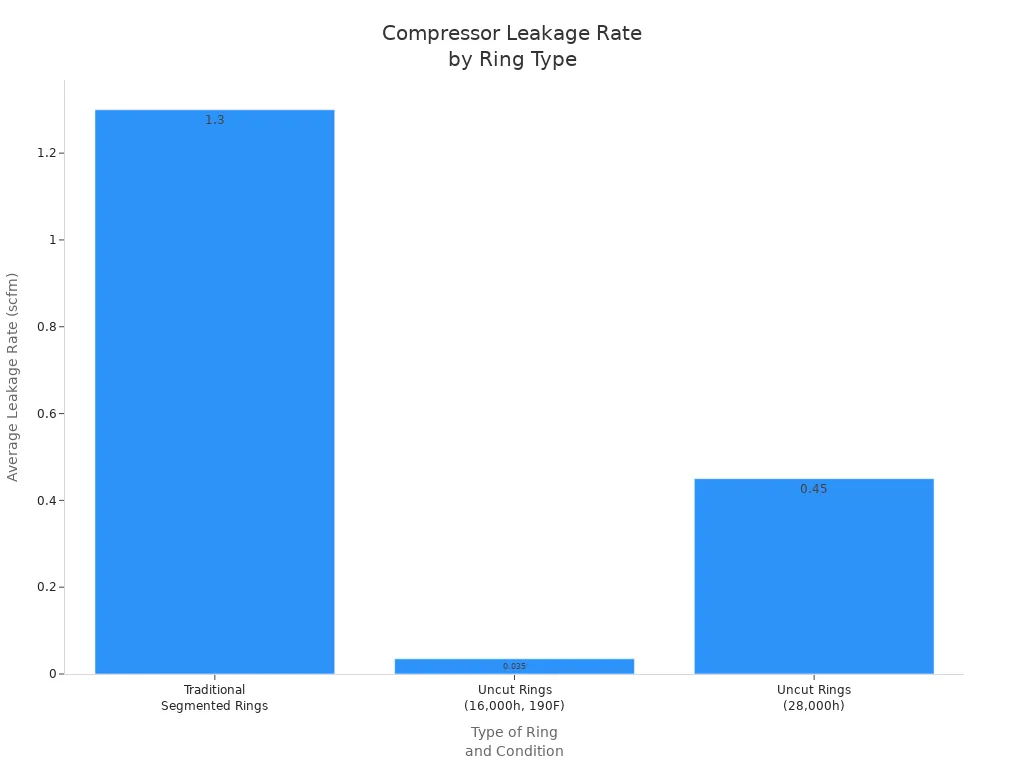
You might see gas leaking from your compressor. The rod packing seal is the main place where too much gas can escape. If the lubrication system does not work, the packing wears out faster. This makes more gas leak out. There are rules, like API 618, that say each distance piece must have good venting. Old compressors may not follow these rules, so you should check them more often.
You can look at how well different seals work by checking how much gas leaks. Old-style segmented rings let out more gas than new uncut rings. The table below shows how much gas leaks with each ring type:
Type of Ring | Average Leakage Rate (scfm) | Operating Hours | Temperature (F) |
|---|---|---|---|
Traditional Segmented Rings | 1.3 | N/A | N/A |
Uncut Rings | 0.035 | 16,000 | 190 |
Uncut Rings (after 28,000h) | 0.45 | 28,000 | N/A |
blait compressors use better sealing technology. This helps stop leaks and keeps your system working longer.
Overheating can hurt your equipment. You should watch for high discharge temperatures and other warning signs. Many things can make your compressor get too hot:
Not enough air moving around the machine
Cooling fins that are dirty or blocked
Hot air coming back into the compressor
High compression ratio
No outside cooling
Big motor that makes a lot of heat
High condensing pressure
Wrong refrigerant used
If the return air gets hotter, the cylinder also gets hotter. A high compression ratio means the compressor works harder and gets hotter. If there is not enough airflow, the machine cannot cool down.
blait compressors have big areas to get rid of heat and use materials that can handle high temperatures. The table below shows how these things help:
Feature | Benefit |
|---|---|
Make the compressor last longer and break less | |
Sealed structures | Make the compressor stronger and more stable |
These features help your compressor stay cool and last longer, even when it is working hard.
You can do things to fix leaks and overheating:
Check rod packing seals often and change them if they are worn.
Make sure the lubrication system is working right.
Clean or change cooling fins to help air move better.
Keep the space around the compressor open for good airflow.
Use the right refrigerant for your compressor.
Watch the discharge temperature and turn off the machine if it gets too hot.
Pick compressors with good seals and cooling, like blait compressors.
Tip: Doing regular maintenance and using good equipment helps you stop leaks and overheating. This keeps your system safe and working well.
You can find low suction pressure by looking at the gauges. Listen to your compressor and see how it works. The suction gauge will show a lower number than normal. Your equipment may not cool or freeze as fast as before. Sometimes, the compressor runs longer to reach the right temperature. The discharge pressure can also go down. You might hear the motor get louder or see warning lights turn on.
Here are some signs you might notice:
The suction gauge shows a low number.
Cooling or freezing takes more time.
The compressor runs for a long time.
Discharge pressure is lower than normal.
The motor sounds louder or works harder.
Tip: Check your gauges every day. Finding problems early helps you fix them before they get worse.
Many things can make suction pressure too low. You should check each part of your system to find out why. A dirty or blocked air filter can stop enough air from getting in. Leaks in the suction line let air out before it gets to the compressor. A bad expansion valve can slow down the flow of refrigerant. Sometimes, the evaporator coil gets ice or dirt on it and blocks the flow. Low refrigerant levels can also cause this problem.
Here is a table to help you find the cause:
Possible Cause | What to Check |
|---|---|
Dirty air filter | Inspect and clean or replace |
Suction line leaks | Listen for hissing, use soapy water |
Faulty expansion valve | Test valve operation |
Iced or dirty evaporator | Look for frost or dirt buildup |
Low refrigerant charge | Check for leaks, measure charge |
Check each thing one by one. This helps you find the problem faster.
You can fix low suction pressure with a few easy steps. First, clean or change the air filter if it is dirty. Next, look for leaks in the suction line. Use soapy water to find bubbles where air comes out. Tighten or replace any loose or broken parts. If the expansion valve is bad, put in a new one. Clean or defrost the evaporator coil if you see ice or dirt. If the refrigerant is low, add more after you fix any leaks.
Here is a quick checklist:
Clean or change the air filter.
Check and fix leaks in the suction line.
Replace a bad expansion valve.
Defrost or clean the evaporator coil.
Add refrigerant if you need to.
Note: Doing regular maintenance keeps your reciprocating air compressors working well. blait compressors have parts that are easy to reach, so these checks and repairs are simple.
If you follow these steps, you can fix most low suction pressure problems and keep your system running well.
If you use a clear troubleshooting process, your compressors work better. Acting early helps you stop big problems and keeps your compressor in good shape. Always look at how your compressor is set up and read the manual before fixing anything. Doing regular maintenance is important. Check the lubricant every day, listen for strange sounds, and look for leaks. Training often helps you find problems sooner. If you want your compressor to work well, you can count on blait for help and good products.
You should check the power supply and look for warning lights. Make sure the compressor is plugged in and the breaker is on. Always follow safety steps before touching any parts.
You should check oil levels every day before starting the compressor. This helps you spot leaks or low oil early. Keeping the right oil level protects your machine.
A knocking sound can mean loose parts, worn bearings, or piston problems. You should stop the compressor and inspect it. Fixing the problem early prevents bigger damage.
You can use pressure gauges, temperature probes, and leak detectors. These tools help you check for leaks, overheating, or low pressure. Good tools make troubleshooting faster and safer.
You should keep the area around the compressor clean. Make sure cooling fins are not blocked. Use the right refrigerant. Regular cleaning and checks help stop overheating.
Low suction pressure can come from dirty filters, leaks, or low refrigerant. You should check each part and fix any problems you find. Clean filters and fix leaks to keep pressure normal.
You should call a technician if you cannot find the problem or if repairs need special tools. If the compressor still will not start after basic checks, get expert help.
Regular maintenance keeps your compressor running well. You can find small problems before they get worse. Clean, check oil, and listen for strange sounds every week.