Call Us
+86-18072289720
- All
- Product Name
- Product Keyword
- Product Model
- Product Summary
- Product Description
- Multi Field Search

Views: 0 Author: Site Editor Publish Time: 2026-10-29 Origin: Site

Upgrading to an industrial-grade compressor requires careful planning and precise calculations. You must balance upfront capital with long-term operational reliability. A 4 cylinder compressor provides significantly higher displacement, smoother operation, and better heat dissipation than standard 1- or 2-cylinder models. However, selecting the wrong specification carries serious mechanical and financial risks. Buying too much or too little capacity can lead to short-cycling, excessive energy waste, or premature mechanical failure in your pneumatic systems. You need the perfect match for your specific daily workflow.
This guide provides an evidence-based framework for evaluating and comparing different models on the market. We will help you select the exact 4 cylinder compressor configuration required for your facility's continuous or peak-demand operations. You will learn how to accurately audit your pressure needs, choose the correct pump stage design, and ensure maximum production uptime.
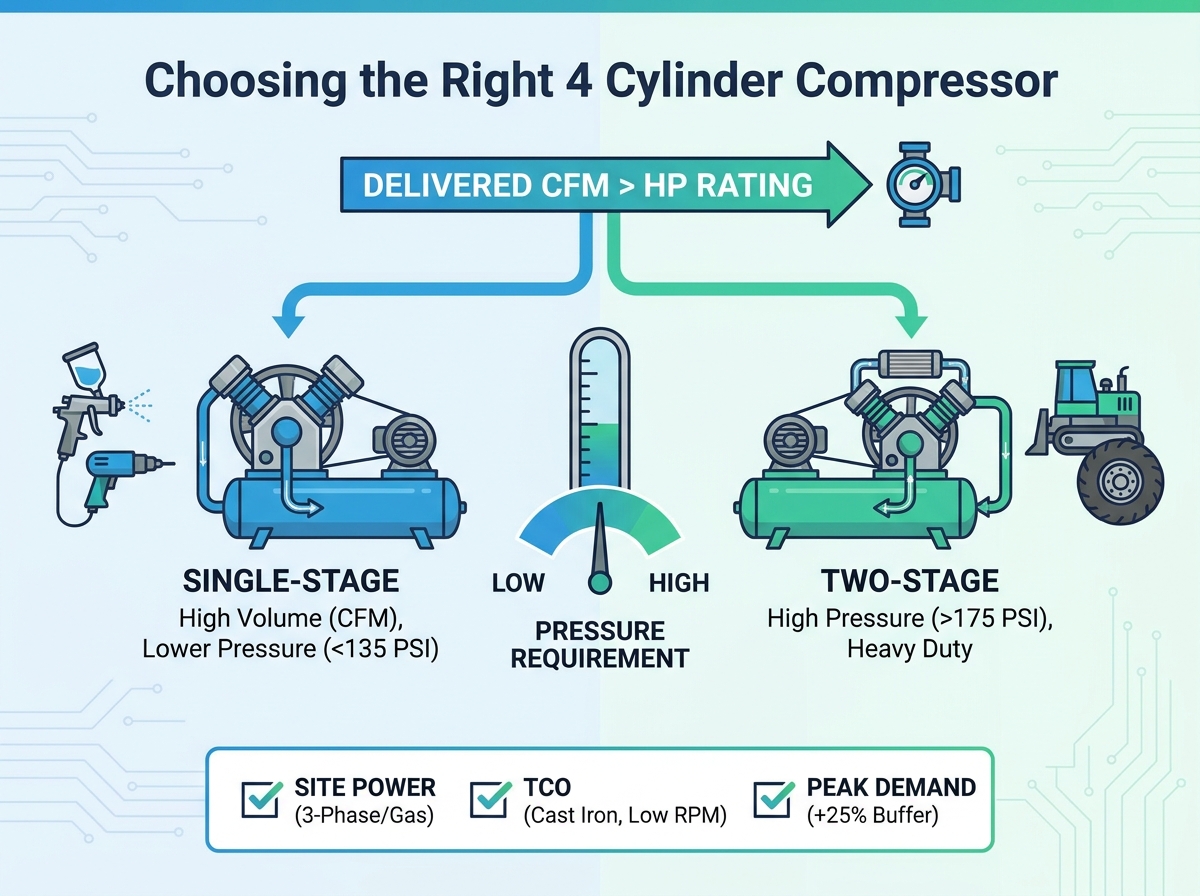
Horsepower (HP) is a popular marketing metric. However, it rarely tells the whole story about industrial performance. HP only measures the electrical power of the motor. It does not measure the actual volume of air you receive at the tool end. Instead, base your purchasing decision on Cubic Feet per Minute (CFM). Focus strictly on the delivered CFM of the equipment at your specific operating pressure (PSI).
Next, calculate your facility's peak demand. You must audit all pneumatic tools running simultaneously. When auditing your tools, do not just guess. Look at the manufacturer specification tags on every grinder, sander, or impact wrench. Note the CFM required at specific pressures, usually 90 PSI. Differentiate between tools used continuously, like orbital sanders, and those used intermittently, like framing nail guns. Continuous tools demand a much higher baseline volume. Add these continuous requirements together to find your baseline peak demand.
Industry standards recommend adding a 20–25% buffer to this final number. This safety margin accounts for inevitable system leaks in your shop piping. It also accommodates future equipment expansion without requiring a completely new air system.
Avoid the temptation to buy the largest unit available. Oversizing introduces severe mechanical risks. Buying too much capacity leads to short-cycling. The machine turns on and off too rapidly to meet small demands. Because of this, it never reaches optimal operating temperatures. Cold operation allows condensation and moisture to accumulate inside the crankcase. This moisture severely degrades the lubricating oil and damages internal bearings over time.
You must decide how the pump processes the incoming air. Manufacturers build these machines in two distinct configurations, and choosing the wrong one will bottleneck your operations.
First, consider single-stage applications. In this design, all four cylinders draw in ambient air simultaneously. They compress it directly to the final pressure in one single stroke. This mechanism delivers high volume at lower pressures. It works best for applications requiring under 135 PSI. Evaluate this option if you run framing crews or automotive painting booths. High-flow pneumatic tools thrive on single-stage delivery because they need volume, not extreme pressure.
Second, look at two-stage applications. This mechanism operates differently to achieve higher force. Two larger cylinders compress air to an intermediate pressure. The air then passes through a cooling tube called an intercooler. Finally, two smaller cylinders compress it to the final pressure before sending it to the tank. This design excels in high-pressure environments. It easily reaches 175 PSI or more. You will need this configuration for heavy manufacturing. Commercial tire shops and heavy-duty industrial machinery also require two-stage power to break loose stubborn bolts or operate heavy presses.
| Feature | Single-Stage | Two-Stage |
|---|---|---|
| Compression Mechanism | Direct to final pressure in one stroke | Intermediate pressure, cooled, then final pressure |
| Ideal Pressure Range | Under 135 PSI | Up to 175+ PSI |
| Best Use Cases | Automotive painting, framing, high-flow tools | Heavy manufacturing, tire shops, industrial machinery |
Material selection dictates the lifespan of your equipment. You will typically find cast-iron cylinders or aluminum cylinders featuring cast-iron sleeves. Full cast-iron construction provides superior durability. It also offers excellent thermal stability for demanding duty cycles. Aluminum dissipates heat quickly, but it warps under extreme industrial stress over years of heavy use.
Operating speed heavily influences pump longevity. Slower-turning pumps run much cooler and quieter. Look for models operating between 600 and 900 RPM. These low-RPM units last significantly longer than high-RPM alternatives. High speeds generate excessive friction and heat, which breaks down oil viscosity prematurely.
Cooling efficiency prevents overheating during extended duty cycles. Evaluate the pump design carefully before buying. Look for deeply finned cylinders. Check for directional air shrouds that force flywheel air directly across the hottest components. Intercoolers and aftercoolers are also vital. They drop the air temperature before it enters the tank, reducing moisture buildup in your air lines.
Finally, consider the lubrication type. You can choose splash-lubricated or pressure-lubricated systems. Splash lubrication works fine for intermittent use. In this setup, dippers on the connecting rods splash oil onto the cylinders. However, pressure lubrication is a mandatory feature for continuous environments. If you run a 100% duty cycle, you need a dedicated oil pump. It forces oil directly into the crankshaft journals and bearings through internal passages. This active lubrication prevents catastrophic bearing failure during heavy, non-stop shifts.
Your facility's infrastructure dictates your power options. First, evaluate your electrical requirements. Check if you have single-phase or three-phase power available on site. Three-phase motors run smoother and consume less electricity under load. They are ideal for heavy industrial settings. You must also consider motor starter requirements. Magnetic starters are far superior to standard pressure switches. They protect your expensive motor against sudden voltage drops from the grid. They also prevent thermal overloads during startup by safely managing the initial inrush current. If a power interruption occurs, a magnetic starter requires a manual reset. This prevents the machine from starting unexpectedly and injuring workers.
Sometimes, hardwired electricity is not an option. You might need gas or diesel-driven alternatives. Engine-driven models provide ultimate portability. They are perfect for mobile service trucks repairing heavy equipment in the field. Agricultural users and off-grid worksites rely heavily on them for reliable remote air power.
Installation also involves managing vibration and noise. The physical layout of the cylinders matters greatly. A V-configuration or W-configuration naturally balances the crankshaft. This geometry significantly reduces operational vibration compared to inline designs. Even so, you should install heavy-duty isolation pads under the feet. These pads prevent structural damage to your concrete floors and reduce resonance. Pay close attention to decibel (dB) ratings for indoor installations. A quieter machine improves workplace safety, enhances communication, and increases overall employee comfort.
Evaluating long-term maintenance realities is crucial for maximizing uptime. Assess the physical accessibility of routine service points before buying. Can you easily reach the air filters without removing heavy safety guards? Are the oil drain ports positioned conveniently, or will they spill oil over the mounting plate? Check the tensioning belts for easy adjustment access. You must also verify the availability of replacement parts. Gaskets, reed valves, and unloader valves should be available locally. Relying on specialized overseas ordering causes unacceptable downtime during a breakdown.
Next, conduct a strict warranty and support evaluation. Look far beyond the standard one-year guarantee. Differentiate between full-unit warranties and pump-only warranties. Many manufacturers offer extended coverage if you meet specific operational conditions. For example, they might require you to use their proprietary OEM synthetic oil. Read the fine print carefully to maintain your warranty status.
Follow these next-step actions to finalize your choice:
Selecting the right equipment requires careful analysis of your daily operations. The best 4 cylinder compressor is not simply the one with the highest specifications on paper. Instead, it is the unit that aligns precisely with your facility's demand cycle. It must fit your power constraints and match your in-house maintenance capabilities.
Keep these final takeaways in mind as you prepare to purchase:
Do not rush this critical capital investment. We strongly encourage you to consult with an industrial pneumatics engineer. Utilize a professional CFM calculator to verify your math and system sizing before finalizing any purchase order.
A: A four-cylinder model offers significantly smoother operation due to better crankshaft balancing. It provides a much higher CFM capacity, allowing you to run more tools simultaneously. Additionally, spreading the compression workload across four cylinders improves heat distribution, which extends the lifespan of the internal components.
A: It depends entirely on the specific pump design. You can run continuously if the manufacturer explicitly rates the unit for a 100% duty cycle. This usually requires a low-RPM pump, robust cast-iron cooling fins, and a pressure-lubricated oil system to prevent bearing failure.
A: Oil change intervals depend on the lubricant type and operating environment. Standard mineral oil typically requires changing every 500 operational hours. If you upgrade to full synthetic compressor oil, you can often extend this interval to 2,000 hours. Always check your manufacturer's manual for specific guidelines.
A: Rebuilding makes sense if the repair costs remain under 50% of a new unit's price. However, modern motors and pumps offer massive efficiency gains. If your old unit suffers from frequent breakdowns or lacks modern cooling features, investing in a new machine is usually more cost-effective long-term.