Call Us
+86-18072289720
- All
- Product Name
- Product Keyword
- Product Model
- Product Summary
- Product Description
- Multi Field Search

Views: 0 Author: Site Editor Publish Time: 2026-11-19 Origin: Site

Selecting the right refrigeration compressor directly dictates long-term energy consumption and facility downtime. In industrial and commercial cooling systems, this specific component acts as the heartbeat of your entire operation. If you make the wrong choice, you risk cascading inefficiencies, high operational costs, and catastrophic system failures. A reciprocating refrigeration compressor provides a highly reliable solution to these engineering challenges. We define this as a positive-displacement machine utilizing a piston-cylinder mechanism. It efficiently compresses refrigerant vapor, fundamentally driving the thermodynamic refrigeration cycle. This article delivers an objective, engineering-focused breakdown of these vital machines. You will explore how they work, examine their unique structural features, and evaluate their distinct operational strengths. We will also provide a clear decision framework. You can use this framework to compare reciprocating models against other compressor types for your specific commercial or industrial applications.
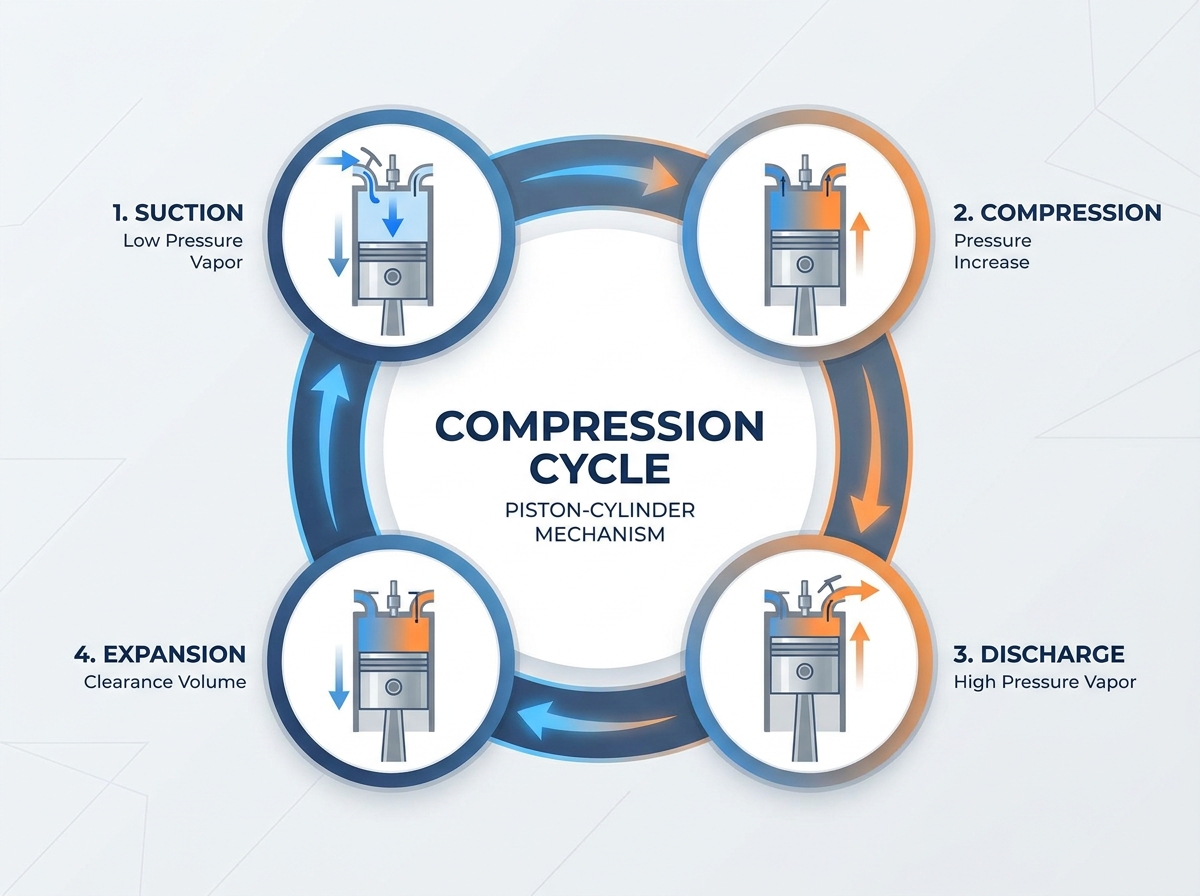
Understanding the internal mechanics helps operators maintain peak system efficiency. The entire process relies on positive displacement. The machine physically reduces the internal volume of a chamber to increase fluid pressure. This action occurs through four distinct stages.
The compressor serves as the prime mover in your system. It raises the pressure and temperature of the refrigerant vapor. This process ensures the fluid can reject absorbed heat efficiently once it reaches the condenser coil. Manufacturers build these machines in three primary configurations.
Modern piston compressors incorporate advanced engineering features. These elements improve energy profiles and extend operational lifespans. Capacity control mechanisms provide massive efficiency gains. Suction valve unloaders mechanically deactivate specific cylinders. They hold the suction valve open during the upstroke. The piston simply pushes vapor back into the suction line. This action matches fluctuating cooling loads perfectly. You reduce electrical energy draw significantly. The system avoids shutting down the primary motor completely. This prevents damaging rapid-cycling.
Internal valve design plays a critical role in system reliability. Suction and discharge valves dictate the overall volumetric efficiency. Engineers typically specify specialized reed or ring types. Reed valves consist of thin, flexible steel strips. They respond quickly to pressure changes. Ring valves utilize robust concentric steel circles. They handle heavier industrial loads effectively. Both designs require precise engineering to minimize flow resistance.
Lubrication systems vary drastically by equipment size. Smaller units utilize simple splash lubrication. A specialized dipper on the crankshaft dips into the oil sump. It splatters lubricant across the internal bearings and cylinder walls. Larger industrial units demand rigorous forced-feed lubrication. A dedicated internal pump delivers pressurized oil continuously. It forces fluid through drilled channels in the crankshaft. Oil separators play a crucial role here. They capture escaping oil droplets from the discharge line. They return this fluid to the crankcase. This prevents oil from insulating the evaporator coils downstream.
Thermal management ensures long-term mechanical survival. The compressor housing must dissipate immense heat. Different cooling methods address this challenge. Smaller fractional-horsepower units rely on air-cooled external fins. A fan blows ambient air across the casing. Larger heavy-duty models utilize water-cooled cylinder heads. Chilled water circulates through internal jackets. High compression ratios generate extreme internal temperatures. Many industrial configurations incorporate dedicated oil coolers. These exchangers remove thermal energy from the lubricant directly. They maintain safe operating viscosity.
Every mechanical design carries distinct operational tradeoffs. You must weigh these factors against your facility requirements. Piston compressors offer several strategic advantages over alternative technologies. They deliver high efficiency at part-load conditions. Early-generation screw compressors struggled under partial loads. Piston designs excel in variable scenarios. They provide exceptional high-pressure capability. Transcritical CO2 systems depend heavily on this specific trait. These applications require massive discharge pressures. Piston architectures handle these extremes safely.
Maintainability stands out as a core operational strength. Local facility technicians can rebuild the internal components. They replace worn valves, pistons, and rods easily. They perform these tasks directly in the plant room. You avoid shipping heavy units back to the manufacturing factory. This localized repair capability minimizes costly production downtime.
You must also mitigate specific implementation risks. Vibration and pulsation pose notable structural challenges. The continuous reciprocal motion creates intense physical forces. You must install heavy rubber or spring vibration isolation. Engineers must design robust piping systems. Flexible discharge loops prevent premature metal fatigue failures.
Internal wear parts require strict operational attention. Pistons, connecting rings, and mechanical valves create constant internal friction. You must adhere to rigorous preventative maintenance schedules. Neglect leads to rapid efficiency drops. Liquid slugging sensitivity remains a major system vulnerability. Liquid refrigerant causes immediate catastrophic cylinder damage. Piston designs cannot compress dense liquids. Hydraulic shock shatters the internal valve plates instantly. Scroll compressors possess some radial compliance to handle minor liquid ingress. Piston models do not offer this structural forgiveness.
Selecting the optimal technology requires careful comparison. You must match the machine characteristics to your load profile. The industry primarily relies on three distinct compressor types. Let us examine how they compete across various applications.
Scroll units feature fewer moving internal parts. Two spiral scrolls interlock to compress vapor. They operate very quietly. Smaller commercial HVAC setups prefer them. They handle steady-load light refrigeration duties exceptionally well. However, a reciprocating design wins in larger industrial capacities. It offers unmatched internal serviceability. Scroll units remain completely sealed inside a welded shell. You cannot repair them internally. Piston designs also dominate ultra-low temperature scientific applications. They handle high compression ratios far better than standard scrolls.
Screw compressors utilize interlocking helical rotors. They handle continuous, massive baseload cooling effectively. Large regional cold storage facilities rely on them. They offer smoother mechanical operation overall. They contain fewer friction-based wear parts. However, piston variants provide a much better initial return on investment. Mid-sized industrial applications benefit most from this lower capital cost. Piston models deliver superior step-capacity control. Highly variable food processing loads require this precise staging precision. They integrate easily into complex setups. Supermarket multi-refrigerant rack systems utilize them extensively.
| Feature Focus | Reciprocating Piston | Scroll Technology | Rotary Screw |
|---|---|---|---|
| Capacity Range | Fractional to 200+ Tons | 1 to 40 Tons | 50 to 1000+ Tons |
| Part-Load Efficiency | Excellent (via unloaders) | Fair (typically on/off) | Good (via slide valves) |
| Maintenance Style | Field rebuildable | Replace on failure | Factory overhaul required |
| Vibration Levels | High (requires isolation) | Very Low | Low to Moderate |
| Liquid Tolerance | Extremely Poor | Moderate | Moderate |
Energy consumption ties directly to internal mechanical integrity. Efficiency degrades rapidly when internal valves wear out. Gas slips backward during the compression stroke. Clearance volumes can increase over time due to carbon buildup. This wastes expensive electrical power continuously. You can optimize performance by pairing units alongside Variable Frequency Drives (VFDs). This technological combination yields an excellent return on investment. The electrical drive matches motor speed to exact cooling demands. It eliminates wasteful mechanical bypassing.
Routine maintenance requires strict adherence to operating schedules. Establish realistic expectations early. Implement a rigorous oil analysis program. Regular fluid sampling detects internal bearing wear prematurely. It reveals moisture contamination instantly. Valve plate inspections prevent sudden mechanical failures. Technicians should monitor operational discharge temperatures closely. Heat spikes indicate internal gas leakage. Vibration monitoring tracks main bearing health accurately. Baseline physical readings help predict inevitable component degradation.
Lifecycle expenses depend heavily on continuous upkeep. You must evaluate initial capital expenditure carefully. Daily electrical energy draw heavily influences long-term operating budgets. Planned rebuild expenses ensure continuous, safe operation. Reliable preventative maintenance prevents the severe financial risk of unplanned factory downtime. Proper scheduling keeps energy consumption entirely flat throughout the equipment lifespan.
Selecting the exact model requires detailed engineering analysis. Refrigerant compatibility is absolutely critical. Ensure all internal materials match your target fluid. Synthetic elastomer seals react differently to various chemicals. Oil types must align correctly. Assess synthetic Polyolester (POE) oils against traditional mineral lubricants. POE handles modern HFC refrigerants perfectly. Mineral oil suits older ammonia or CFC systems. Confirm compatibility regarding modern low-GWP chemical blends.
Sizing and capacity staging require extreme precision. Avoid over-sizing your equipment arbitrarily. Excess capacity leads to rapid mechanical cycling. Map the facility cooling load profile accurately. Match this demand to available unloading stages. You want the unit to run continuously at partial loads. This prevents damaging motor wear. It stabilizes internal lubrication flow.
Compliance and safety remain non-negotiable elements. Verify regional energy efficiency standards immediately. Check Department of Energy (DOE) or European Ecodesign regulations closely. Ensure strict adherence to ASME pressure vessel safety codes. High-pressure natural refrigerants demand specialized safety relief valves.
Your next steps involve direct expert consultation. Recommend consulting an Original Equipment Manufacturer (OEM) directly. Experienced systems integrators provide immense value during the design phase. Ask them to run a detailed thermodynamic simulation. Base this digital model on site-specific ambient conditions. Use accurate facility thermal load profiles. Analyze the output data carefully before finalizing any purchase order.
Take immediate action to optimize your cooling infrastructure. Review performance curves for your shortlisted models today. Contact a qualified application engineer. Request a comprehensive thermodynamic system audit immediately.
A: Liquid slugging acts as a primary destructive culprit. Liquid refrigerant enters the cylinder and breaks internal metal components. Loss of lubrication destroys internal bearings rapidly. Continuous overheating due to abnormally high discharge temperatures ruins internal seals and carbonizes the valve plates.
A: Yes, they integrate well together. You must observe one major mechanical caveat. The internal motor requires minimum operational speeds to maintain adequate oil pressure. Running the unit too slowly starves the system of vital lubrication. Always consult manufacturer guidelines for safe frequency ranges.
A: Standard industry benchmarks rely on recorded run-hours. Facilities usually inspect internal valves every 8,000 to 10,000 hours. Predictive maintenance indicators matter more. A noticeable cooling capacity drop signals immediate valve wear. High discharge temperatures also prompt an early internal inspection.
A: Yes, they excel in this category. Engineers use them heavily inside modern transcritical booster systems. Their heavy structural design handles extreme internal system pressures easily. Natural refrigerants like CO2 absolutely require this specific type of robust physical engineering.