Call Us
+86-18072289720
- All
- Product Name
- Product Keyword
- Product Model
- Product Summary
- Product Description
- Multi Field Search

Views: 0 Author: Site Editor Publish Time: 2026-09-15 Origin: Site

Facility managers constantly face a difficult business dilemma. You must balance high initial capital expenditure against the promise of lower operational costs. This tension becomes especially evident when purchasing new cooling equipment. High upfront prices make many buyers skeptical. Complex proprietary parts also raise significant doubts. You might wonder if those long-term energy savings actually materialize. We understand this hesitation completely. It is crucial to look past aggressive marketing claims. Facility budgets leave little room for costly experiments. This article provides an objective, data-informed framework. We will help you evaluate these advanced systems properly. You will learn if the premium price translates to an actual return on investment for your specific operational footprint. We break down the real-world performance data. We also highlight hidden maintenance risks. Proper evaluation requires understanding mechanical limits. By the end, you will know exactly how to assess these systems.
Upfront costs are typically 30% to 50% higher due to integrated variable frequency drives (VFDs) and complex control boards.
ROI depends heavily on load variability; facilities with constant, predictable cooling loads rarely recoup the initial investment.
Maintenance realities must be factored into the total cost of ownership (TCO), particularly the susceptibility of inverter boards to power surges and voltage anomalies.
Engineering limitations exist—running a compressor at extremely low speeds can cause oil return and lubrication issues, offsetting expected efficiency gains.
Why do these units cost so much more? Upfront costs typically run 30% to 50% higher than standard models. You are paying for sophisticated technology. A variable speed refrigeration compressor includes an integrated variable frequency drive (VFD). It also features advanced sensors and proprietary control boards. High-precision electronic pressure transducers replace basic mechanical switches. These electronic components add significant manufacturing expense. Manufacturers invest heavily in software development. The algorithms controlling the motor must be incredibly precise.
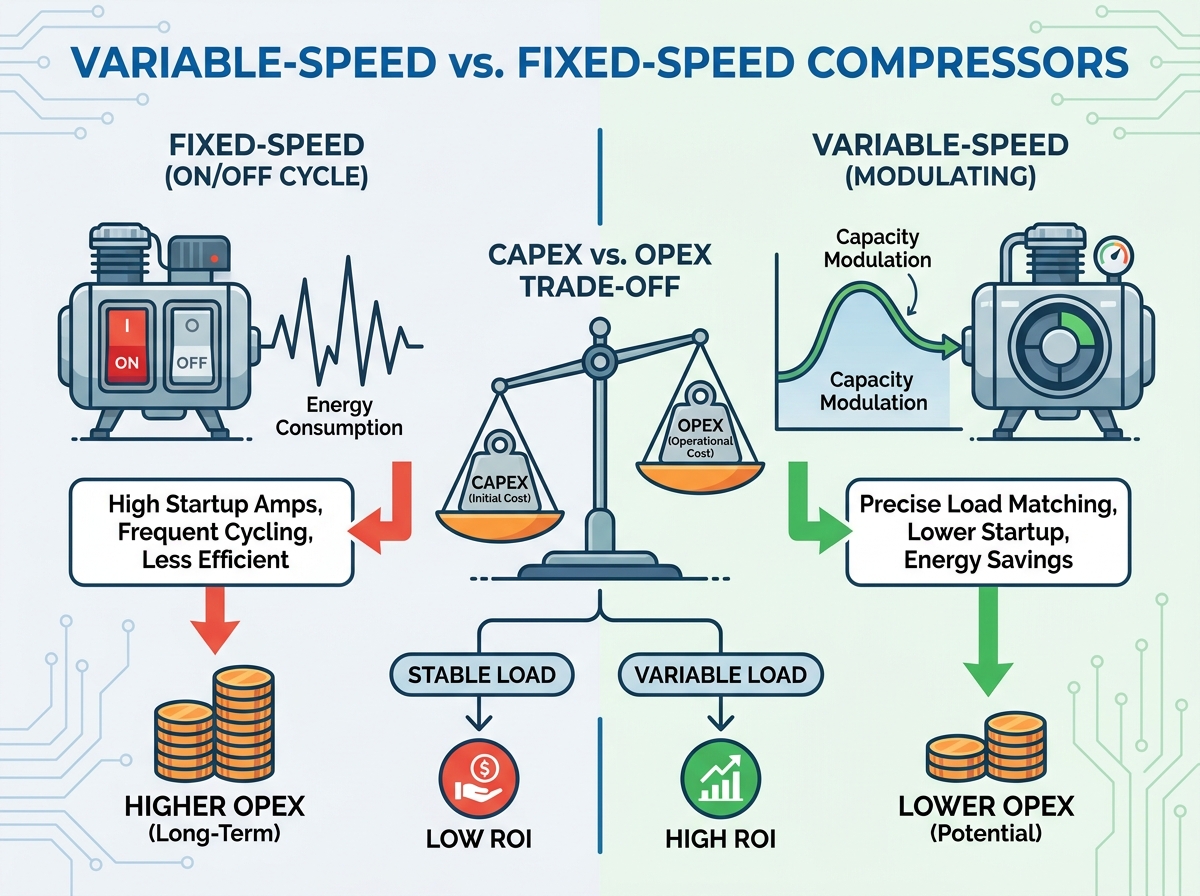
We must understand the operational mechanics clearly. Fixed-speed units use simple bang-bang control. They turn fully on or fully off. This creates sudden power surges. It also stresses internal mechanical components. Variable-speed units use intelligent capacity modulation. They adjust motor speeds smoothly. They match the exact cooling demand at any moment. This requires complex algorithms and highly robust electronics.
You should align your capital expectations with the equipment lifespan. Most industrial cooling systems last 15 to 20 years. The higher initial price spreads out over two decades. However, you must carefully evaluate replacement parts. The advanced boards cost far more than traditional contactors. A standard relay might cost fifty dollars. A replacement VFD board can easily exceed three thousand dollars. You must keep these figures in mind during procurement.
Initial Cost Breakdown Comparison
Component Category | Fixed-Speed Unit | Variable-Speed Unit |
|---|---|---|
Motor & Drive | Standard induction motor | Motor + VFD inverter |
Controls | Basic mechanical contactors | Proprietary microprocessor boards |
Sensors | Standard pressure switches | High-precision electronic sensors |
Average CapEx Premium | Baseline | +30% to +50% |
Energy load matching is a major advantage. Modulating compressor speed meets real-time demand accurately. This prevents destructive short-cycling. A standard unit turns on and off constantly. This frequent cycling spikes electrical current. It also wastes massive amounts of energy. A variable unit reduces amp draw on startup significantly. It ramps up slowly and runs continuously at lower speeds. This steady operation utilizes power much more efficiently.
However, the low-speed efficiency myth misleads many buyers. Running at extremely low speeds does not guarantee linear energy savings. Thermodynamic limitations play a crucial role here. Compressors lose volumetric efficiency below certain RPMs. Sometimes, running too slowly actually increases the energy consumed per ton of cooling. You cannot assume a 50% speed reduction equals a 50% power reduction. The motor still requires baseline power to overcome mechanical inertia. Compression ratios also shift unfavorably at minimal speeds.
You must calculate an accurate break-even point. Several metrics matter here. Look closely at your local utility rates. High electricity costs accelerate payback periods tremendously. Consider average ambient temperatures in your region. Determine your daily duty cycle percentages. These data points reveal if the operational savings justify the premium. Facility managers must conduct rigorous mathematical modeling. Do not rely solely on manufacturer estimates.
Early adopters often face unexpected maintenance hurdles. Inverter drive vulnerabilities represent a significant risk. Control boards experience high failure rates in certain regions. Electrical grid fluctuations easily damage sensitive electronics. Power surges can destroy an inverter drive instantly. This remains a common pain point for industrial facilities. Lightning strikes or grid switching events spell disaster for unprotected units.
Mechanical limitations also require careful attention. Lubrication and oil return issues frequently arise. Prolonged low-speed operation reduces refrigerant velocity inside the piping. The system needs sufficient velocity to carry oil back to the compressor. Poor oil return causes severe mechanical friction. The bearings starve for lubrication. This ultimately impacts equipment longevity. Upgrading to active oil management systems adds even more cost.
Consider the stark contrast in expected repair costs. Replacing a standard contactor on a fixed-speed unit is cheap. It often costs under a hundred dollars. Any local technician can perform the swap quickly. Replacing a proprietary variable-speed control board is entirely different. It can cost thousands of dollars. It also requires specific diagnostic software. You must weigh these potential repair bills against your monthly energy savings. Always check local availability for these specialized parts. A variable speed refrigeration compressor demands precise maintenance protocols.
Not every facility benefits from modulating technology. We need a clear decision framework. You must analyze your specific operational environment carefully.
Highly fluctuating heat loads: Some facilities face varying production schedules. Frequent door openings also change cooling demands rapidly. Variable units excel here. They adapt instantly to shifting requirements.
Extreme seasonal swings: Certain geographic regions experience wild temperature changes. High humidity also requires precise capacity control. Modulating equipment handles these shifts perfectly. It removes moisture without overcooling the space.
Strict temperature compliance: Pharmaceutical storage demands tight tolerances. Sensitive food processing also requires exact temperatures to meet regulations. Variable systems maintain highly stable environments. They prevent damaging temperature swings.
Stable maximum loads: Cold storage facilities often run at continuous peak demand. A constant load rarely justifies a variable drive. If the motor runs at 100% capacity constantly, you gain nothing.
Dirty power environments: Some areas suffer frequent electrical surges. Unless you invest heavily in power conditioning, sensitive boards will fail. Rural areas often experience severe grid instability.
Short-term budget cycles: Some projects have strict budget caps. If you plan to sell the facility soon, you will not realize the operational savings. The payback period often exceeds five years.
Application Suitability Matrix
Facility Type | Cooling Demand Profile | Recommendation |
|---|---|---|
Multi-shift Manufacturing | Highly Variable | Strongly Recommended |
Deep Freeze Storage | Constant / High | Not Recommended |
Pharmaceutical Lab | Strictly Regulated | Strongly Recommended |
Rural Warehouse (Poor Grid) | Moderate | Requires Power Conditioning |
Selecting the perfect equipment requires diligent engineering analysis. You cannot guess your capacity requirements. You must conduct a thorough load profile analysis.
Audit your current peak cooling load during summer months.
Measure your partial load requirements during night shifts.
Document these figures across different seasons to find averages.
Calculate the total hours spent at partial capacity.
Next, evaluate your facility power quality thoroughly. This step is entirely non-negotiable. Assess the need for surge protection devices (SPDs). Consider installing phase monitors before putting the equipment online. Clean power ensures the electronic drives survive their expected lifespan. Integrating a variable speed refrigeration compressor into a poor grid guarantees failure. Voltage imbalances will destroy the microprocessors quickly. Review your utility bills for peak demand charges as well.
Finally, establish strict vendor evaluation criteria. Ask contractors direct questions during the bidding phase. How fast can they source replacement boards? Do warranties exclude electronic components damaged by power spikes? Ensure local technicians possess the right expertise. Specialized diagnostic tools are absolutely necessary. A great machine fails without proper local support.
Variable-speed technology is not a universal silver bullet. It does not automatically guarantee massive energy savings. The heavy initial investment makes sense only under specific conditions. Your operational environment must feature truly variable loads. Furthermore, your facility must adopt modernized maintenance protocols. You cannot treat sophisticated electronics like simple mechanical relays. Proper power conditioning is strictly mandatory.
Take ample time to review your facility data. Measure your ambient temperatures and duty cycles accurately. We strongly encourage you to request a custom energy audit. Run a comprehensive long-term financial calculation before finalizing your equipment specification. Evaluate the long-term maintenance realities alongside the promised utility savings. Make an informed decision based on hard numbers. Integrating a modern variable speed refrigeration compressor can transform your facility when applied correctly. It offers unparalleled precision and efficiency for the right application.
A: A well-matched system typically saves between 15% and 30% in energy costs. Marketing materials often claim "up to 50%" savings, but these represent extreme edge cases. Real-world savings depend entirely on load matching. Facilities with highly variable cooling demands see the best results.
A: Mechanically, they often last longer. Modulating speeds reduces startup stress and physical wear on internal bearings. However, their electronic components are highly vulnerable. Control boards and inverter drives frequently fail before the mechanical parts do. The overall system lifespan depends heavily on your power quality.
A: Retrofitting is generally discouraged. Standard compressors lack the specialized oil pumps required for low-speed lubrication. Adding a VFD often causes severe oil return issues and compressor burnout. Furthermore, this modification almost always voids the manufacturer's warranty. It is safer to purchase a factory-engineered unit.
A: Variable units rely on sensitive microprocessors and inverter boards to modulate speed. These electronic parts cannot handle electrical grid fluctuations. Even minor voltage spikes can fry a proprietary control board permanently. Installing surge protection devices and phase monitors is essential to protect your expensive investment.