
Call Us
+86-18072289720
- All
- Product Name
- Product Keyword
- Product Model
- Product Summary
- Product Description
- Multi Field Search

Views: 0 Author: Site Editor Publish Time: 2025-02-28 Origin: Site

The spare parts of a refrigeration compressor are not a long list of everything inside the machine. They are the short list of parts that wear, fail or leak while the rest of the machine keeps working. On our semi-hermetic piston machines that list is concrete: valve plates, gaskets, piston rings, bearings, the oil pump, and — on a semi-hermetic machine — the motor. On a screw machine the list shifts: capacity-control parts and oil-circuit parts lead it.
This article walks through those parts in the order they actually fail, explains what each one does, what you notice when it goes, and how to order a replacement that fits the first time. If you maintain cold stores, freezing lines or process cooling, this is the working answer to the question.
A parts list written for "a compressor" fits no machine. The three questions that set the list:
Piston or screw? A piston machine wears valve plates, rings and bearings. A screw machine wears oil-circuit parts and capacity-control parts. Almost nothing crosses over.
Semi-hermetic or open? A semi-hermetic machine has its motor inside the refrigerant circuit — no shaft seal, and a burned motor is a repair. An open machine has a shaft seal that is a wear part in its own right.
Which series, exactly? Our T series and the YBF series share physical frames, but the parts are not interchangeable between them. A valve plate or gasket set quoted for the wrong series will not bolt on.
If you want the full tour of what sits inside a semi-hermetic machine and why each part is shaped the way it is, we wrote that up separately: What Is Inside a Semi-Hermetic Refrigeration Compressor. And if you are still deciding between a piston and a screw machine for a new duty, the honest comparison lives in Reciprocating or Rotary Compressor: The Three Numbers That Decide.
This article stays on the parts themselves.
On a piston machine, the valve plate is the part that decides whether gas moves. It is a single machined plate carrying two sets of thin flexible reeds: one set opens to let suction gas into the cylinder, the other opens to push discharge gas out. The reeds are held by rivet pins and flap between open and closed at stroke speed, every stroke, for years.
That is why it wears first. Every reed cycle is a metal flex. Carbon washed around the circuit, liquid slugging from a flooded evaporator, or a hard start under load all shorten its life. What you notice when it fails is characteristic:
The machine runs but cooling drops off — gas is recirculating instead of pumping.
The suction line frosts unevenly or pulls a vacuum.
A cylinder goes quiet — one reed set has stopped working and that cylinder is along for the ride.
A valve plate is also the cheapest major fault to fix. The plate sits between the cylinder head and the body; replacing it is a head-off job, not a teardown. We supply stainless steel valve plate sets with the reeds and pins fitted, matched to the machine series — see Semi-Hermetic Refrigeration Compressor Valve Plate Replacement Part.
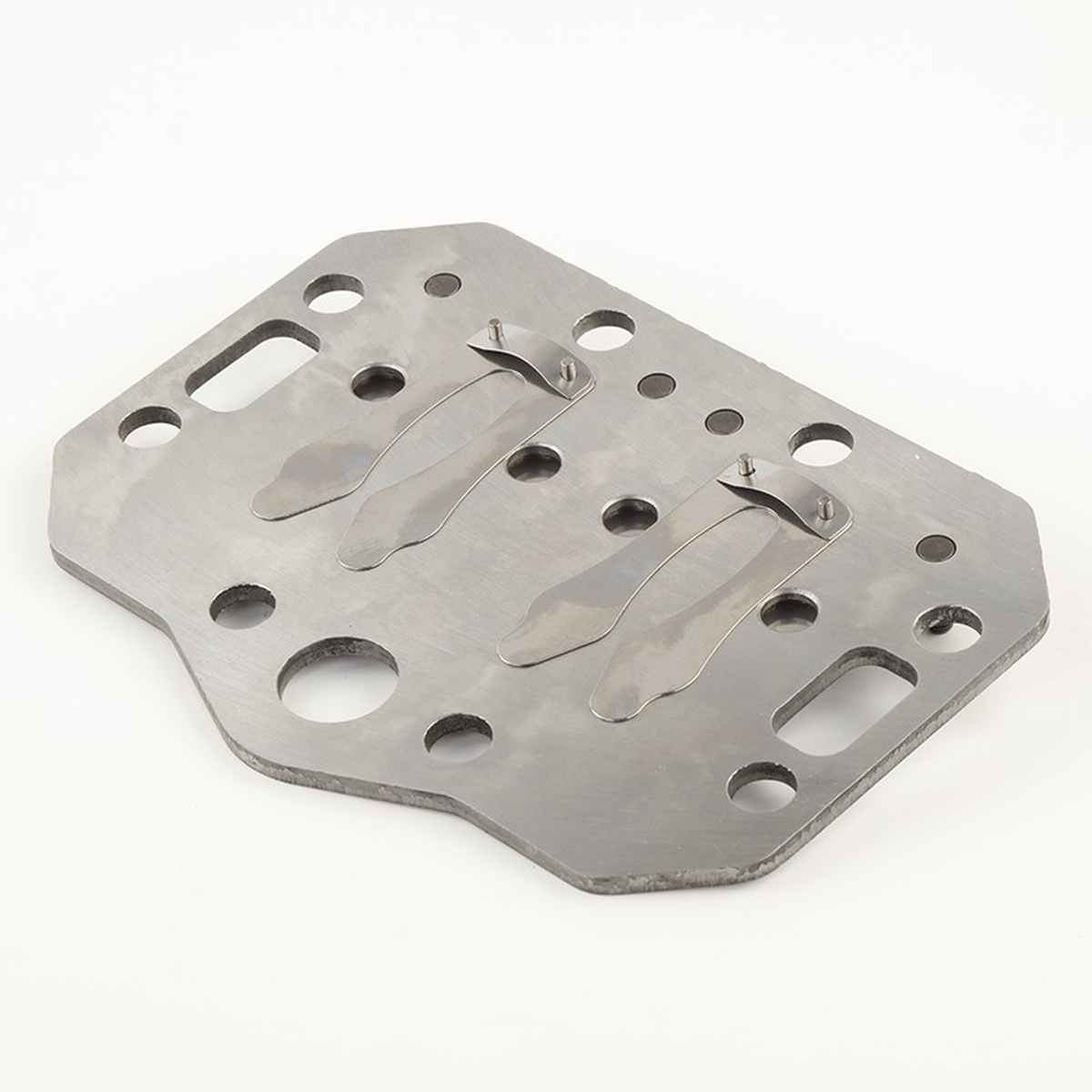
The valve plate: one plate, two reed sets. The reeds flex every stroke, which is exactly why this is the part that wears first on a piston machine.
Where the plate fits in the machine:
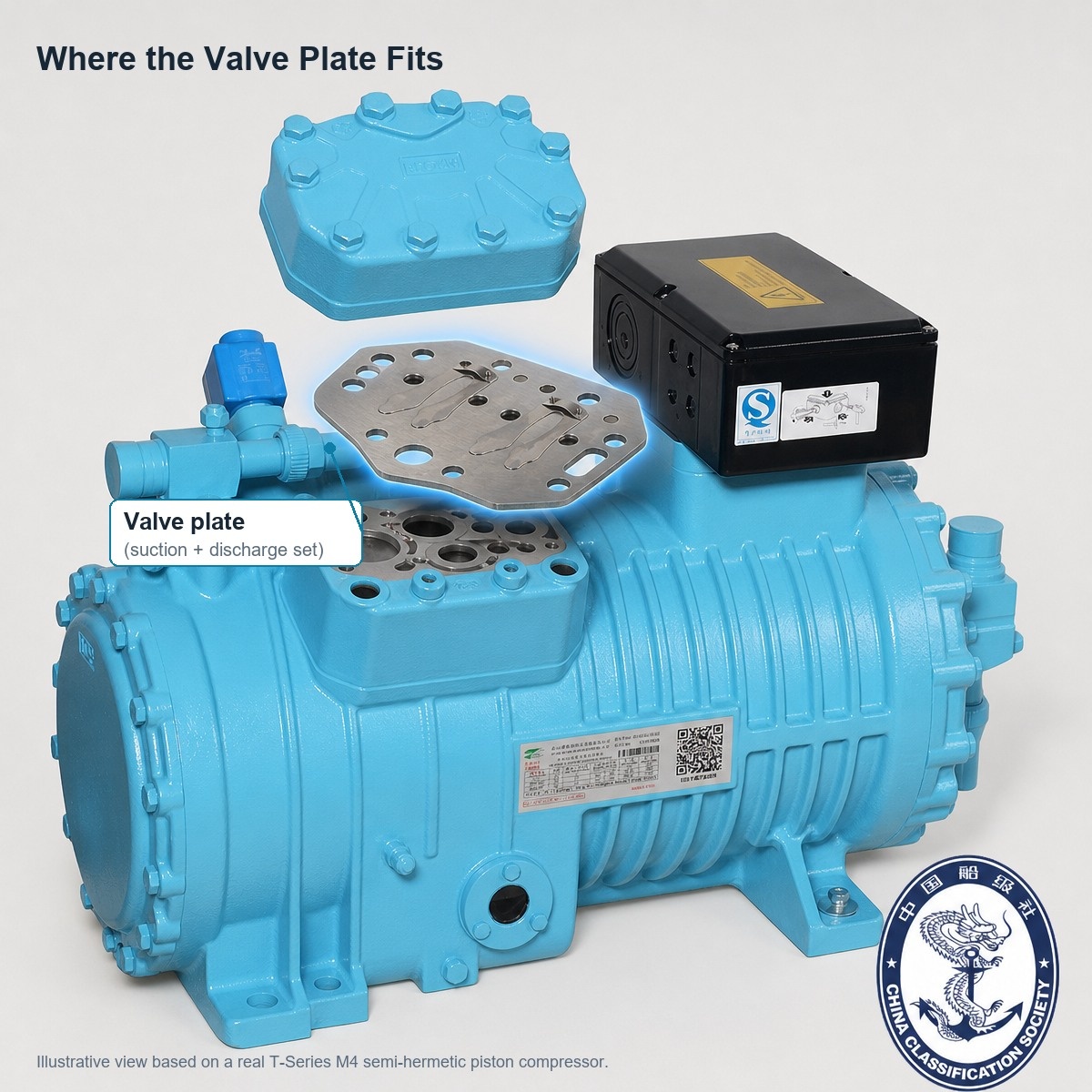
The plate closes the top of the cylinder block. Head off, plate out — a valve plate swap is a repair you can plan for a service window, not an emergency teardown.
Every joint on the machine that opens for service closes again on a gasket or an O-ring: the cylinder head, the valve plate, the crankcase cover, the oil pump, every service port cap. They are the cheapest parts on the machine and the ones most often blamed for lost gas.
Two things matter when you order them:
Material matched to the refrigerant and oil in your system. A gasket that swells or hardens in the wrong oil fails in weeks, not years.
Cut to the series, not "close enough". Our series share frames but not port patterns; a gasket set from the wrong series blocks a port or leaves one uncovered.
We hold the common gasket sets and seals for our machines, including the head and valve plate sets: Semi-Hermetic Refrigeration Compressor Gaskets. On an open machine, add the shaft seal to this list — on a semi-hermetic machine there is none, which is one of the quiet advantages of the design.
The pistons and their rings carry the compression load. Rings seal the compression stroke; they ride the cylinder wall and wear with it. What tells you rings are done:
Oil consumption climbs and the oil turns dark fast.
Compression feels weak on one cylinder — the machine pumps less than its rated duty.
Crankcase pressure rises, pushing oil out of seals that were fine before.
Rings and small-end bushings are normally ordered as part of a piston kit — piston, rings, pin and circlips together — because fitting new rings onto a worn pin or an old piston recreates the fault in a month. We build piston kits to match the machine series: Customized Refrigeration Compressor Piston Kit.
One boundary worth knowing: piston and rod work crosses from maintenance into rebuild territory. If the crankshaft journals are scored, the repair conversation changes. That is the moment to send us photographs rather than part numbers.
The main and rod bearings carry the whole rotating assembly. When they fail, they take the neighbors with them — a spun main bearing can scrap a crankshaft. The good news is that bearings announce themselves. Rising oil temperature, a knock that changes with load, metal glitter in the oil sight glass or on the drain plug: these are warnings with weeks of runway, not minutes.
Bearing replacement is a full teardown, done with the right pulls and presses, and the parts must be exactly the series' fit — bearings are the one category where "close" is a word that costs a machine.
On our piston machines the oil pump feeds the bearings and the power end under pressure. It is a small, cheap part with a whole-machine failure mode behind it: when it weakens, the oil-pressure protection does its job and stops the machine first. What you notice:
The machine trips on oil pressure during cold starts, then runs fine warm.
Oil pressure holds at speed but fades at part load.
Either way it is a pump swap, not a compressor. We stock the pump for our machines: High-Performance Oil Pump Compressor Spare Part, and we also supply oil pumps used on other makes of semi-hermetic machines. The oil specification itself follows the refrigerant — on HFC machines that means ester oil, and the oil grade is part of the spare-parts conversation, not a separate one.
On a semi-hermetic machine the motor sits inside the refrigerant circuit, cooled by suction gas. When a winding fails, the machine comes apart and the motor is rebuilt or replaced — the body, crankshaft and running gear survive. That is the design's core service advantage over a sealed machine: a burnout is a repair, not a scrapped compressor.
Spare parts at the motor level are the terminal box internals — gaskets, terminal posts, and the protection module. The protection side matters as much as the power side: our machines carry a PTC 110 °C discharge-temperature sensor and an INT69 FSY protection module, and both are standard replacement items.
On a screw machine the oil circuit and the capacity control do the work that valve plates do on a piston machine, and their parts lead the wear list:
The slide valve and its drive — it strokes continuously to follow load, and its position feedback is what keeps the machine efficient.
The solenoids that step it — on our two-stage YLG machines, four solenoids (CR1–CR4) step the slide valve down and up to follow load. A single failed solenoid shows up as one step that will not engage.
Oil-circuit maintenance items — the oil that separates at discharge returns through the intermediate-pressure chamber, and keeping that circuit clean is the screw machine's version of ring work.
We broke down how the two-stage single-body machine is built and how its capacity control steps in YLG Two-Stage Screw Compressor: Inside a Single-Body Machine.
Pressure relief valves, the oil-pressure switch, the discharge-temperature sensor, the protection module: these parts do no work at all — right up to the day they do all of it. They are cheap, they are standard, and the correct time to replace them is at a planned service, not after a trip you cannot diagnose. When you order them, the machine series and the protection module part number are all we need.
| Part | Piston machine | Screw machine | What you notice when it wears |
|---|---|---|---|
| Valve plate / reeds | Wears first | — | Cooling drops, cylinder goes quiet, uneven frost |
| Slide valve + solenoids | — | Wears first | One capacity step will not engage |
| Gaskets, O-rings, seals | Routine | Routine | Oil weep, gas loss at joints |
| Piston rings / kit | Wear item | — | Oil consumption up, weak cylinder, dark oil |
| Bearings | Rebuild level | Rebuild level | Knock with load, metal in oil |
| Oil pump | Wear item | Oil circuit | Cold-start trips, fading pressure at part load |
| Motor + terminal parts | Burnout repair | Burnout repair | Trips on protection, no run |
| Sensors / protection | Replace on schedule | Replace on schedule | Nuisance trips, or no trip when one is needed |
Most spare-part freight emergencies are not supply problems — they are identification problems. The part existed all along; it was ordered against the wrong series or without the details that pick the variant. The short list that prevents it:
The nameplate photo — model and serial, exactly as stamped. Our T series and YBF series share frames; the nameplate is what separates them.
A photo of the old part — before it gets degreased, painted or binned.
The refrigerant and the oil in the machine — on HFC machines that means ester oil, and it sets gasket material and ring coating.
The machine type you already know — piston or screw, semi-hermetic or open.
Quantity and duty — a cold store running one machine at 100% and a freezing line with standby machines order different quantities of wear parts.
Three photographs and two words — refrigerant and oil — turn a spare-parts inquiry into a matched quote. Most wrong parts ship because one of the five was missing.
Send those five things and the matching is our work, not your risk.
Our spare-parts range is built around our own machines first:
Valve plate sets — stainless plates with reeds and pins fitted, by series. Valve plate product page
Gasket and seal sets — head, valve plate and pump sets, cut to series and matched to refrigerant and oil. Gaskets product page
Piston kits — piston, rings, pin and circlips together, built to the series. Piston kit product page
Oil pumps — for our machines, and pumps used on other makes of semi-hermetic machines. Oil pump product page
Shut-off and service valves — including valves fitted on other makes of screw machines, such as our steel shut-off valve compatible with Bitzer compressors.
The whole range is under Compressor Spare Parts. Parts beyond the stock list — oversized gaskets, kit variants, protection modules for older machines — we build or source against the nameplate photo.
On our machines, yes. The reeds flex every stroke, so the valve plate wears ahead of rings and bearings. It is also the cheapest major fault: a head-off job you can plan, not a teardown.
No — and that is the point of the design. The motor sits inside the refrigerant circuit, so there is no rotating joint to seal and no shaft seal to stock. Open machines do have one, and it is a wear item there.
No. The two series share physical frames, but ports, gasket patterns and internal fits differ. A gasket set quoted for the wrong series blocks a port or leaves one uncovered. The nameplate model is what we match against.
A nameplate photo, a photo of the old part, the refrigerant and oil in the machine, the machine type, and the quantity. Those five items pick the variant; without them, ordering is guessing.
We supply a range of shut-off valves and oil pumps used on other makes of semi-hermetic and screw machines, alongside the full parts list for our own machines. Send the nameplate and the old-part photo and we will tell you straight whether we can match it.
The spare parts of a refrigeration compressor are the parts that wear: on a piston machine, the valve plate first, then gaskets, rings, oil pump and bearings; on a screw machine, capacity-control and oil-circuit parts lead. Order against the nameplate photo and the refrigerant — those two details are what make a spare part fit the first time.


