
Call Us
+86-18072289720
- All
- Product Name
- Product Keyword
- Product Model
- Product Summary
- Product Description
- Multi Field Search

Views: 0 Author: Site Editor Publish Time: 2025-04-07 Origin: Site
A buyer wrote to us last month asking for "a rotary compressor, because rotary is more efficient". He needed −35 °C for a frozen-storage extension. Two problems were folded into that one sentence, and both are expensive. The word rotary was standing in for a machine that might not do the duty at all, and efficiency was being treated as a property of the machine rather than a property of the duty it runs.
This article is about the choice that actually exists in industrial refrigeration: the reciprocating (piston) compressor against the twin-screw compressor. We build both, so we have no interest in declaring a winner, and no interest in selling you the wrong one and living with the service calls. What follows is the order we actually work in — the word first, then the three numbers that decide the machine, then the six questions that confirm it.
In domestic and light commercial air conditioning, rotary almost always means a rolling-piston or rotary-vane compressor: a sealed steel can, brazed into the circuit, no suction valve, no discharge valve, not repairable, sized from a fraction of a kilowatt to a few kilowatts. It is a fine machine for what it does. It is also not a candidate for a refrigeration plant, because there is nothing to service and nothing to unload.
In industrial refrigeration, rotary usually means a twin-screw compressor: two meshing rotors in a cast or fabricated body, oil-flooded, capacity controlled by a slide valve, semi-hermetic motor, built from tens of kilowatts well past the megawatt. A third layout exists — the single-screw machine, one main rotor meshing with a gate rotor on each side — but it is a specialist build; the industrial mainstream, and every screw machine we build, is twin-screw.
Those two machines share a rotation and nothing else — different bearings, different oil system, different failure modes, different service economics. So the useful version of the question is not "reciprocating or rotary". It is:
Reciprocating or screw? That is the question worth answering, and everything below compares those two. If the machine you are looking at is the sealed can inside an air conditioner, the comparison does not apply to your plant, and the rest of this article will feel like it is answering a different question — because it is.
Neither machine is a centrifugal. Both trap a fixed volume of gas, close it off, and squeeze it until the pressure is high enough to leave. That single shared trait is what makes an honest comparison possible at all: the same four quantities describe both, and the same physics limits both.
What differs is how the volume closes. In a piston machine, a valve plate and two sets of spring-loaded valves do it, once per revolution, with a piston stopping dead at top dead centre and reversing. In a screw machine, the rotor mesh does it continuously along the length of the rotors, with no reciprocating mass and no valve plate to fatigue.
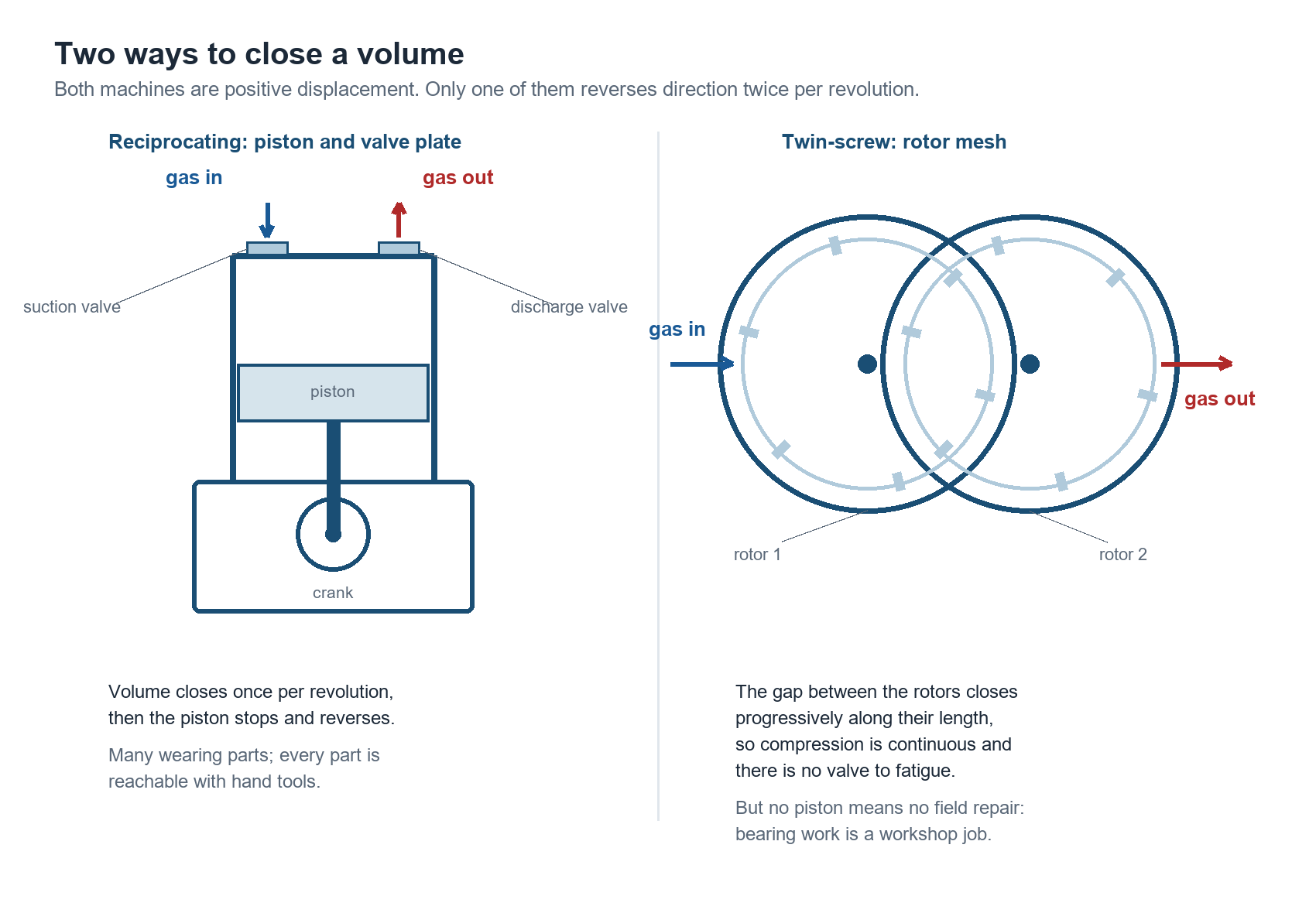
Two ways to close a volume: a piston with suction and discharge valves at one end, and two meshing rotors that trap gas in the gap and carry it to the discharge port. Both are positive displacement; only one reverses direction twice per revolution.
That difference in motion is the origin of almost every practical difference downstream — vibration, part count, valve wear, oil handling, how capacity is controlled, and what a technician can fix on site at two in the morning.
Buyers compare compressors by horsepower. Horsepower tells you roughly how much iron you are buying. It does not tell you whether the machine will survive your duty, and it cannot be compared across the two types anyway, because the same shaft power buys a different displacement depending on rotor profile, stroke and speed.
Three numbers do the real work:
Displacement, in cubic metres per hour. How much suction gas the machine sweeps per hour. It sizes the machine. On its own it says nothing about whether the duty is inside the machine's limits.
Cooling capacity, in kilowatts, at a stated evaporating and condensing temperature. This is the number to compare — but only against another capacity quoted at the same two temperatures, on the same refrigerant. A capacity figure without its temperature pair is a number with no meaning attached.
Pressure ratio, and the discharge temperature it produces. This is the survival number, and it is the one buyers most often skip. Pressure ratio is absolute condensing pressure divided by absolute evaporating pressure. It is not gauge pressure, and the difference matters: a suction gauge reading near zero on a freezer is not zero pressure, it is roughly one atmosphere absolute, and the ratio against a forty-degree condensing condition is far higher than the gauge numbers suggest.
A quotation that gives you only horsepower, or only kilowatts without temperatures, is not a quotation. It is a label.
There is a rule of thumb from the compressed-air world that gets carried into refrigeration and quietly wrecks specifications: screw for volume, piston for pressure. In compressed air it holds, because screw air ends are built around a narrow band of delivery pressures and piston machines are pushed to higher pressures in smaller flows.
Refrigeration has no delivery pressure to speak of. What the machine has to do is lift heat from an evaporating temperature to a condensing temperature, and the pressure ratio is a consequence of the refrigerant and those two temperatures — not something you choose. Reverse the air-side rule and you get closer to the truth: the deep, high-ratio duties are where a second stage belongs, and the shallow, high-flow duties are where a big single-stage machine belongs.
And the failure mode of using the air rule is expensive rather than merely wrong. A machine selected on "screw means low pressure" gets installed on a freezer duty where the ratio destroys the discharge end within a season. A machine selected on "piston means high pressure" gets installed on a large continuous duty where the frame is absurd and the cylinder count becomes a maintenance programme.
The other air-side habit worth dropping is treating efficiency as a single number attached to a machine type. Efficiency is a property of a machine at a duty. Ask for it at your evaporating temperature, your condensing temperature and your refrigerant, and ask for it at part load as well, because a plant spends most of its life there.
The piston machine has been in refrigeration for a century for reasons that are still valid.
It is serviceable in place. Cylinder head off, valve plate out, rings and connecting rod bearings replaced — all of it is field work with hand tools and a torque wrench. Where the plant is a fishing vessel, a remote cold store or a plant room with poor access, that property is worth more than a few percent of efficiency, because the alternative is a crane and a week of downtime.
It handles stepped capacity without an oil system. Unloading cylinders, or hot-gas bypass, gives you a coarse but completely reliable way to follow a load. There is no slide valve to calibrate and no oil separator vessel to keep healthy.
It keeps the oil in the crankcase. The oil charge sits in the sump, splash or pump distributed, and returns with the suction gas. No external separator, no oil cooler circuit, no differential oil supply to design and maintain.
It tolerates a wide refrigerant range. Our piston range runs on R22 with mineral oil where that installed base still exists, and on R404A or R507A with POE. The same machine architecture covers both, which simplifies spares for a fleet.
It goes two-stage in small capacities. When the duty drops below what a single stage can hold, a two-stage piston is a compact, repairable answer — the deep-freeze duty does not automatically belong to a screw machine.
What it costs you: many wearing parts, a reciprocating mass that needs a properly rigid base and correct pipe support, and a frame that becomes physically large and cylinder-heavy as capacity rises. At large capacities, the maintenance load scales with the cylinder count.
The screw earns its place in a different part of the map.
Capacity per cubic metre of plant room. At large capacities the screw is dramatically more compact than a piston machine of the same duty, and it is continuous rather than cyclic.
Fewer wearing parts. Two rotors, their bearings, a slide valve and a shaft seal on the open-drive version — a semi-hermetic build removes even the shaft seal, because the motor sits in the suction gas. There is no valve plate to fatigue and no reciprocating mass to balance.
Steady discharge. Gas leaves continuously along the rotor, not in pulses from a cylinder, which is gentler on the discharge line, the oil separator and the condenser.
Capacity control by slide valve, which gives a wide, smooth control band and long intervals between overhauls.
What it costs you is mostly concentrated in one place: oil management is the whole machine. Separator efficiency, oil cooler capacity, differential oil supply, oil return, oil temperature. A screw with marginal oil management runs hot, loses volumetric efficiency and eventually damages its bearings — and it does so quietly, without the mechanical noise a failing piston machine makes.
The second cost is part load. Screw efficiency falls away from the design point unless the slide valve position and the built-in volume ratio suit the duty. A screw selected at its rated point and run at half load for most of the year will not return the number it was sold on.
| What you are comparing | Reciprocating | Twin-screw |
|---|---|---|
| How the volume closes | Piston, valve plate, spring valves | Rotor mesh, no suction or discharge valves |
| Best capacity band | Small to medium | Medium to large |
| Capacity control | Cylinder unloading or hot-gas bypass, stepped | Slide valve, wide band |
| Wearing parts | Rings, valves, bearings, con rods | Bearings, slide valve, shaft seal (open drive only) |
| Field repair | Most of it, with hand tools | Limited; rotor and bearing work is a workshop job |
| Oil system | Charge in the crankcase, no separator | Separator, cooler, differential supply — the critical subsystem |
| What ends its life early | Liquid slugging, high discharge temperature | Poor oil management, running far from its design point |
There is a second ambiguity in this comparison, and it costs more money than the first.
In air conditioning, two-stage usually means two capacity steps — the machine runs at roughly seventy percent or full output. In industrial refrigeration, two-stage means two stages of compression in series, with the gas cooled between them. A buyer comparing a "two-stage" air-conditioning unit with a "two-stage" refrigeration compressor is comparing two unrelated ideas, and the numbers will never line up.
The refrigeration meaning is the one that matters here. A single stage has a ceiling, and the ceiling is set by discharge temperature rather than by pressure ratio on its own. Push a single stage into a deeper evaporating temperature and the discharge gas gets hot enough to break the oil down; the machine keeps running, the oil slowly cooks into the discharge line, and the valves and rings that were fine last season are not fine this one. Nothing announces itself. That is what makes it expensive.
So the real question is not "how deep can one stage go" but "at what evaporating temperature does my duty need a second stage, and what capacity do I need there". Both families have an answer:
Small deep-freeze duty → two-stage piston. Compact, repairable in place, no external oil management.
Large deep-freeze duty → two-stage screw. One body instead of a cascade of cylinders, continuous rather than cyclic.
Our own two-stage screw is a single-body machine: two rotor sets on one axis with the motor between them, and the intermediate pressure chamber machined into the body rather than hung outside it as a separate vessel. How that machine is put together is covered in detail elsewhere; the point here is that a second stage is an architecture decision, not an accessory.

Deep-freeze duty is where the single-stage ceiling bites first: the colder the room, the hotter the discharge gas has to be pushed to reject heat at the same condensing condition.
A common way to lose money on this decision is to pick the machine first and the refrigerant afterwards. The refrigerant sets the pressure ratio, the discharge temperature and the oil chemistry, and the machine is only the thing that has to live with all three.
R22 with mineral oil is forgiving. Mineral oil tolerates moisture far better than the synthetics, the pressures are moderate, and a plant that already runs on it can be repaired with what is on the shelf. It is also being phased down, so new investment needs to account for that.
R404A and R507A with POE are the common low-temperature choice now. POE is the right oil for the duty and the wrong oil for a careless technician: it absorbs moisture aggressively, so filter driers, evacuation time and sealed-system discipline stop being good practice and become the difference between a five-year machine and a one-year machine. The compressor is unchanged. Its failure profile is not.
CO2 (R744) is a different regime, not a substitute. Transcritical operation means pressures an order of magnitude above the HFC range, different materials, different controls and different service equipment. No compressor is "CO2 ready" as a bolt-on property.
The practical consequence: a compressor rated on one refrigerant has a different capacity and a different discharge temperature on another. The rating does not transfer, and neither does the comparison between two machine types made on different refrigerants.
A plant runs at its design condition for a few weeks a year. For the rest of the year it runs below it, which means the part-load behaviour of the machine determines most of the electricity bill — and part-load is exactly where the two types diverge, and exactly where quotations go quiet.
Piston machines unload cylinders or bypass hot gas. It is coarse: on a six-cylinder machine you get steps rather than a slope. It is also completely reliable, needs no calibration and does not drift.
Screw machines use a slide valve, which in principle gives a continuous band. In practice it is worth asking how the valve is driven. On our YLG the slide valve is moved by a hydraulic piston working against a spring, with four solenoids stepping the capacity — so the control is stepped, not stepless, however the phrase is usually written. A machine that claims stepless control usually means the steps are small enough not to matter at the scale it runs at.
The question that settles this section is not "what is the efficiency" but this one, and it is worth asking in writing: at my actual condensing temperature, running at half load, what capacity does the machine deliver, and what power does it draw?
A machine chosen on its rated point alone is a machine chosen for the two weeks a year when the weather is worst.
Both machines fail, and they fail differently. Knowing which failure belongs to which machine is most of what "reliability" means in practice.
| Failure | What it does to a piston machine | What it does to a screw machine |
|---|---|---|
| Liquid slugging | Bends valves and connecting rods; a single bad slug can end a season | Tolerates an occasional slug; a habit of it destroys bearings and rotor contact |
| Oil starvation | Rings and cylinder walls wear, then seize | Bearing damage within minutes, often without warning noise |
| High discharge temperature | Valve plates burn, oil cokes in the discharge line | Rotor discharge end runs hot, oil degrades, volumetric efficiency collapses |
| Motor burnout | Possible — the motor sits in the suction gas on a semi-hermetic build | Possible for the same reason; the cleanup is the expensive part, not the motor |
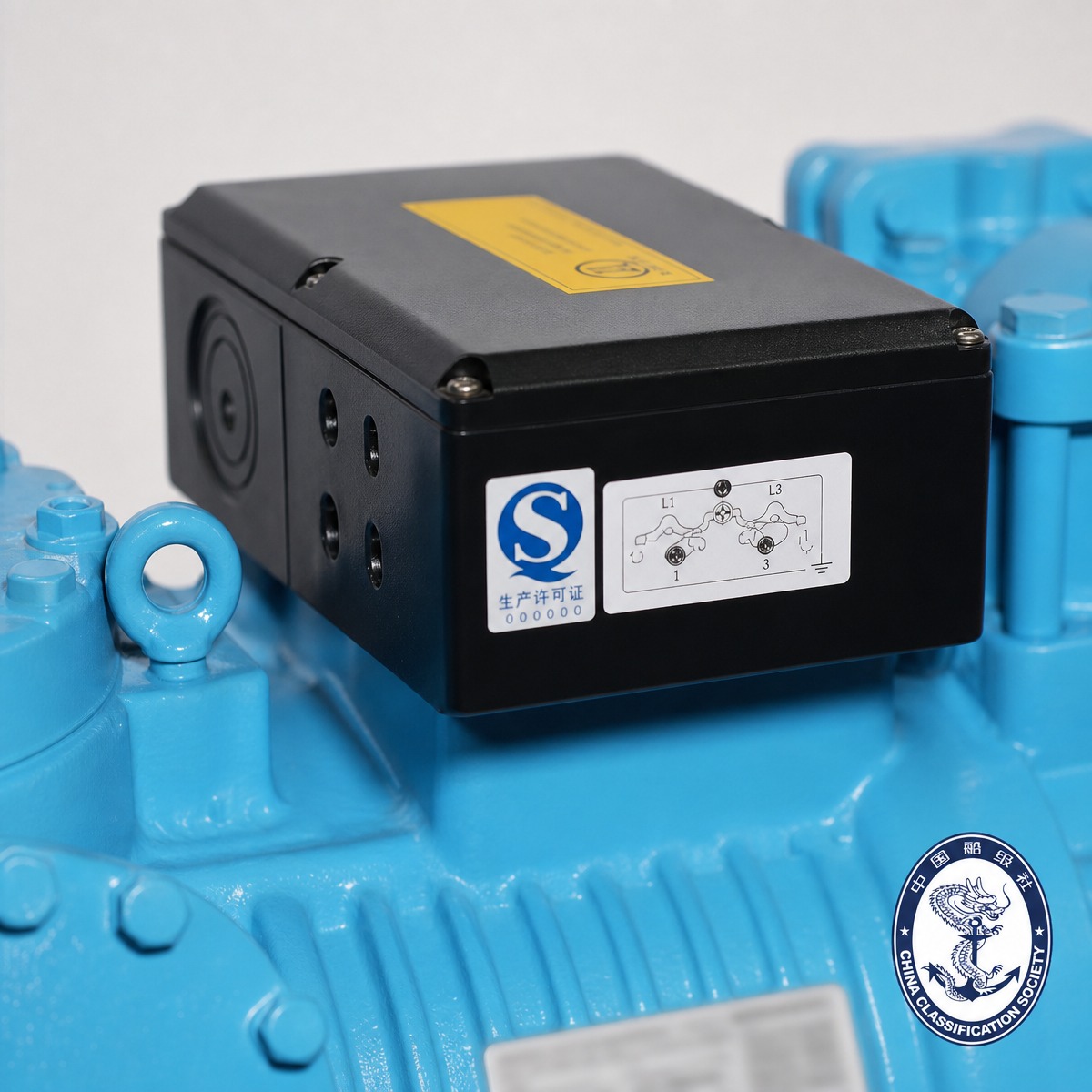
The terminal box on a semi-hermetic machine. Winding connections and earth are all brought out at this casting, and the cover carries the diagram a technician works from when the motor is reconnected.
That last row is worth dwelling on. On a semi-hermetic machine the motor is inside the refrigerant circuit, which removes the shaft seal and its leak path, and adds a failure mode: when the winding fails, the products of that failure are distributed through the oil, the separator and the pipework. Replacing the compressor without cleaning the circuit is how a plant burns out two machines in one season.
On an open-drive machine there is no motor in the gas at all, so burnout is not on the list — but a shaft seal is, and a shaft seal is a leak that no amount of monitoring catches until the charge is low.
Most of the debate collapses once six answers are on the table. None of them is about which machine is "better".
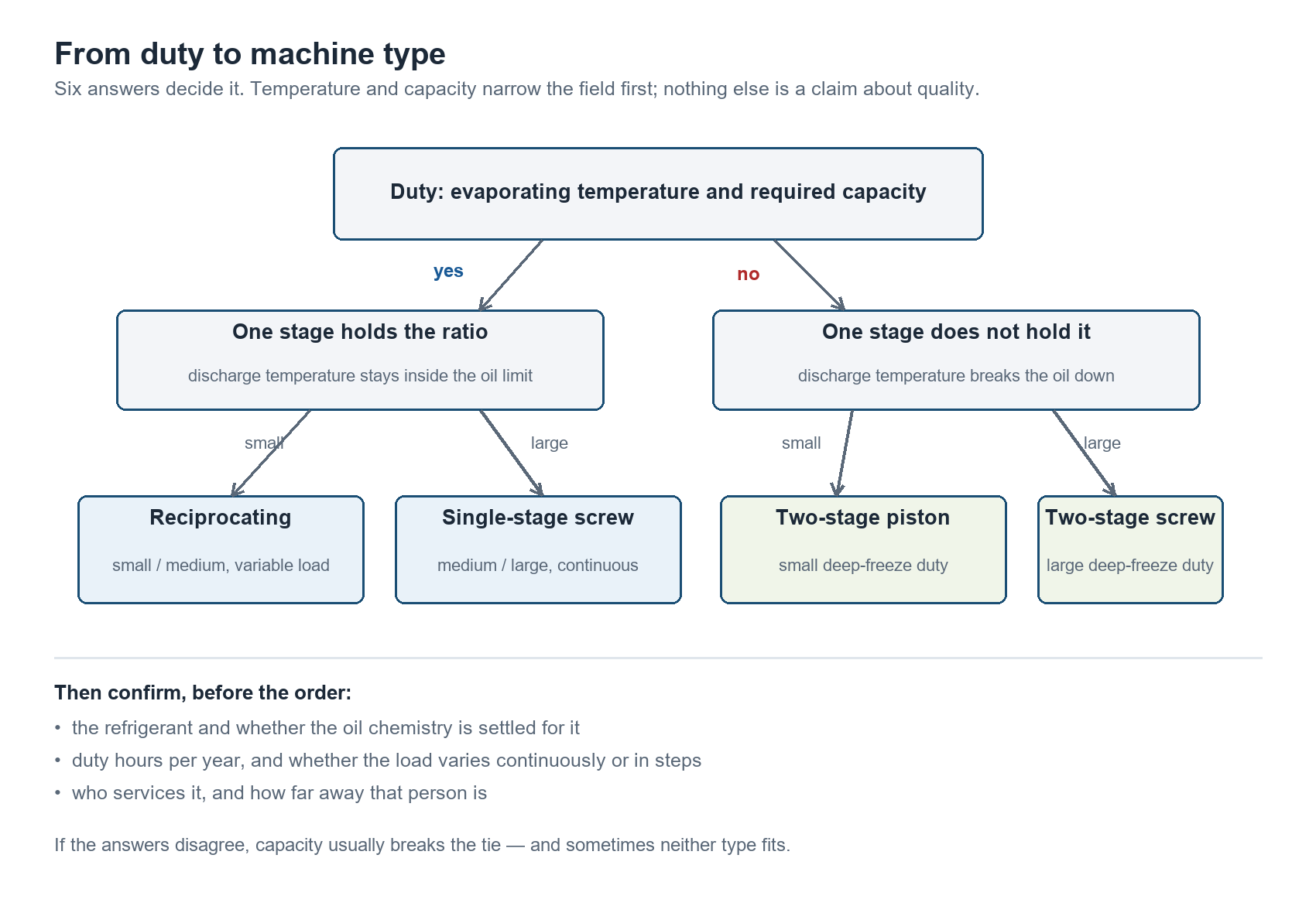
The sequence we actually run when a duty comes in: the temperature and the capacity narrow the field first, and everything else — refrigerant, duty hours, site service capability — decides what is left.
| Question | Points to the piston machine | Points to the screw machine |
|---|---|---|
| How deep is the evaporating temperature? | One stage is enough, or a two-stage piston at small capacity | Beyond one stage at large capacity, or continuous deep-freeze duty |
| How much capacity, in kW, at that temperature? | Small and medium | Medium and large |
| How many hours a year does it run? | Intermittent, seasonal, or heavily variable | Continuous, year-round |
| Which refrigerant, and is the oil chemistry settled? | R22 in an existing plant, or a small R404A/R507A duty | R404A/R507A on a large duty, or CO2 in an engineered system |
| Who services it, and how far away? | A local technician with hand tools | A service organisation with oil analysis and rotor experience |
| What does the load profile look like? | Few, large steps are acceptable | A wide, continuously varying load |
If the six answers point in different directions, the capacity figure usually breaks the tie — and the honest outcome is sometimes that neither of our machines fits and a different architecture does.
We make both machines, which is the only reason this article can be written without a sales angle.
Piston: semi-hermetic machines in two-, four- and six-cylinder frames. The semi-hermetic reciprocating compressors cover commercial refrigeration, process cooling, ice machines and marine duty. Our T series and the YBF series share physical frames, and horsepower, operating current, weight and lubrication do not transfer between the two — so we quote by exact model and rated condition rather than by frame size.
Screw: we build both stage counts, because the duty decides which one fits. The single-stage screw compressors carry duties whose pressure ratio one stage can hold. Where the ratio outruns a single stage, the YLG two-stage screw compressor takes over — a single-body semi-hermetic machine with two rotor sets on one axis, built for evaporating temperatures from −70 °C to +5 °C and condensing from 10 °C to 60 °C on R22, R404A and R507A. The full line sits in the screw compressor range.
Where a plant is going into a classed vessel, approval is a separate question from capacity. Ask for the certificate and read what it actually names — a model, a refrigerant, a design pressure, a rated condition — because a type approval does not cover a whole series, and it is never the same thing as what the salesman says it covers. The duty where that question comes up first is marine, and we build a six-cylinder machine for exactly that.
If you are still working out what the machine is being asked to do, start one step back with how a refrigeration compressor works and why industrial duty is a different problem from domestic cooling.
Not as a general statement. At the same duty a well-selected screw and a well-selected piston machine land within a few percent of each other on full-load efficiency, and the gap opens at part load and at the extremes of pressure ratio. What decides it is whether each machine is running near the point it was selected for. A screw running far below its design capacity and a piston machine straining at a pressure ratio beyond one stage are both inefficient for the same underlying reason: the machine does not suit the duty.
Rarely as a drop-in. The screw will be physically different in footprint and weight, its oil system needs a separator and a cooler that the piston machine did not need, and its control interface expects a slide valve rather than cylinder unloaders. The refrigerant charge, pipe sizing and electrical protection all change. It is a plant modification, not a part swap — budget it as one.
Two stages are two compressions in series with intercooling between them, which lowers the discharge temperature and is what allows a deep evaporating temperature. Two speeds are two operating points of one compression stage, which changes capacity without changing the pressure ratio. They are not alternatives; a machine can have either, both or neither.
It removes the shaft seal, which is the single most common leak path on an open-drive machine, so yes in that specific sense. It does not make the machine leak-proof: the terminal plate, the joint faces and the valve covers are all still sealed joints, and a semi-hermetic machine that has been opened badly will leak at the gasket rather than at the seal.
Compute the pressure ratio from absolute pressures at your evaporating and condensing temperatures on your actual refrigerant, then compare the resulting discharge temperature against the oil's limit — not against the machine's nominal maximum. If the discharge temperature is running into the region where the oil breaks down, a second stage or liquid injection is doing real work, not adding cost.
If the duty is small to medium, variable, and someone has to be able to repair it where it stands, buy the reciprocating machine. If the duty is large and continuous and the plant needs to fit in a room, buy the screw. If the evaporating temperature is deep, the question is not piston against screw at all — it is one stage against two, and both families have an answer.
And if a quotation arrives with a horsepower figure, no temperature pair and no refrigerant, the right response is not to compare it with another quotation. The right response is to send us the duty — evaporating temperature, condensing temperature, refrigerant and required capacity — and let the machine be chosen from that instead of from the name of the technology.


