Call Us
+86-18072289720
- All
- Product Name
- Product Keyword
- Product Model
- Product Summary
- Product Description
- Multi Field Search

Views: 0 Author: Site Editor Publish Time: 2026-11-03 Origin: Site

Upgrading your shop air supply represents a high-stakes operational decision. Downtime or inadequate pressure quickly impacts revenue across automotive, woodworking, and light industrial settings. Choosing the wrong machine disrupts production lines. You rely on consistent airflow to keep pneumatic tools running efficiently. Buyers frequently confuse single-cylinder, twin-cylinder single-stage, and two-stage piston compressors. This confusion leads to mismatched specifications and drastically shortened equipment lifespans.
We provide a transparent, evidence-based evaluation of these systems. We separate marketing claims from engineering facts. You will discover the exact capabilities and limitations of these machines. This guide helps you align your shop demand with the right compressor technology. You will learn exactly how to determine if these units meet your specific pressure, volume, and duty-cycle requirements.
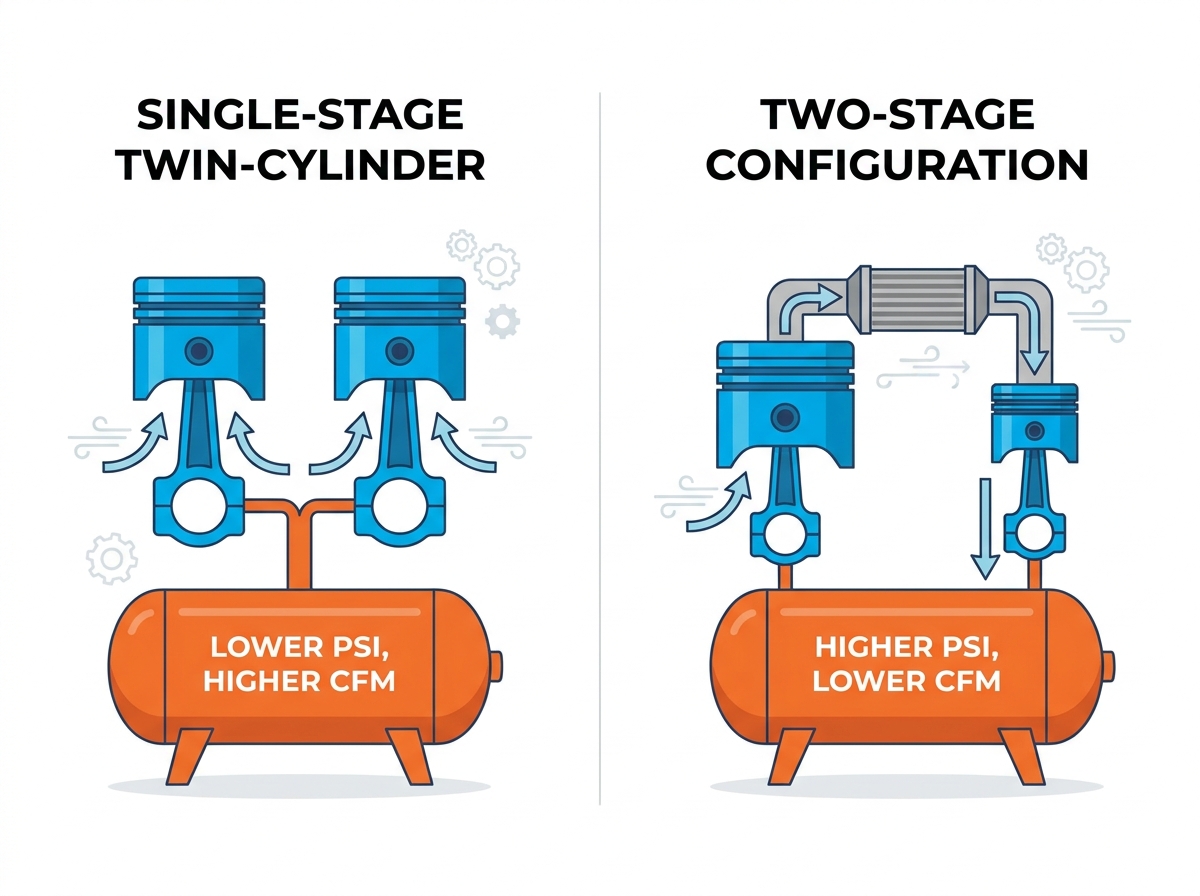
Understanding the internal mechanics prevents costly purchasing mistakes. Many buyers see two cylinders and assume they are buying a two-stage machine. This assumption is incorrect. You must distinguish between single-stage and two-stage configurations to meet your shop requirements.
Cylinder count does not dictate the compression stages. Manufacturers build two-cylinder pumps in two entirely different configurations. Each serves a distinct operational purpose.
Heat is the enemy of mechanical efficiency. Two-stage variants utilize a finned intercooler tube. This tube sits directly between the two cylinders. It acts as a critical thermal bridge. Hot air exits the first cylinder and travels through this finned tube. The flywheel fan blows ambient air across the fins. This action dissipates heat before the air enters the second cylinder.
Cooling the air between stages improves volumetric efficiency. Cooler air is denser. Denser air allows the second cylinder to pack more molecules into the tank. This thermal management also reduces mechanical wear on the high-pressure piston rings.
Industrial two-cylinder pumps feature robust construction. They utilize heavy-duty cast-iron cylinders. Cast iron resists warping under extreme thermal loads. These pumps also feature oversized bearings. Oversized bearings handle heavier industrial loads without premature failure.
Furthermore, these pumps operate at slower RPMs (revolutions per minute). A consumer-grade single-cylinder pump might scream at 3,400 RPM. An industrial two-cylinder pump often chugs along at 800 to 1,200 RPM. Slower speeds mean less friction. Less friction translates directly to a longer operational lifespan.
Selecting the right equipment requires matching machine strengths to your daily workflow. A two-cylinder piston compressor offers distinct advantages for specific industrial applications. They dominate environments requiring high pressure and intermittent usage.
The two-stage two-cylinder piston compressor remains the industry standard for high-pressure applications. Many heavy-duty tasks require 150 to 175 PSI. Heavy truck tire inflation demands these pressures. Pneumatic pressing and stamping equipment also require high PSI to function correctly. Single-stage units simply cannot reach these pressures efficiently. The sequential compression of a two-stage unit delivers this force reliably.
Prolonged demand spikes generate massive amounts of heat. Distributing the compression workload across two cylinders prevents the pump from overheating. The interstage cooling process removes thermal energy before the final compression phase. This thermal management keeps the pump within safe operating temperatures. It prevents oil breakdown and protects internal seals from melting.
Return on investment depends heavily on equipment longevity. Industrial two-cylinder pumps run at lower RPMs to generate target CFM. They produce the same volume as smaller high-speed units but work half as hard. Lower RPMs equal less friction wear. Less friction wear results in a significantly longer service life. If you maintain them properly, these heavy iron pumps can last for decades.
Best Practice: Always place your compressor in a well-ventilated area. Ambient air temperature directly affects cooling efficiency. A hot, enclosed closet will negate the benefits of the intercooler and shorten pump life.
Piston technology is universally understood. You do not need specialized, brand-specific technicians to perform basic repairs. Replacement parts are widely available. Valve rebuild kits are cost-effective and simple to install. Local maintenance expertise exists in almost every industrial market. This universal serviceability keeps repair budgets low and minimizes unexpected downtime.
No technology is perfect. You must understand the limitations of a two-cylinder piston compressor before installation. Ignoring these constraints leads to catastrophic equipment failure and expensive production halts.
We must state a crucial fact clearly. A two-cylinder piston compressor is not a 100% duty cycle machine. It cannot run non-stop all day. Manufacturers typically rate them for a 60% to 75% duty cycle. This means the pump must rest and cool down for 25% to 40% of its operating hour. Pushing it beyond this cycle leads to excessive heat. Excessive heat degrades the lubricating oil. Degraded oil causes rapid friction wear and premature pump failure.
You must address the operational environment before installation. These units are loud. They produce significant decibel levels, often hitting 80 to 90+ dB. They also generate intense low-frequency vibrations. You cannot place them next to an office or a quiet workspace.
Mitigation requires dedicated compressor rooms. You should install vibration-isolation pads under the tank feet. Acoustic planning is mandatory if noise compliance is a facility requirement.
High-temperature piston compression generates substantial condensation. Hot air holds moisture. As the air hits the storage tank and cools, water drops out of suspension. You must budget for air treatment. You will need refrigerated air dryers. You will also need in-line particulate and coalescing filtration. These add-ons are non-negotiable. They protect sensitive pneumatic tools from rust. They also prevent moisture from ruining expensive paint finishes.
Piston units demand strict maintenance diligence. You cannot ignore them. You face a non-negotiable need for regular maintenance tasks.
Neglecting these simple steps guarantees a catastrophic failure.
Facility managers often struggle deciding between piston and rotary screw technologies. The choice depends entirely on your daily air consumption patterns. You must analyze how your tools consume air.
| Evaluation Feature | Two-Cylinder Piston | Rotary Screw |
|---|---|---|
| Duty Cycle | 60% - 75% (Intermittent) | 100% (Continuous) |
| Operating Noise | Loud (80-90+ dB) | Quiet (65-75 dB) |
| Max Pressure (Typical) | 175+ PSI | 125-150 PSI |
| Upfront Capital Need | Lower | Significantly Higher |
You should select a two-cylinder piston model under specific conditions. Choose it when your demand is highly variable or intermittent. Auto body shops and custom fabrication bays are perfect examples. Mechanics use bursts of air for impact wrenches, then stop. You should also choose it when high pressure (175 PSI) is required, but continuous volume is not. Finally, it fits perfectly when budget constraints prioritize lower upfront capital expenditure over continuous duty capabilities.
You must upgrade to a rotary screw system when your facility requires a 100% continuous duty cycle. If your air runs non-stop for 8 or more hours a day, a piston pump will melt down. Upgrade if noise compliance is a strict facility requirement. Rotary screws operate quietly enough to sit directly on the shop floor. Finally, upgrade if your operation demands ultra-clean, minimal-pulsation air delivery. CNC machining centers and sensitive packaging lines require the smooth airflow that only rotary screws provide.
Buying the right unit requires careful specification. You must look past flashy marketing stickers. Focus on the engineering metrics that actually drive your pneumatic tools.
Horsepower (HP) is a misleading metric. Marketing departments often inflate peak horsepower numbers. You must guide your evaluation based on CFM (Cubic Feet per Minute). CFM measures the actual volume of air the pump delivers. Evaluate your tools based on their peak CFM consumption at 90 PSI. Add up the CFM of all tools you plan to use simultaneously. Multiply that total by 1.25 to create a safety buffer. Size your compressor pump to meet or exceed that final CFM number.
You must outline your implementation reality regarding power availability. Check your building's electrical panel before shopping. Understand the difference between single-phase and three-phase power. Most residential and light-commercial buildings only have single-phase 220v power. Heavy industrial parks usually offer three-phase power.
Common Mistake: Do not buy a heavy-duty three-phase compressor for a shop wired only for single-phase power. Phase converters are expensive and often inefficient. Match the motor phase exactly to your existing wall power.
Tank size directly impacts your duty cycle. The tank acts as a pneumatic battery. It stores compressed air for immediate use. A larger tank provides a larger buffer. For example, an 80 to 120-gallon tank holds enough air to run tools while the pump rests. This larger buffer allows the two-cylinder pump longer cooling periods between compression cycles. If your tank is too small, the pump will short-cycle constantly. Short-cycling generates excessive heat and destroys the motor starter.
You must choose between splash-lubricated and pressure-lubricated systems. Splash-lubricated pumps use dippers on the connecting rods. These dippers splash oil around the crankcase. They work well for light to medium duty. Pressure-lubricated systems use an actual oil pump. They force oil through internal galleries directly to the bearings and wrist pins. We strongly recommend pressure-lubricated pumps for harsher, daily-use industrial environments. They offer superior wear protection during heavy demand spikes.
A two-cylinder piston compressor serves as the optimal bridge between light-duty consumer units and high-cost rotary screw systems. They deliver exceptional high-pressure performance and long-term durability. However, you must respect their duty cycle limits. Proper thermal management and diligent maintenance are non-negotiable for long-term success.
Your next step requires data collection. Conduct a formal air audit of your current pneumatic tools. Total your required CFM and target PSI. Once you have those numbers, consult with a compressed air specialist. They will help you finalize the exact tank size and voltage configurations needed for your facility.
A: No. They generally require a 30% to 40% rest period (60-70% duty cycle) to dissipate heat and prevent pump damage. Running them continuously boils the lubricating oil and destroys the internal seals.
A: The difference lies in the physical layout. V-twin configurations offer better cooling due to maximum surface area exposure to the flywheel fan. Inline pumps are more compact and fit tighter spaces. Both can perform similarly depending on the specific cooling fin design.
A: You must change the oil after the first 50-hour break-in period. After that, change it every 500 hours or annually, whichever comes first. Always use compressor-specific synthetic non-detergent oil to prevent carbon buildup on the valves.