Call Us
+86-18072289720
- All
- Product Name
- Product Keyword
- Product Model
- Product Summary
- Product Description
- Multi Field Search

Views: 0 Author: Site Editor Publish Time: 2026-11-02 Origin: Site

Compressor downtime is rarely just a mechanical nuisance. It acts as a critical operational bottleneck driving up production costs rapidly. When air systems fail, entire assembly lines grind to a halt. A 4 cylinder compressor handles much heavier duty cycles compared to smaller units. This heavy workload creates immense stress. Sudden failures often stem from continuous load strain. Poor environmental conditions also play a huge role. Lapsed maintenance routines accelerate these breakdowns significantly. Ignoring early warning signs only guarantees catastrophic damage later.
This guide sets an objective, diagnostic tone for equipment operators and maintenance teams. We promise a clear framework to help you identify root causes quickly. You will learn how to execute verifiable fixes safely. You will also discover how to make smart commercial decisions between repairing or replacing aging equipment. By following these exact steps, you can restore system stability and protect your bottom line.
Industrial facilities rely heavily on consistent pneumatic power. When a heavy-duty compressor degrades, the hidden costs multiply quickly. You might not notice the immediate financial drain. However, degraded performance forces the motor to run longer cycles. This extended run time increases energy consumption drastically. A minor pressure drop can ruin manufacturing tolerances. You will likely see higher scrap rates on the production line. Eventually, unaddressed performance issues lead to complete line shutdowns. These shutdowns cost thousands of dollars per hour in lost revenue.
System complexity makes diagnosis challenging. A multi-cylinder design inherently introduces more points of friction. You have four pistons, multiple valve assemblies, and a complex crankshaft. These components generate massive amounts of thermal stress compared to smaller, single-cylinder units. Every moving part requires precise lubrication and cooling. When one cylinder loses compression, the other three must overcompensate. This imbalance creates a cascading failure effect across the entire machine.
To effectively troubleshoot, we must define what a successful resolution looks like. A "successful fix" is not just getting the machine to turn on. True resolution means achieving a stable CFM (Cubic Feet per Minute) output. The unit must operate consistently within safe temperature thresholds. Furthermore, the repaired system must pass all internal compliance and safety audits. Meeting these criteria ensures long-term reliability rather than a temporary bandage.
Quick Diagnostic Reference Guide
| Diagnostic Issue | Primary Symptom | Common Root Cause | Immediate Action |
|---|---|---|---|
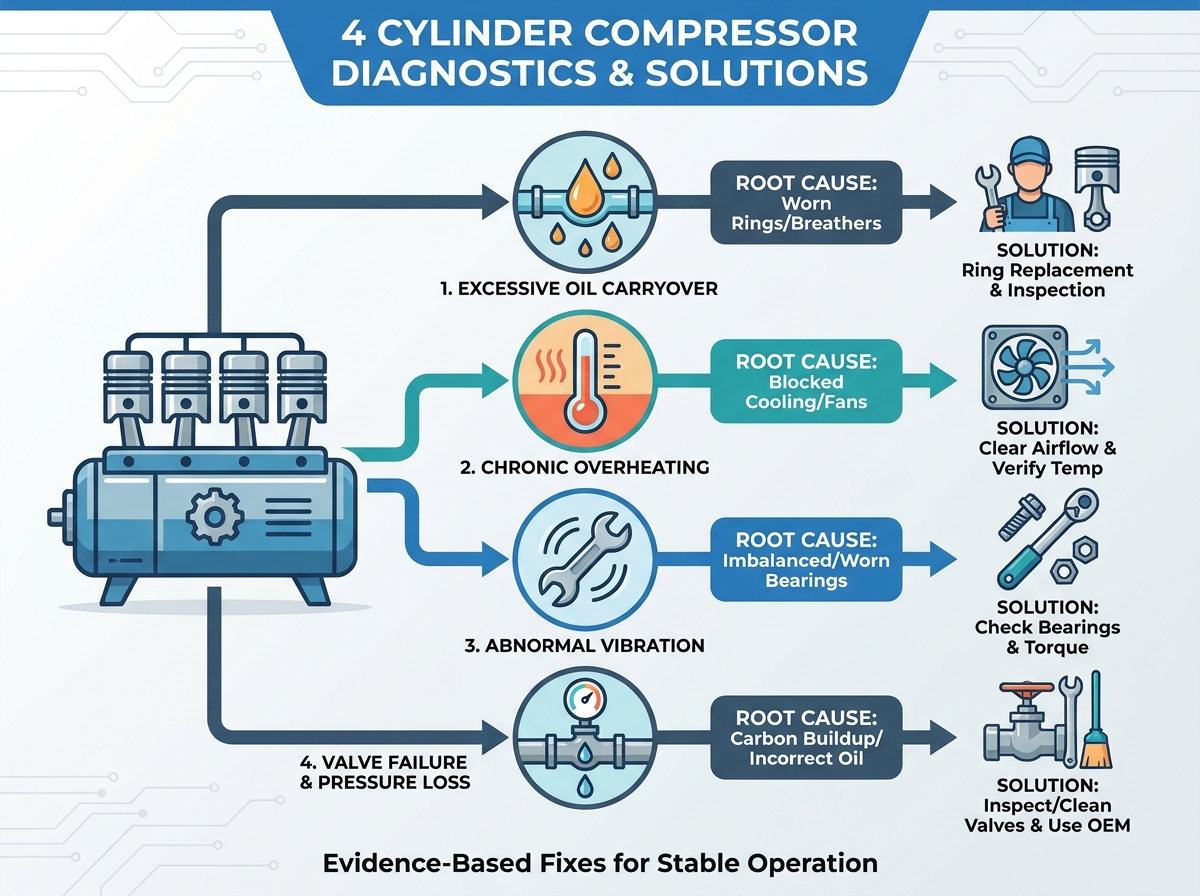
| Excessive Oil Carryover | High oil consumption, fouled lines | Worn piston rings | Inspect cylinders and replace rings |
| Chronic Overheating | Tripping thermal overloads | Blocked airflow, failed fans | Clear ventilation pathways |
| Abnormal Vibration | Metallic knocking, floor shaking | Worn rod bearings, loose bolts | Emergency shutdown, re-torque bolts |
| Valve Failure | Inability to build pressure | Carbon buildup on reed valves | Clean or replace valve assemblies |
Oil carryover is a frustrating and costly issue. Operators usually notice this problem when oil consumption spikes unexpectedly. You might find yourself topping off the crankcase every few days. Downstream symptoms include heavily contaminated air lines and fouled pneumatic tools. In worst-case scenarios, oil mist sprays directly from exhaust ports.
The root cause analysis almost always points to internal wear. Worn piston rings allow crankcase oil to bypass the combustion chamber. Scored cylinder walls create gaps where oil escapes into the air stream. Additionally, degraded crankcase breathers fail to separate oil vapor properly. When breathers clog, internal pressure forces oil past the seals.
Intervention requires a systematic teardown. You must remove the cylinder heads to inspect the cylinder walls. If the walls show deep scoring, honing or replacing the sleeves becomes necessary. Replacing the piston rings is standard procedure during this teardown. Ignoring oil contamination carries severe operational risks. In sectors like food processing or automotive painting, trace amounts of oil will ruin entire product batches. Clean air is not optional; it is a strict quality control requirement.
Heat is the primary enemy of industrial machinery. Symptoms of overheating are usually obvious. The machine will repeatedly trip its thermal overload switches. Maintenance staff might observe discolored, heat-warped valve plates during inspections. Unusually hot discharge air is another dead giveaway. If the air piping feels dangerously hot to the touch, you have a thermal crisis.
Root causes vary, but they all relate to poor heat dissipation. Blocked intercoolers prevent multi-stage units from cooling air between compression cycles. Failed cooling fans strip the machine of its primary defense against ambient heat. Restrictive exhaust ventilation traps hot air inside the compressor room. Finally, running the unit continuously beyond its rated duty cycle guarantees thermal overload.
Intervention starts with restoring airflow. Clear all pathways around the machine. Use compressed air to blow dust out of the cooling fins and intercoolers. Verify the ambient facility temperatures. If the compressor room exceeds 100°F (38°C), install dedicated exhaust fans. You must also assess plant demands. If the compressor never stops running, it is likely undersized for your current facility needs.
Compressors naturally vibrate, but abnormal shaking demands immediate attention. Symptoms include heavy floor vibration transferring through the concrete slab. You might hear distinct metallic knocking sounds keeping pace with the motor RPM. Routine inspections often reveal loose mounting hardware or cracked brackets.
The root causes are highly destructive if left alone. Imbalanced flywheels create eccentric forces. Worn connecting rod bearings allow the pistons to slam against the crankshaft. Uneven foundation mounting causes the frame to flex during operation. This flexing fatigues the metal over time.
We recommend immediate shutdown when you hear mechanical knocking. Continuing to run the machine invites catastrophic rod failure. A snapped connecting rod will punch a hole straight through the crankcase block. Detail a technician to check bearing tolerances against OEM specifications. You must also re-torque all anchor bolts. Ensure the foundation uses properly rated isolation pads to dampen normal operational frequencies.
Pressure loss paralyzes pneumatic operations. The most common symptom is the inability to build tank pressure. The compressor runs endlessly but the gauge barely moves. You will notice incredibly slow recovery times after air usage. Sometimes, you can actually hear air leaking back through the intake filter after shutdown.
Root cause analysis points to the valve assemblies. Carbon buildup on reed or concentric valves prevents them from seating properly. When valves do not seal, compressed air gets pushed back and forth uselessly. This carbon coking often occurs due to using incorrect or severely degraded lubricating oil. Cheap mineral oils break down fast under high heat.
To intervene, you need a clear framework for inspecting the head. Remove the valve plates carefully. Clean them using an approved industrial solvent. If the reed valves look cracked or warped, replacement is mandatory. Never attempt to bend a warped valve back into shape. Always highlight the importance of using OEM or highly rated aftermarket components. High-quality valves ensure longevity and prevent sudden pressure drops.
When facing a major breakdown, facilities must decide whether to rebuild or replace. Making this decision based solely on emotion or frustration leads to wasted capital. You need a quantifiable evaluation framework.
We introduce the 50% Rule as an industry-standard metric. Calculate the total cost of the proposed repair. This includes parts, labor, and emergency service fees. Next, quote the replacement value of a comparable 4 cylinder compressor. If the repair cost exceeds 50% of the new unit's price, replacement is generally the safer commercial bet. Pouring heavy funds into an aging machine rarely yields a good return on investment.
You must also analyze efficiency deficits. Aging units lose their volumetric efficiency over time. They consume more electricity to produce less air. Compare the energy consumption of your current unit against modern alternatives. High-efficiency replacements often feature variable speed drive (VSD) integrations. A VSD unit matches energy consumption to actual air demand, saving thousands annually on utility bills.
Consider the risk of obsolescence. Sourcing legacy parts for older multi-cylinder units becomes increasingly difficult. If the manufacturer no longer supports your model, you are at the mercy of secondary markets. Waiting weeks for a refurbished crankshaft is unacceptable for a primary production facility.
Finally, utilize downtime calculus. Frame the decision strictly around equipment lead times. A comprehensive rebuild might take three weeks. Conversely, a new unit could be delivered and installed in three days. You must factor the lost production revenue into your overall financial assessment. Often, the revenue saved by faster installation justifies the higher capital expense of buying new.
If you decide to upgrade, seamless implementation requires proactive planning. You cannot simply drop a new machine into the old spot without verifying facility readiness. Modern equipment evaluation spans three critical dimensions.
First, check footprint requirements. Newer, enclosed rotary or high-efficiency piston units might have different dimensions. Ensure maintenance teams have adequate clearance to access service panels. Second, verify electrical panel capacity. Upgrading to a larger motor requires verifying breaker sizes, wire gauges, and starter capacities. Third, evaluate ventilation adequacy. A more powerful machine rejects more heat into the room. You may need to upgrade the room's ductwork or exhaust fans.
Scalability is another crucial factor. Evaluate your future CFM demands accurately. Speak with your production managers about upcoming facility expansions. You do not want a scenario where the facility outgrows a newly replaced system within 12 to 24 months. Buying a slightly oversized unit with VSD capabilities offers a buffer for future growth without wasting energy today.
Do not overlook compliance and safety. During major overhauls or new installations, emphasize strict adherence to local regulations. Ensure the new setup meets OSHA noise standards. High-decibel environments require sound-attenuating enclosures. Furthermore, adhere strictly to ASME pressure vessel guidelines. Ensure all receiver tanks and safety relief valves possess current certifications and inspections.
Partnering with the right vendor dictates the success of your air system strategy. Do not choose a service provider based solely on the lowest hourly rate. You need specific vendor vetting logic to ensure reliability.
Look for authorized dealer status. Authorized dealers have direct access to OEM parts, technical support, and factory training. Ask about emergency response times. A vendor who guarantees a four-hour response time is infinitely more valuable than one who cannot arrive until next week. Investigate the availability of loaner units. Good vendors will provide a temporary rental unit to keep your plant running while they rebuild your primary machine.
Beware of common warranty traps. Advise your purchasing team to remain skeptical regarding "lifetime" warranties. Read the fine print carefully. Teach your team to look for transparent terms regarding wear items. Belts, filters, and valves are almost never covered. Furthermore, look out for mandatory service intervals. Some warranties become void instantly if you fail to use the vendor's proprietary (and often expensive) lubricating oil.
Take actionable next steps before making your first phone call. Guide your maintenance team to log the unit's current performance metrics. Record cycle times, operating temperatures, and daily oil usage. Providing accurate historical data to service technicians or sales engineers drastically improves the quality of their consultation. Data-driven conversations lead to better equipment sizing and faster diagnostics.
Diagnosing heavy-duty air systems requires a calm, systematic approach. Prioritize safety above all else. Never ignore warning signs like heavy vibration or excessive heat. Identify the root cause systematically rather than just swapping parts blindly. Most importantly, calculate the true financial impact of downtime before committing to a major rebuild.
We cannot overstate the value of routine care. Proactive maintenance of a 4 cylinder compressor is always more cost-effective than reactive emergency repairs. Clean your coolers, change your oil on time, and listen to the machine daily. Small investments in preventative care prevent massive capital losses later.
Take control of your facility's pneumatic reliability today. Download a comprehensive diagnostic checklist for your maintenance team. Request a system energy audit from a certified professional. Contact an authorized technician immediately if your system currently exhibits any symptoms of thermal overload or mechanical knocking.
A: Normal discharge temperatures typically range between 250°F and 300°F (121°C to 149°C). However, standard baselines vary by brand and cooling method. Air-cooled units run hotter than water-cooled systems. If discharge temps exceed 350°F (176°C), the oil begins to break down. Always consult your specific OEM manual for precise thermal limits.
A: Mineral oils usually require changing every 500 to 1,000 operating hours. Synthetic oils perform much better, often lasting between 4,000 and 8,000 hours. High ambient temperatures and extreme duty cycles degrade oil faster. You should sample and test the oil regularly. Change it sooner if it appears milky or smells burnt.
A: Technicians can usually replace worn piston rings on-site. This field service capability saves significant transportation time. However, if the cylinder walls require heavy machining or honing due to deep scoring, a complete shop teardown might be necessary. A skilled technician will gauge the cylinder wear during initial inspection.
A: Slow recovery times typically point to internal compression losses. Carbon-fouled reed valves failing to seat properly are the primary suspects. Worn piston rings also allow air to bypass into the crankcase. Finally, major air leaks in your downstream piping system will simulate poor compressor performance. Check valves and leaks first.
A: Aftermarket parts offer tempting cost savings but carry variable quality control. Using aftermarket components for structural items like connecting rods or crankshafts is risky. It can also void active manufacturer warranties. For critical internals, OEM parts are safer. Aftermarket options are more acceptable for non-critical items like external air filters.