
Call Us
+86-18072289720
- All
- Product Name
- Product Keyword
- Product Model
- Product Summary
- Product Description
- Multi Field Search

Views: 0 Author: Site Editor Publish Time: 2026-04-05 Origin: Site


Ask what is inside a compressor and you will usually get an answer about a household refrigerator: a welded steel dome, an aluminium-wound motor, no serviceable parts, and a repair decision that resolves to "replace the unit". That description is accurate for an appliance and useless for a plant room.
The machines we build at Blait (Zhejiang Briliant Refrigeration Equipment Co., Ltd.) are semi-hermetic. Semi-hermetic means one specific thing that changes every downstream decision: the shell is bolted, not welded. The motor and the compression mechanism sit in the same sealed refrigerant volume, so there is no shaft seal to leak, but every cover comes off with hand tools, and almost everything inside is a part we keep in stock.
That single design choice is why the anatomy matters commercially. On a welded machine you buy a consumable. On a bolted machine you buy a rebuildable asset, and the person who understands what is inside will spend a fraction of what the person who does not will spend over the same ten years.
A semi-hermetic shell is bolted: the head cover, the cylinder head and the end covers all come off, so a worn internal part is a parts order rather than a machine replacement.
The valve plate is the intended wear item. It is a stocked spare, not a diagnosis of a dead compressor.
The motor is cooled by the gas it is about to compress, which is why a system that returns liquid, loses charge or runs a dirty condenser attacks the motor from the inside.
Oil is a component, not a consumable: its type is fixed by the refrigerant, its level is visible on the sight glass, and its condition decides whether the bearings or the windings fail first.
Rotalock joints and service valves are the boundary between the machine and your system, and they are where almost all diagnostic evidence is taken.
What is inside changes with the duty: a medium-temperature frame and a low-temperature two-stage frame are not the same machine with a different sticker.
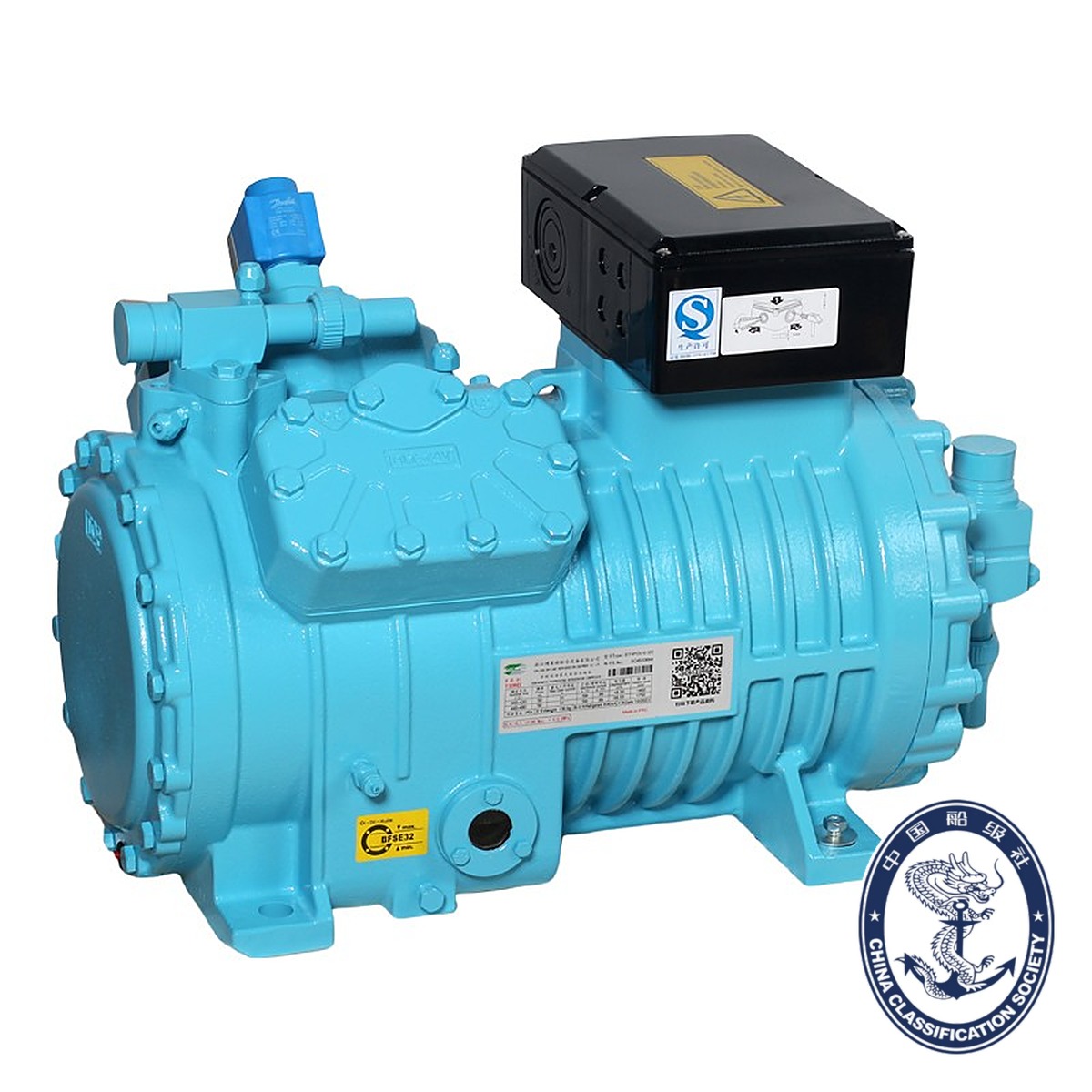
A T-Series frame as it arrives: bolted cylinder head cover, terminal box over the motor, oil sight glass low on the crankcase, rotalock ports and mounting feet. Everything you can see here is serviceable with hand tools.
Look at the outside and you can already read the internal layout: the cylinder head at the top with its bolt circle, the crankcase body with the sight glass low on the side, the terminal box on top of the motor, the rotalock connections at the suction and discharge ports, and the mounting feet at the base.
Three consequences follow from the bolted shell:
No shaft seal. An open-drive compressor leaves the shaft to find its way out of the crankcase and needs a mechanical seal, which is a wear item and a leak point. A semi-hermetic puts the motor inside the same envelope as the crank mechanism, so the only paths for refrigerant are gasketed joints and the service valves.
The motor runs in refrigerant gas and is bathed in oil. That is a benefit and a constraint at the same time. It never ingests dust, and it never needs a separate fan. But anything you put into the circuit - moisture, acid, varnish, metal debris - is also touching the windings.
Every wear surface is reachable. Head bolts, gaskets, valve plates, pistons, rings, bearings, the oil pump on frames that have one, and the motor itself can all be replaced. This is the whole argument for our spare parts range: the machine is designed to be opened more than once in its life.
Our reciprocating machines use three-phase induction motors, typically 380-420 V, 3 phase, 50 Hz, with a double-star winding connection on the T-Series frames. The motor is cooled by suction gas: returning low-pressure gas passes over the windings before it is drawn into the cylinders, so the machine's own intake air is its coolant.
Copper winding is the standard build. The copper-versus-aluminium debate you will read about belongs to appliance procurement, where a few cents of conductor per motor decides a margin; on a 4.4 to 15 kW industrial frame the failure modes that actually matter are thermal and chemical, not conductor cost:
Moisture in the circuit, which attacks insulation and, with refrigerant and oil, forms acid.
Acid, which eats varnish and eventually the winding insulation, usually after a burnout that was itself caused by something else.
Voltage imbalance and single-phasing, which overheat one leg while the overload relay watches the others.
Loss of suction gas cooling, from a low charge, a frosted evaporator or an oversized expansion valve, which starves the motor of the cool gas it depends on.
High discharge temperature, which cooks the oil before it cooks the winding, and then the winding goes because the oil stopped doing its job.
The protection devices around the motor are part of the same parts range: motor protection modules, discharge temperature sensors and crankcase heaters. If you want the test sequence for a machine that will not start or will not stay running, it is in How to Check a Refrigeration Compressor Step by Step.
Inside the crankcase: a crankshaft, one connecting rod per cylinder, and a piston in a bore. Rotating motion becomes reciprocating motion, and the geometry of that conversion decides how much gas the machine moves.
On the T-Series four-cylinder frames the internal design work concentrates on exactly these surfaces:
Hardened cylinder bore, so the wall the piston rides against does not wear into ovality, which is how a machine slowly loses compression and starts sending oil with it.
Lightweight piston with a thinner oil ring and reduced clearance volume, which cuts the re-expansion loss of gas trapped in the head space at the end of the stroke. Less trapped gas re-expanding means more fresh gas drawn in, which is where the efficiency comes from.
Upgraded bearings, because the seizure that ends a machine usually starts at a bearing surface that lost its oil film.
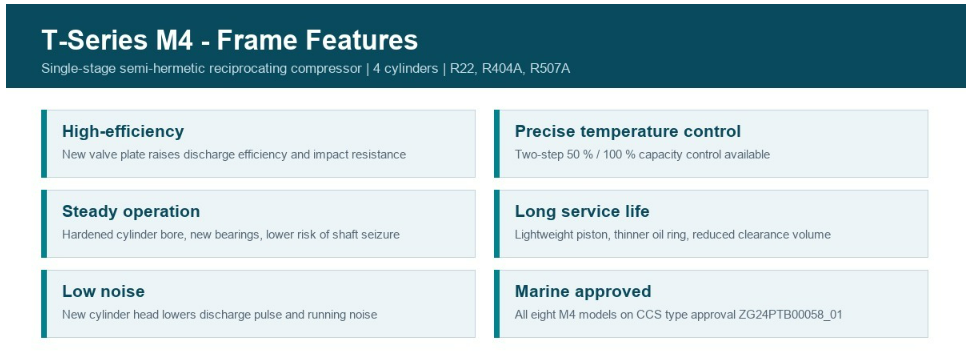
What the current T-Series four-cylinder frame changed inside: a new valve plate for discharge efficiency and impact resistance, a hardened bore, upgraded bearings, a lighter piston with a thinner oil ring, and a cylinder head that runs quieter.
At the top of each cylinder sits the valve plate: a flat assembly carrying thin spring-steel reeds and lift restrictors, with separate suction and discharge paths. On the downstroke the piston pulls the cylinder below suction pressure and the suction reed lifts. On the upstroke the reed snaps shut, the gas compresses, and once cylinder pressure exceeds discharge pressure the discharge reed lifts.
This is the highest-stress component in the machine and the only one engineered to be a consumable. It flexes at line frequency, thousands of cycles per minute, and it is the first casualty of two specific events:
Liquid slugging. Liquid is incompressible. When liquid refrigerant or a flood of oil-filled gas arrives at the suction port, the piston tries to compress something that will not compress, and the energy goes into the reed. Bent, cracked or missing reed segments are the signature.
Sustained high discharge temperature, which hardens the oil into varnish on the plate, so the reed stops seating cleanly and starts hammering.
A valve plate that has lost its seal produces a very recognisable pattern: the machine still runs, still draws current, still pumps - but the suction pressure sits high, the discharge pressure sits low, the head is warm rather than hot, and the box never reaches temperature. Nothing electrical is wrong. The compression has simply leaked back through the plate on every stroke.
This is why we stock valve plate replacement parts and the matching paper gasket seals as ordinary line items. On a bolted machine this is a parts order and an afternoon, not a replacement quote.
Oil sits in the crankcase sump and does four jobs at once: it carries the bearing film, it seals the piston rings, it cools, and it transports heat out of the machine. It is also the only internal part you can inspect without opening anything.
The oil type is fixed by the refrigerant, not by preference. Our HFC machines on R404A, R507A and R134a duty run ester oil; R22 machines run mineral or alkylbenzene grades; the subcritical CO2 frames run their own specified ester. Put the wrong oil in and you get a machine that runs for weeks before it fails, which is the worst possible failure pattern because the install looks fine at handover.
The feed arrangement depends on the frame and the build. Smaller frames rely on splash and thrower lubrication from the crankshaft. Larger frames, and builds specified for capacity regulation, carry an oil pump and an energy control valve, and those machines also need the oil differential pressure to be correct before they will run happily. Whether your machine has a pump is marked on the nameplate and confirmed by the serial number, and the pump itself is a stocked item.
What to look at through the glass. The level should sit at the marked line and stay there. Oil that fizzes or foams after start-up means liquid refrigerant is coming back and dissolving into the sump, which strips the bearing film within minutes of that machine starting. Oil that has turned dark or milky is telling you about acid or moisture. A machine that runs with a steady low film is telling you about oil retention somewhere else in the circuit.
We supply the monitoring around the oil as well: crankcase heaters, photoelectric oil level switches and oil differential switches all sit in the accessory range. On the T-Series four-cylinder frames the crankcase holds 2.6 litres and the heater is 120 watts, and the heater has to be on before the machine is allowed to start, not after.
Everything above is inside the machine. This is where the machine stops being a component and becomes part of a system, and it is the part of the anatomy a purchaser usually never sees quoted.
The suction and discharge connections are ported into the head and the crankcase, and on our frames they carry rotalock joints: a threaded collar and a flexible washer that lets you make and break the connection without unsoldering the pipe run. Bolted to those ports sit the service valves, and they do three jobs at once: isolate the machine so it can be removed or opened, carry the gauge ports where every diagnosis starts, and set the pressure drop the machine has to work against.
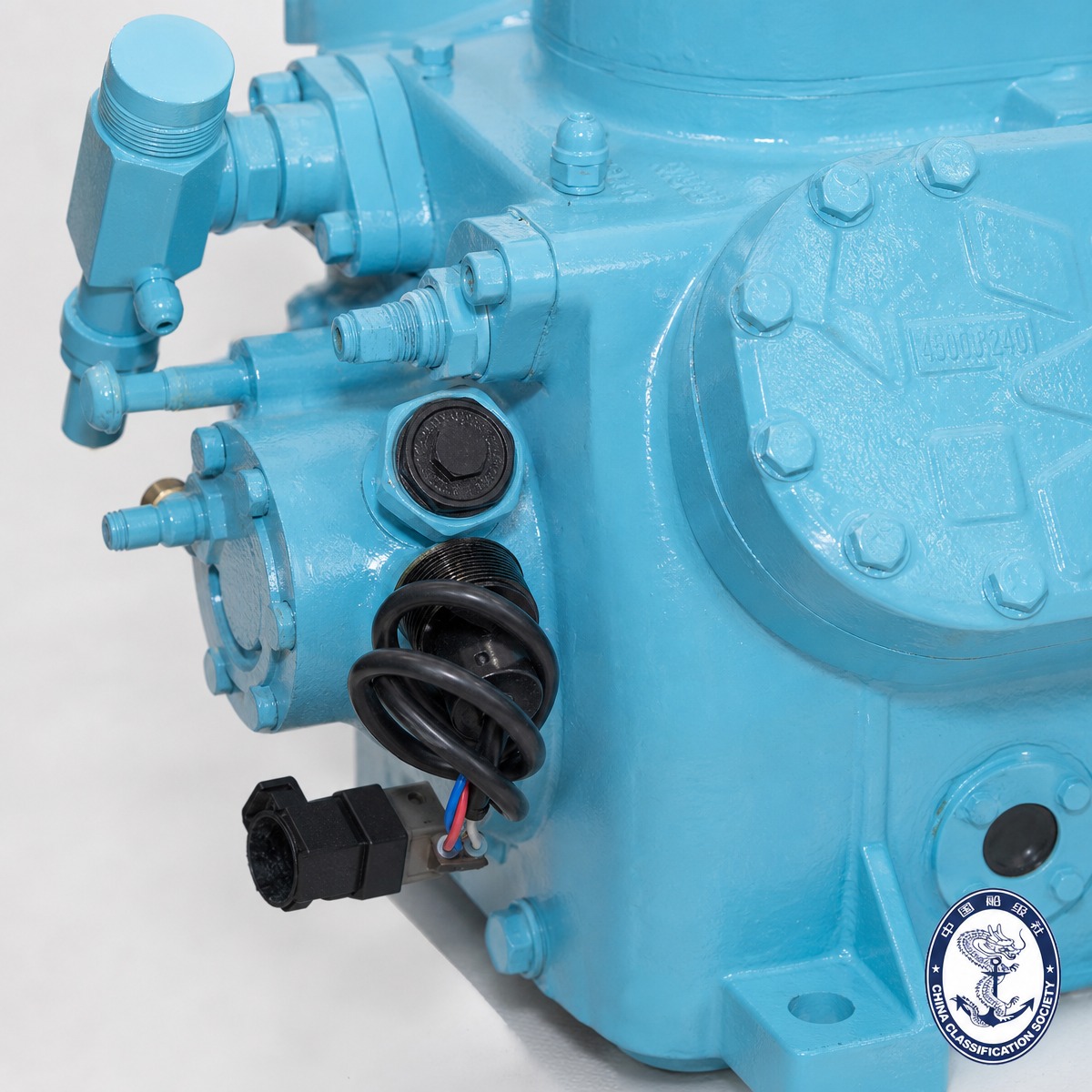
A rotalock joint, the gauge port nipples and a sensor with its cable and plug, shown as fitted on the six-cylinder frame. Every gauge connection you will use comes off these ports, and they decide how much pressure the machine has to work against.
Our J2BS shut-off valves are cast iron, rated 4.5 MPa, working from -30C to +150C on R22, R404A and R507A, and matched to the port sizes on our frames. On the pipe side we build steel rotalock shut-off valves, cast steel angle stop valves for ammonia and freon service, J64F angle globe valves, flanged globe valves for screw machines and brass service ball valves.
The commercial point is simple: a compressor quoted without its valves is quoted incomplete. The port size on the machine is the size the valve should be, and a valve one size small is a permanent tax on every kilowatt the machine draws.
A machine destined for a +5C cold room and a machine destined for a -40C blast freezer are not the same product. As evaporating pressure falls, the suction gas gets thinner, so the machine sweeps a larger volume to move the same mass, and the compression ratio climbs.
Two internal responses matter:
Stage splitting. Above roughly a ratio of eight to one, single-stage operation pushes discharge temperature past what the oil will tolerate. That is the reason two-stage frames exist: the gas is compressed part way, cooled, and compressed again, so each stage works within a sane ratio. Our low-temperature two-stage models, such as the YBF6F-30.2DS, are built for exactly this corner of the map.
Liquid injection. At the cold end of the operating range an electronic liquid-injection controller is required to hold discharge temperature inside limits. We build and stock those controllers as part of the same accessory range as the heaters and sensors, which is the practical reason we would rather supply the machine and its regulation together than have a controller guessed at on site.
Anatomy is only half the procurement question. The other half is what the manufacturer did to that specific serial number before it was crated:
Each unit is run on the test bench before packing, so the machine you receive has already proven its oil pressure, its noise, its vibration and its valve behaviour under load.
The shell is leak tested with the service valves and rotalock joints fitted, which is the joint set most likely to weep in year three if it is assembled and torqued carelessly.
The crankcase arrives charged with the correct oil grade for the specified refrigerant, at the correct level, with the heater connected per the wiring diagram on the terminal box.
The nameplate carries the model, the refrigerant, the motor data and the allowable low-side and high-side pressures, and the serial number lets us pull the build record years later.
Frames destined for marine duty carry CCS type approval, with all eight ester-oil variants of the T-Series four-cylinder line on the certificate.
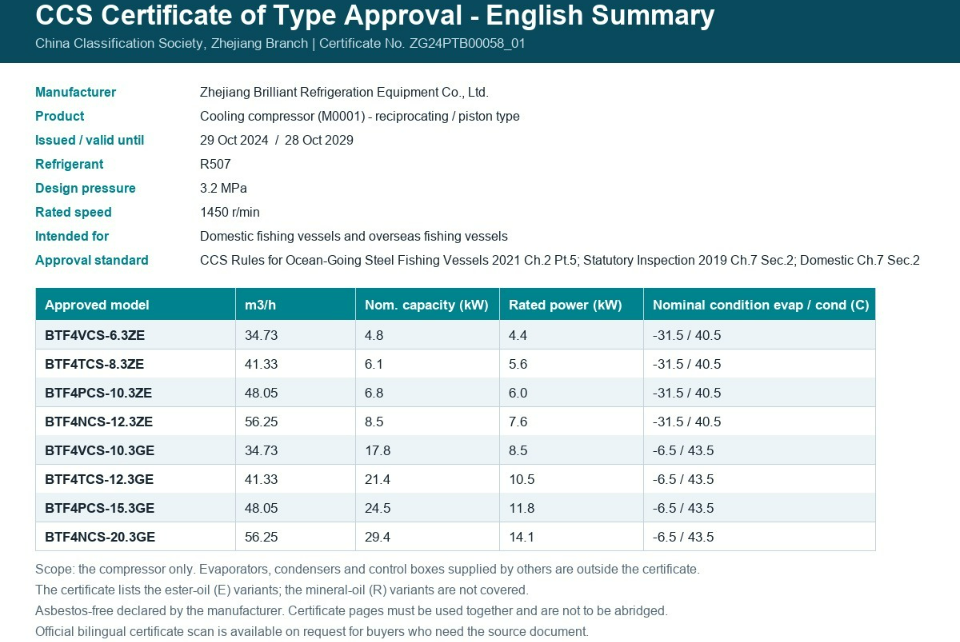
The marine side of the record: one CCS type approval covering all eight ester-oil variants of the T-Series four-cylinder line, on R507 at 3.2 MPa design pressure, issued 29 October 2024 and valid to 28 October 2029.
| Cause | What it does inside | What prevents it |
|---|---|---|
| Liquid return and slugging | Bends valve plate reeds, washes the bearings, dilutes oil | Correct superheat, proper refrigerant charge control, crankcase heater energised before start |
| Sustained high discharge temperature | Varnishes oil, embrittles reeds, acidifies the circuit | Right stage selection, clean condenser, liquid injection at the low-temperature corner |
| Moisture in the circuit | Acid formation, copper plating, insulation attack | Proper evacuation, driers in service, filter changes on schedule |
| Voltage imbalance and single-phasing | Overheats one leg, kills the winding | Supply measured at commissioning, protection module wired in |
| Restricted or wrong-size valves and piping | Raises the ratio the machine must work at, permanently | Port-size matched valves, full-bore isolation, rotalock joints torqued correctly |
| Extended operation at low load with short cycling | Overheats suction gas, destroys the oil film in stop-start duty | Correct machine sizing, minimum run logic, one machine per pull-down duty rather than one oversized unit |
| Part | What it does | When you need it |
|---|---|---|
| Valve plate replacement part | Seals suction and discharge per stroke | Capacity loss with healthy electricals |
| Paper gasket seal set | Seals every bolted joint on the shell | Any time a cover comes off |
| Oil pump spare part | Feeds the bearings on pumped frames | Low or unstable oil differential pressure |
| Cold storage spare part range | Fasteners, covers and wear items | Planned overhaul kits |
| J2BS service valve | Isolates the machine, carries gauge ports | Weeping joint, seized cap, new installation |
| 24 V solenoid coil | Opens and closes the liquid line | Machine runs but the system never pumps down |
Hermetic means the shell is welded shut, so the internal parts are not intended to be reached and a failure ends the machine. Semi-hermetic means the motor and crank mechanism share a sealed bolted envelope: there is no shaft seal to leak, but the covers come off and the internal parts are replaceable. Every reciprocating machine we build is semi-hermetic, which is why we stock valve plates, gaskets, motors and oil pumps as ordinary spare lines.
The valve plate. Its reeds flex at line frequency on every stroke and it is the component that takes the impact when liquid arrives in the suction line. Capacity loss with a machine that is still running and still drawing current is the usual symptom, and it is a parts-and-gaskets repair on a bolted machine.Why is the motor inside the refrigerant?
To remove the shaft seal. Putting the motor in the same envelope as the crank mechanism eliminates the one rotating joint where refrigerant and oil could escape, and it lets the returning suction gas cool the windings. The trade-off is that anything you allow into the circuit, including moisture and acid, is in contact with the insulation as well.
No, and this is not a preference decision. Our HFC duty machines run ester oil, R22 machines run mineral or alkylbenzene grades, and the subcritical CO2 frames run their own specified ester. The grade is set by what the refrigerant does to the oil and what the oil does to the insulation.
Two usual reasons. Either liquid refrigerant is returning and dissolving into the sump, which makes the oil look like it is foaming and disappears the level, or oil is being carried out of the machine and trapped somewhere in the circuit without a return path. Both are system faults, and both destroy bearings.
Often yes, if the damage is limited to the valve plate and the oil was diluted rather than the winding being cooked. Replace the plate and gaskets, correct whatever let liquid back, change the oil and the drier core, and prove the insulation resistance before restarting. If the machine has already burnt out, the acid it left in the circuit will kill the replacement unless the system is flushed and dried first.
The fastest way to get the right internal part is not a photograph of the old one, it is the model code and serial number off the nameplate. With those two we can tell you which frame you have, whether it carries an oil pump, which oil grade it was charged with, and which valve plate, gasket set or service valve matches that build.
Send that, plus the refrigerant and the temperature duty, through our contact page or by phone on +86-18072289720. If the machine is already showing symptoms, the test sequence to run first is in How to Check a Refrigeration Compressor Step by Step, and the selection logic between reciprocating and screw frames is in How to Choose a Screw or Piston Refrigeration Compressor.


