
Call Us
+86-18072289720
- All
- Product Name
- Product Keyword
- Product Model
- Product Summary
- Product Description
- Multi Field Search

Views: 0 Author: Site Editor Publish Time: 2026-03-23 Origin: Site
The question "screw or piston" is copied almost word for word from the compressed air industry, where a piston machine really does have to stop and cool down between runs. That framing is useless for a refrigeration plant, and it is the reason so many buyers make an expensive choice with the wrong spreadsheet.
A refrigeration compressor does not get a rest period. A cold store, an ice cream line, a supermarket rack system or a fishing vessel hold runs between 6,000 and 8,760 hours a year, and the machine is expected to hold temperature through every one of them. Both technologies we build at Blait (Zhejiang Briliant Refrigeration Equipment Co., Ltd.) are semi-hermetic, both are rated against a cooling load at a defined pair of evaporating and condensing temperatures, and both are engineered for continuous duty at those conditions.
So the real question is not which machine is better in the abstract. It is which construction fits your temperature lift, your load profile, your refrigerant, your pressure envelope and your maintenance crew. This guide answers that with the parameters our engineers actually use when we size a plant.
Duty cycle is not the discriminator in refrigeration. Compression ratio and discharge temperature are. A single-stage machine of either type runs out of breath well below minus 30C evaporating.
Reciprocating compressors keep high volumetric efficiency at high pressure ratio, so a smaller, cheaper machine delivers the kilowatts at low temperature. That is why our low-temperature range is two-stage piston: BTF4G-12.3DS, BTF6J-16.3DS and BTF6F-30.3DS.
Screw compressors win on capacity per square metre of floor, stepless slide-valve capacity control, tolerance of liquid slugging, and lower, flatter discharge temperatures. Our single-stage screw range runs from YLG20Z-84 to YLG180G-535.
Below roughly minus 25C to minus 30C evaporating, a screw needs an economizer injection port or two stages to stay efficient. Buying a screw without the economizer connection is the most common and most expensive mistake in low-temperature projects.
Above about 400 kW of duty, screw construction stops being an option and becomes the default for the base load, with staged piston units behind it.
The component that decides how painful your plant is to service is not the compressor. It is the service valves on its suction and discharge ports, and the pressure drop they add.
A semi-hermetic piston refrigeration compressor traps a fixed volume of suction vapour in the cylinder and squeezes it between the piston crown and the valve plate. The reed valves in the cylinder head do the metering, and they are the part that ages: at 1,450 rpm each valve lip flexes roughly 24 times a second, and it is flexing against whatever the gas carries with it.
That is the whole story of piston maintenance. Oil carbonisation from sustained high discharge temperature stiffens the valve lips, they lose their seal, compression leaks back into the cylinder on the next stroke, and capacity falls before anything actually breaks. Our third-generation T-Series addresses exactly this path: an optimised compressor body, an advanced cylinder head, an improved valve plate and reinforced bearings, which is why the range is specified for reliable performance under continuous workload rather than intermittent use.
The structural advantage is equally real. Because the cylinder is filled from a fixed volume, volumetric efficiency stays high as the pressure ratio climbs. At a hard working condition, a four-cylinder machine delivers more of its theoretical swept volume as real cooling capacity than a screw of the same footprint, which is what makes piston construction the economical answer for low-temperature rooms and high-lift duty.
A single-stage screw refrigeration compressor has no valves to fail. Two precision-machined rotors turn inside a housing, sealed and lubricated by an injected oil film, and the compression simply continues for as long as the rotors turn. Discharge temperature is lower and far flatter across the operating map, vibration is lower, and the motor sits in the cooled gas stream rather than in the crankcase heat of a reciprocating machine.
Where a screw earns its higher first cost is control. A slide valve gives continuous capacity modulation across the working range instead of the fixed steps a piston can offer, so a plant whose load swings between a Monday-morning pull-down and a Thursday night hold load rides the demand instead of cycling against it. Our units also use a part-winding start, which cuts inrush current, and an economizer port for intermediate-stage vapour injection, which is what recovers efficiency at low evaporating temperatures.
Forget the 60-70 percent duty cycle claim you will read in air-compressor articles. In refrigeration, the boundary that ends a single-stage machine's life is the ratio between condensing and evaporating saturation pressure, because that ratio drives discharge temperature, and discharge temperature destroys oil and valve plates.
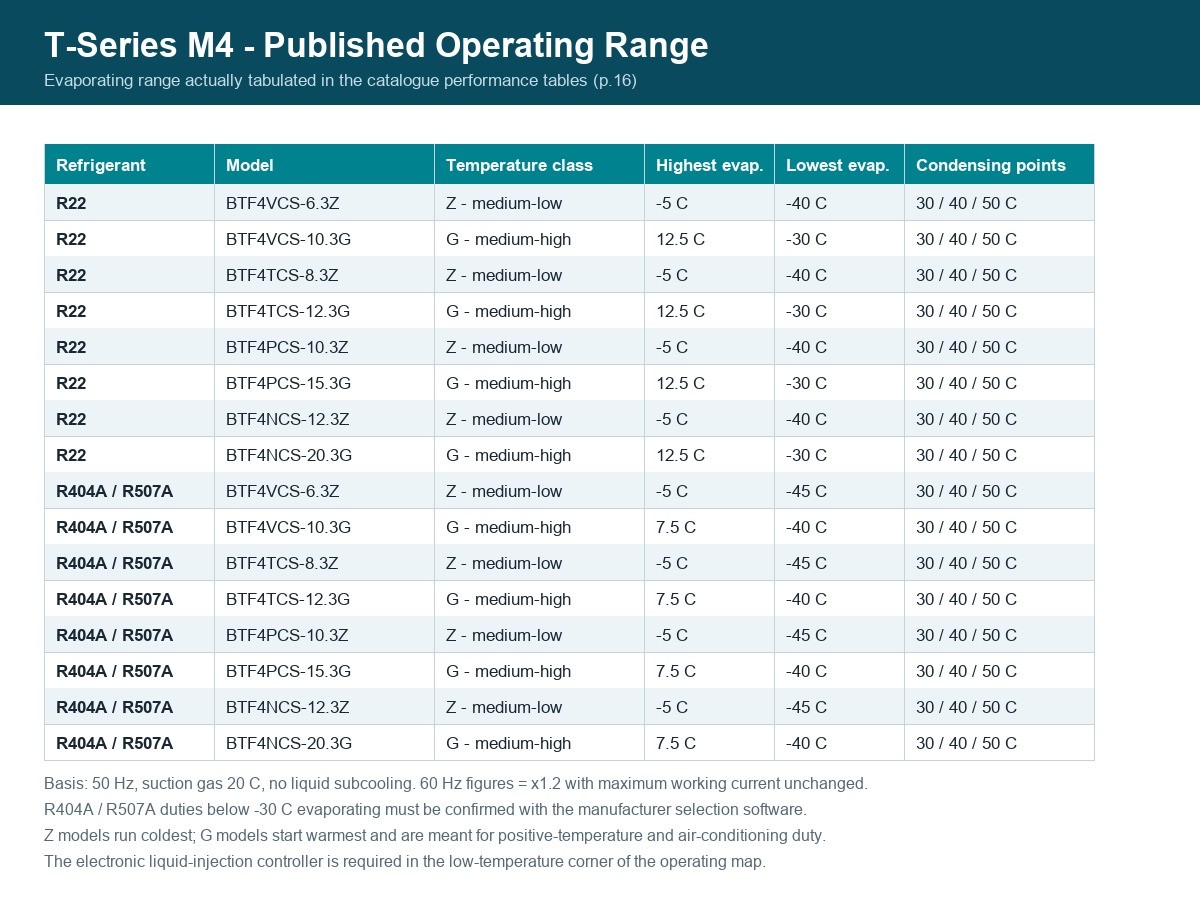
Published operating range for the T-Series M4 four-cylinder frames. The Z class reaches minus 45C evaporating on R404A and R507A; below minus 30C the duty must be confirmed against our selection software, and the low-temperature corner needs the electronic liquid-injection controller.
| Working condition | What we would specify | Representative models |
|---|---|---|
| Plus 5C to minus 10C evaporating, medium temperature cold room, fresh produce, beverage cooling | Single-stage piston, single screw for larger plants | BTF2FC-2.3Z through BTF6F-50.3G, YLG series |
| Minus 15C to minus 25C evaporating, frozen storage, dairy, ice cream hardening | Single-stage with care, or two-stage piston, or economized screw | YBF4TCS-8.2ZR, YBF6F-30.2DS, YLG with economizer |
| Minus 30C to minus 45C evaporating, blast freezing, block ice, deep freeze | Two-stage reciprocating, or two-stage screw | BTF4G-12.3DS, BTF6J-16.3DS, BTF6F-30.3DS, two-stage screw series |
| Subcritical CO2 systems, low-GWP retrofit, supermarket central plants | Purpose-built CO2 reciprocating, not a modified HFC machine | YBFS4F-7DK to YBFS4N-30DK |
| Fishing vessel, marine refrigeration, offshore process cooling | Type-approved four or six-cylinder frames | T-Series M4 four-cylinder, T-Series six-cylinder |
Lift is the whole specification. Take the coldest evaporating temperature the room will ever see and the condensing temperature in the worst ambient the machine will ever see, not the average. Roof-mounted condensers in a summer heat wave, and a fully loaded blast chamber on its first pull-down after a door failure, are the two points that kill an under-specified selection.
As a rule of thumb our engineers use roughly 2 to 3 percent of capacity for every 1C of condensing temperature rise at high lift, which is why we would rather quote a machine with margin on the hot day than one that only looks efficient on the rating plate. Treat that as a starting estimate and confirm it against the capacity and power tables for the specific model.
Comparing displacement between a piston and a screw tells you almost nothing, because the two machines deliver wildly different fractions of their swept volume at the same condition. Compare cooling capacity in kW and power input in kW at the same evaporating and condensing pair, on the same refrigerant.
For reference, our four-cylinder T-Series M4 frames (BTF4VCS, BTF4TCS, BTF4PCS and BTF4NCS) cover 4.4 to 15 kW motor input, 34.73 to 56.25 m3/h displacement and 117 to 138 kg of weight, which puts them exactly where a screw unit would be over-built and a two-cylinder piston would be overloaded. At the other end, our YLG60G to YLG180G screw models go up to 535 HP for cold storage and food processing plants where floor area and pipe rack loads matter more than first cost.
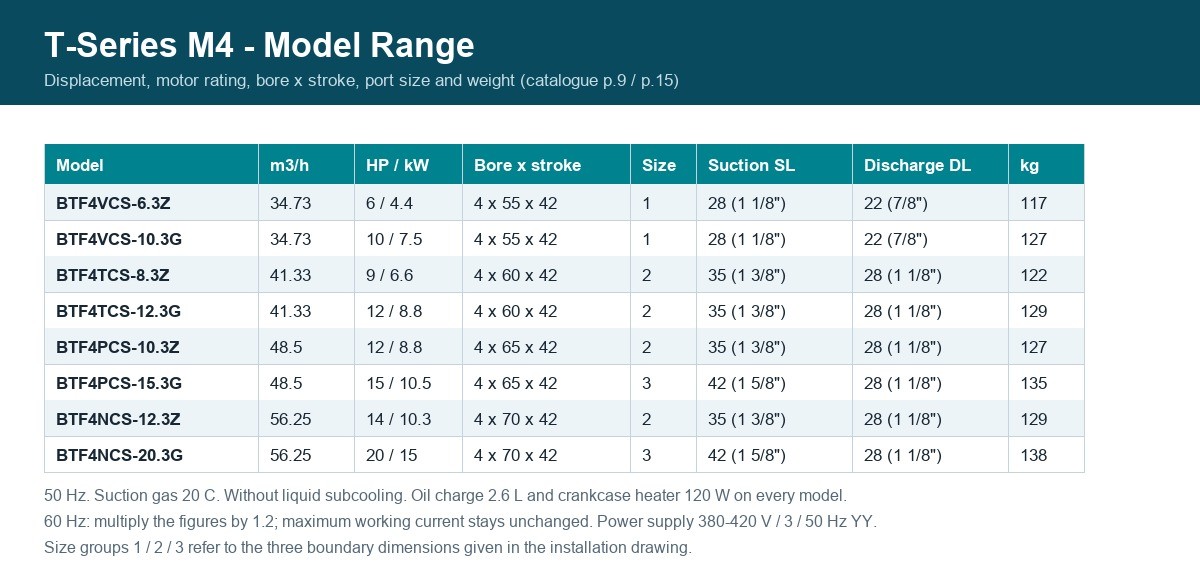
Displacement, motor rating and port sizes across the M4 range. Suction port grows from 1 1/8 inch to 1 5/8 inch between size groups, which is why the service valve follows the machine rather than the pipe run.
If the plant holds a steady temperature against a steady load, both technologies run near their design point and the piston's lower purchase price wins. If the load swings, which is what defrost cycles, staggered door openings and multi-room expansion actually produce, continuous control becomes worth paying for.
A multi-cylinder reciprocating machine reaches part load by unloading individual cylinders, so its steps are discrete: on a four-cylinder frame you get a small number of capacity plateaus. A slide-valve screw moves continuously through its modulation range, and a VFD on either machine smooths what is left. For a twenty-room distribution warehouse we specify screw base load with piston trim; for a two-room shop extension we specify two piston units staged against each other so that a service interruption on one leaves the stock cold.
Our single-stage screw range covers R22, R404A and R507A on the YLG20Z to YLG50Z models, and R134a with R407A and R407F on the YLG60G to YLG180G models, with POE150 or AB100 charge for R22 systems and POE170 for the HFC machines. The compact four-cylinder YBF4CC-6.2ZR and the rest of the YBF range sit on the same common refrigerants.
CO2 is a different machine, not a different label. Our subcritical CO2 series runs YBFS4F-7DK to YBFS4N-30DK over a minus 50C to minus 10C evaporating window with a design envelope of 3.0 MPa low side and 5.3 MPa high side, IP66 terminal protection and POE 60 lubrication. Any HFC compressor repurposed for that pressure and temperature profile will fail on the first hot summer week.
A refrigeration fitter in a regional cold store network can change a reed valve set, a strainer and lubricating oil on a piston machine in an afternoon with parts from our spares catalogue. Screw service is less frequent but more specialised: oil, oil filter, air filter and the oil separator element, normally by a trained technician, and the separator element is the part that decides whether the machine keeps its efficiency.
For a vessel that will be at sea, the calculus changes again. Our T-Series four-cylinder M4 frames hold CCS type approval under certificate ZG24PTB00058 for fishing-vessel refrigeration duty on R507, and that paperwork is the reason we specify piston construction for marine installations rather than the price. You can read the certification background in our classification society article.
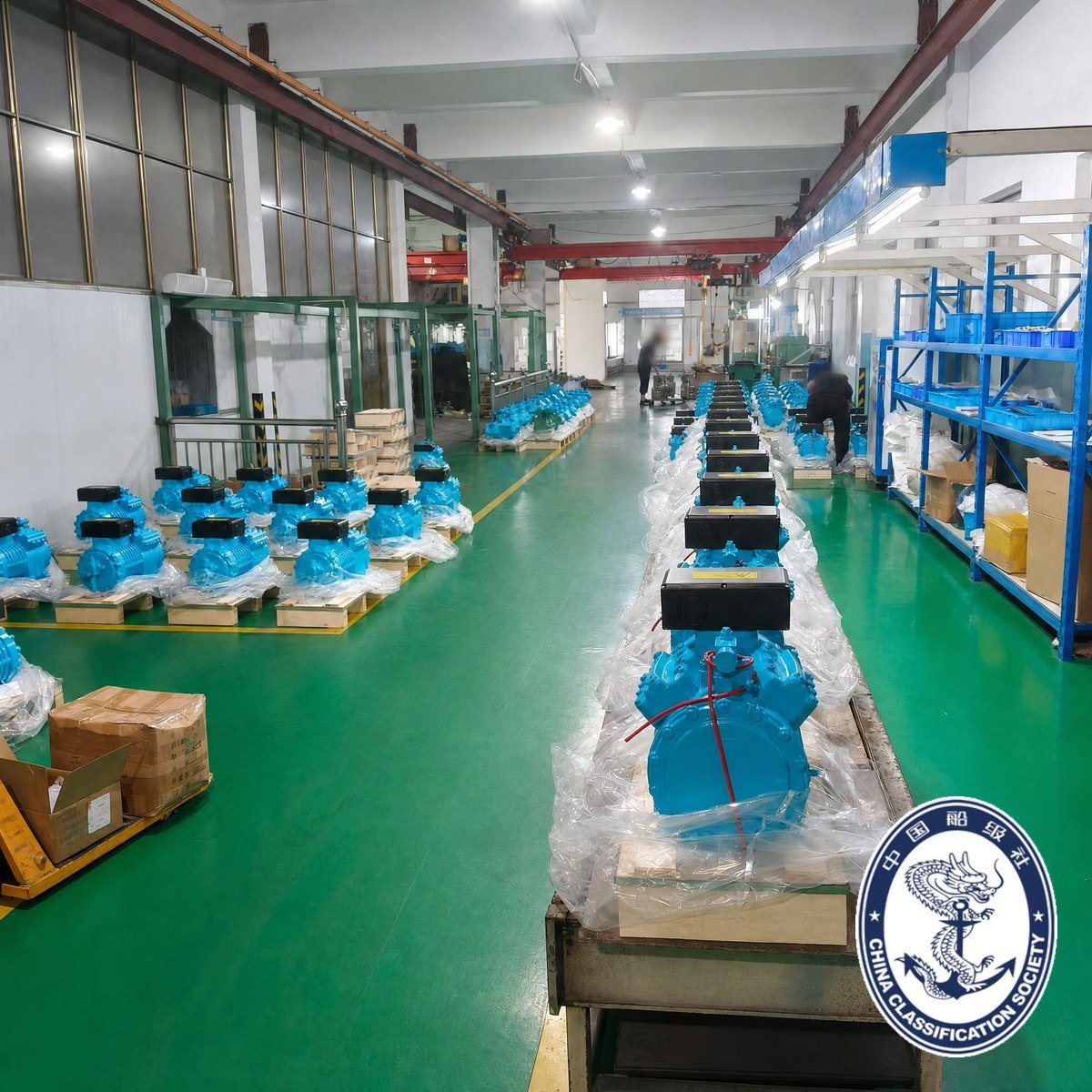
Finished semi-hermetic compressors on the assembly line at Xinchang, Zhejiang. Every unit is run-tested before packing, which is what a remote operator relying on local spares is actually buying.
Every compressor comparison stops at the machine and forgets the eleven components bolted to it. We manufacture both, which is why we treat the valve set as part of the selection rather than as a site purchase.
A reciprocating machine needs isolation at both ports so that a valve plate can be opened without pumping down or recovering the whole charge. A screw needs the same isolation, but at higher sustained flow and with a different oil return behaviour, so the port geometry matters more. Our J2BS shut-off valve for screw compressors is cast iron, rated 4.5 MPa across minus 30C to plus 150C for R22, R404A and R507A service, and sized for screw compressor ports. On the piston side we supply cast steel angle stop valves for ammonia and freon systems, ductile iron globe valves, brass service ball valves and two-step solenoid valve coils, plus check, relief, pressure maintaining and pressure regulating valves and oil temperature control valves for the balance of the circuit.
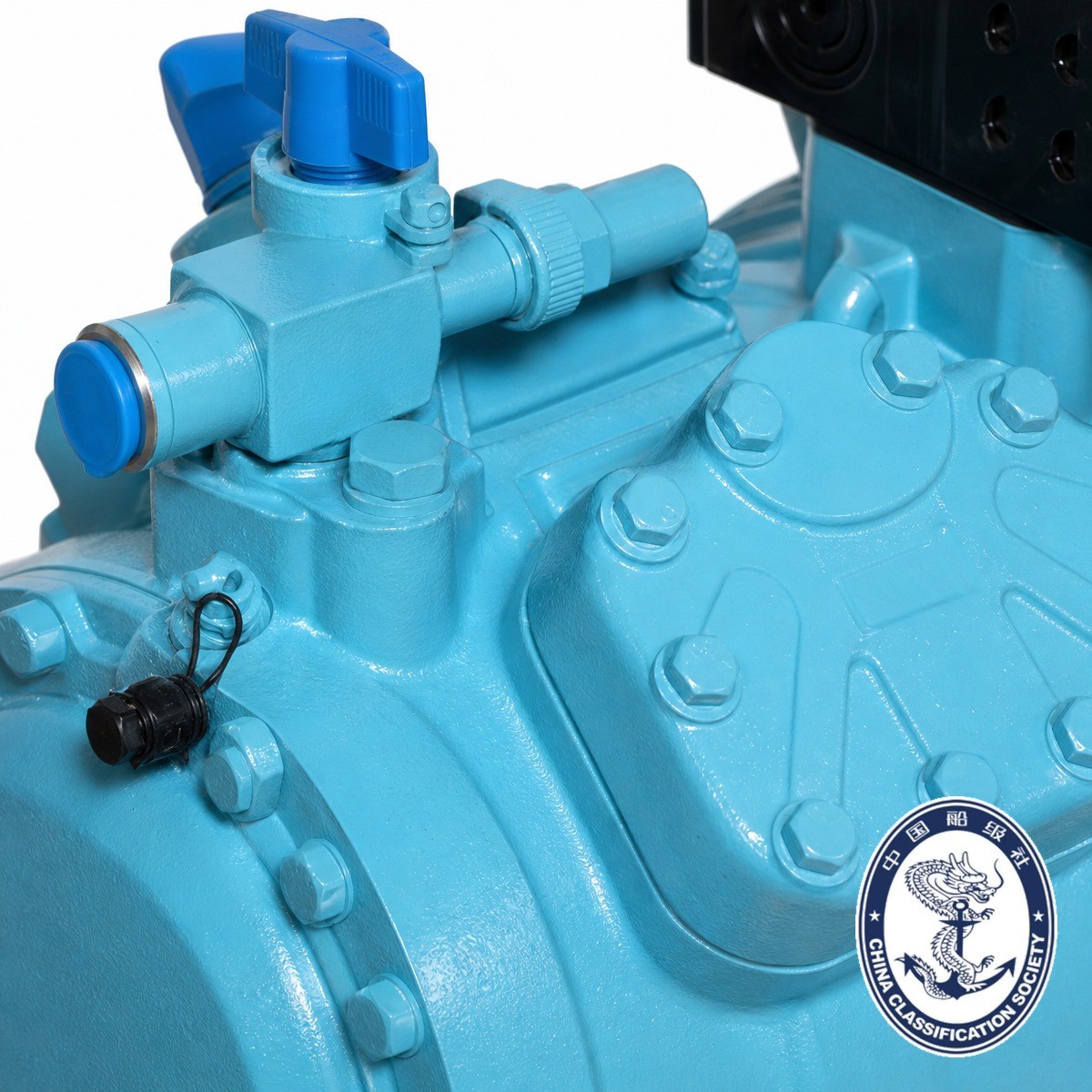
Suction and discharge service valves and a rotalock joint on a production M4 machine. This interface decides whether a valve plate service takes an afternoon or a weekend.
Three consequences for your decision:
Pressure drop on the suction side is paid for in kilowatts for the life of the plant. A valve or strainer one size too small, or a line routed to favour the plumber rather than the refrigeration engineer, raises the saturation pressure the compressor must work against. Check published pressure drop against flow, never thread size alone.
A piston plant vibrates. That is not a defect, it is reciprocating mechanics, and it is why we fit TR series rotalock valve joints rated 4.5 MPa from minus 40C to plus 150C at the machine connections and flexible connectors in the pipe run. A screw plant is quieter and gentler on joints, which reduces, but does not remove, that requirement.
The CO2 and low-temperature machines need valve sets whose pressure and temperature rating matches the envelope, not the refrigerant name on the drum. Our valve range is built to the 4.5 MPa class for exactly this reason.
Online comparisons like to publish a five-year table with invented dollar figures. The honest version is a method, because the answer genuinely flips with your annual operating hours.
Energy cost is the sum, over each load band, of the hours spent in that band multiplied by the power input at that band. You get power input from the capacity and power tables at your own evaporating and condensing pair, and you get the load profile from the room. Three inputs, and no made-up numbers:
Annual operating hours. A plant below roughly 2,000 hours a year, such as a seasonal produce store or a workshop, almost never repays a screw's price premium. A plant above 6,000 hours, which is any distribution cold store, will.
Part-load shape. Where the plant spends most of its year at 50 to 70 percent of design, continuous slide-valve control on a screw usually beats a fixed-speed piston on annual kilowatt-hours even when the piston looks better at full load.
Maintenance and downtime. Piston wear parts are cheaper and fit for in-house work; screw separator elements cost more and are changed less often. Add the value of an hour of warm room, because on a loaded warehouse that dwarfs both.
Do the arithmetic once with our selection software or your own spreadsheet at your real conditions, and the ranking will usually be obvious. Where it is close, buy the machine your local crew can service.
Specifying a single-stage machine at minus 40C evaporating because the capacity table on the datasheet happens to reach that column. It reaches it, and the discharge temperature will not stay legal. Go two-stage, as with our BTF6F-30.3DS, or economized screw.
Ordering a screw without the economizer connection because it was cheaper, then running it at low temperature and paying the difference in electricity for fifteen years.
Replacing one failed piston compressor with a bigger one instead of two smaller staged units. Redundancy is the cheaper upgrade in every cold store we have audited.
Sizing the suction line and valves for the pipefitter's convenience. Pressure drop is a permanent electricity tax.
Rating the machine for the rating conditions rather than the worst summer week. Condensing temperature is not a constant, and the datasheet is not the site.
Choosing the technology before choosing the refrigerant, and then discovering the oil, the valve elastomers and the pressure envelope all need revisiting.
| Your situation | Our recommendation |
|---|---|
| Under about 60 kW of duty, medium temperature, steady load, limited budget | Single-stage piston, T-Series or YBF four or two-cylinder frame |
| Low temperature down to minus 45C, single machine, high lift | Two-stage reciprocating rather than a screw without injection |
| Above roughly 150 to 200 kW, variable multi-room load, 6,000 hours a year or more | Single-stage screw with economizer and slide valve control |
| Supermarket central plant or low-GWP retrofit on CO2 | Dedicated subcritical CO2 reciprocating range |
| Fishing vessel or offshore installation | CCS type-approved T-Series frame plus our 4.5 MPa service valve set |
| Plant maintained by your own fitter, remote site, long spare part lead times | Reciprocating, stocked valve and reed plate spares from us |
Yes, and it must. Unlike a workshop air compressor, a semi-hermetic refrigeration compressor is designed for continuous duty at its rating conditions, because a cold store never stops asking for cooling. The practical limit is compression ratio and discharge temperature, not a duty cycle percentage, which is why very low evaporating temperatures are handled by two-stage machines such as our BTF6J-16.3DS rather than by resting a single-stage unit.
The piston is cheaper per intervention and suitable for in-house work, with reed valve sets, gaskets and strainers as the routine items. The screw needs fewer interventions but more specialised ones, and the oil separator element is the significant recurring part. Across a fifteen-year life the difference is small next to the electricity bill, so the deciding factor is usually who is available to do the work.
Never by displacement. Compare cooling capacity in kW and absorbed power in kW at the same evaporating and condensing temperatures, on the same refrigerant and the same oil. A piston's volumetric efficiency collapses with pressure ratio far more slowly than a screw's, so the ranking you get at plus 5C evaporating is not the ranking at minus 35C. Our published tables use EN 12900 style rating points for exactly this comparison.
Yes, by a meaningful margin. Reciprocating machines produce pulsation as well as structure-borne noise, which is why we specify flexible connectors and rotalock joints at the machine rather than rigid pipe. If the compressor sits above or beside occupied space, this alone can decide the technology.
No, but there are two good reasons to. Our service valves are sized and threaded for our own compressor ports, so the isolation actually works without adapters, and the pressure drop figures we quote for a complete machine already assume a correctly sized valve. A valve with the wrong port size can quietly undo the efficiency the selection was built on.
Yes. On land we supply T-Series and YBF reciprocating compressors for cold rooms, blast freezing, block ice, dairy and process cooling, plus YLG semi-hermetic screws for larger plants. Afloat, our four-cylinder M4 frames carry CCS type approval for fishing-vessel duty on R507, and our valve range is manufactured under ISO 9001, ISO 14001, ISO 45001, TS pressure piping licence, IATF 16949 and CE certification.
We will come back with a model, a capacity and power table at your conditions, the matching valve set and a quotation. Nine lines is enough:
Cooling capacity required in kW, or room volume, insulation and product if you do not know it yet
Evaporating temperature the room must hold
Condensing temperature or the site's worst summer ambient, and whether the condenser is air or water cooled
Refrigerant, or your preference if you have not fixed it
Number of rooms or circuits, and whether they defrost together
Annual operating hours and the load profile, steady or swinging
Available electrical supply: phase, voltage, frequency, and whether reduced inrush is required
Land or marine installation, and any classification society requirement
Who services the plant, and how fast you need spares
Send these to us through the contact page and our engineering team will return a selection rather than a catalogue. If you want to understand the reciprocating construction in more depth first, read The Basics of Reciprocating Compressor for Refrigeration, and for the rotating alternative, how a screw compressor works.


