Call Us
+86-18072289720
- All
- Product Name
- Product Keyword
- Product Model
- Product Summary
- Product Description
- Multi Field Search

Views: 0 Author: Site Editor Publish Time: 2026-11-10 Origin: Site

Choosing the correct air compressor dictates the rhythm of your entire operation. A mismatched system creates hidden bottlenecks. These bottlenecks slowly drain operational resources and frustrate your production team. Over-speccing an air compressor wastes valuable capital upfront on unnecessary capacity. Conversely, under-speccing leads to sudden pressure drops, stalled pneumatic equipment, and excessive mechanical wear. You need a reliable air supply properly sized for your specific daily demands.
This guide breaks down the operational, financial, and application-specific differences between single-stage and two-stage air compressors. We will bypass marketing fluff to offer a strictly evidence-based framework. You will learn how to evaluate your true pressure requirements and compare energy efficiency models accurately. By the end, you will understand exactly which compressor technology aligns perfectly with your facility's daily workflow.
Understanding internal mechanics helps you make a smarter purchasing decision. Air compression inherently generates massive amounts of heat. How a system handles this thermal load defines its ultimate capability and lifespan.
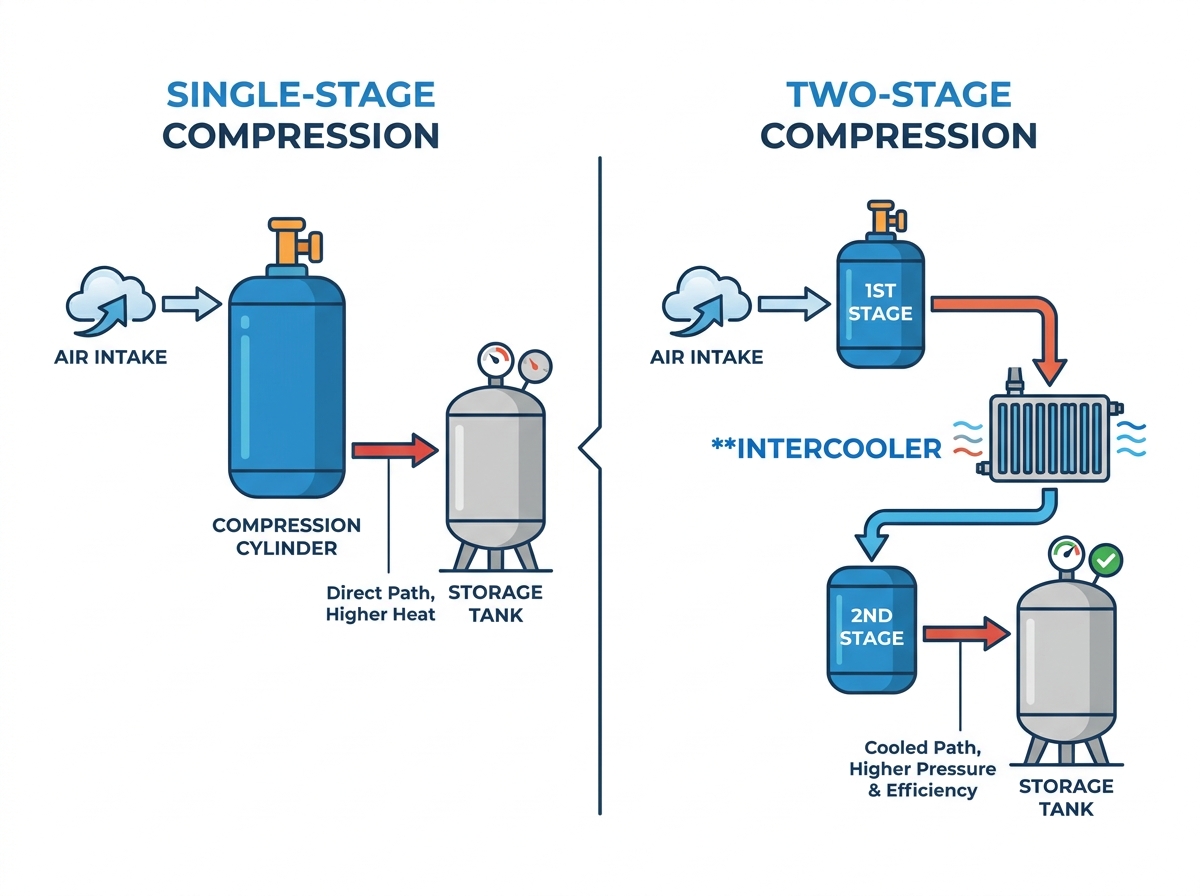
Single-stage compressors operate through a straightforward mechanical cycle. The machine draws ambient air into a cylinder or a central rotor housing. It compresses the air to its final target pressure in a single stroke or rotation. Next, the system routes this freshly compressed air directly into the storage receiver tank. This simple design fundamentally limits the maximum achievable pressure. It also generates significant internal heat because the air undergoes rapid compression without any intermediate cooling phase.
Two-stage systems utilize a highly efficient dual-step process instead. First, they compress ambient air to an intermediate pressure level. Before reaching the second compression phase, the air travels through a specialized intercooler. The intercooler sheds excess heat into the surrounding environment. Finally, the machine compresses the cooled air a second time to reach the final, much higher pressure. The system then sends this high-pressure air directly to the storage tank for distribution.
The intercooler acts as the critical differentiator between these two technologies. Cooling the air between stages dramatically increases air density. Denser air requires much less mechanical work to compress during the second stage. This strategic heat reduction improves overall volumetric efficiency. It also actively protects internal components from severe thermal stress, significantly extending the lifespan of internal seals, valves, and bearings.
Many facilities rely on single-stage compressors for basic pneumatic tasks. They serve a specific, valuable purpose in lighter industrial and commercial settings.
These units excel in environments demanding intermittent air supply. Ideal applications include small woodworking shops, automotive garages, and light manufacturing lines. They easily power standard pneumatic hand tools. You will often see them running nail guns, impact wrenches, and blowguns without issue.
A single-stage setup proves highly cost-effective under specific operating conditions. They succeed completely when your facility's peak demand rarely exceeds 100 PSI. For traditional piston models, your operational duty cycle should remain under 50%. If your tools operate in short bursts rather than continuous flows, this technology fits your shop perfectly.
The biggest draw remains the lower upfront capital expenditure. You spend less money at initial purchase. Single-stage compressors also feature a smaller physical footprint and lighter overall weight. They fit easily into cramped utility rooms or small garage corners. Maintenance remains simpler over time because they contain far fewer moving parts compared to complex dual-stage models.
These machines struggle severely under continuous industrial demand. They run much hotter during prolonged use. This excess heat degrades lubricating oil much faster, demanding frequent changes. Furthermore, they struggle to maintain high CFM (Cubic Feet per Minute) at elevated pressures. They simply lack the underlying energy efficiency required for massive, large-scale operations.
Heavy industrial applications demand robust, uncompromising solutions. When pressure drops halt production lines, two-stage technology steps in to stabilize your daily workflow.
These heavy-duty machines support the most demanding environments. We typically see them deployed in heavy manufacturing, continuous CNC machining, and commercial auto body shops. Any modern facility requiring a continuous, stable air supply above 100 PSI should look here. They handle demanding tools like media sandblasters and industrial paint sprayers effortlessly.
Dual-stage models solve the critical problems of heat degradation and sudden pressure drops. They thrive during prolonged, heavy-duty operation. If your plant runs multiple shifts per day, these machines deliver consistent air volumes without overheating or stalling.
For massive operations, rotary screw technology transforms shop productivity. Integrating a two-stage screw compressor directly benefits large-scale facilities. These machines combine the 100% duty cycle of rotary screw designs with the immense energy savings of staged compression. Often, they yield 10-15% more air per kilowatt than their single-stage rotary counterparts. You receive non-stop performance alongside sharply reduced electrical demand.
The intercooler facilitates significantly cooler operating temperatures across the board. Cooler internals actively extend component life and delay chemical oil breakdown. You achieve a much higher maximum PSI threshold. The intercooler also provides much greater moisture control, naturally dropping water out of the air before it ever reaches the receiver tank. Ultimately, you gain superior energy efficiency at an industrial scale.
You must evaluate your pneumatic options across several technical dimensions. Looking solely at horsepower ratings can easily mislead your entire procurement process.
Table: Core Differences Between Single and Two-Stage Models
| Evaluation Dimension | Single-Stage Configuration | Two-Stage Configuration |
|---|---|---|
| Maximum Pressure Capacity (PSI) | Typically peaks around 120-135 PSI | Consistently delivers 150-175+ PSI |
| Operational Duty Cycle | Usually under 50% (for piston models) | Supports up to 100% continuous use |
| Initial Capital Investment | Lower baseline cost | Higher premium investment |
| Thermal Management | Relies solely on air-cooled fins | Features an active intercooler |
| Optimal Use Case | Intermittent tasks and small shops | Heavy industrial and continuous workloads |
You must audit your facility requirements carefully. Do not buy a two-stage unit just for high CFM if your tools do not actually require high PSI. Evaluate machines based on the specific tool demands. A high-volume, low-pressure application might run perfectly on a large single-stage rotary unit. Conversely, heavy plant equipment needing 150 PSI absolutely requires a dual-stage system to function.
Compare the distinct power consumption curves. The 10-15% energy savings of a two-stage system dramatically impacts your financial payback timeline. High-demand manufacturing facilities often see equipment payback within 12 to 24 months. By reducing the electrical kilowatts needed to generate each cubic foot of air, you lower your monthly utility bills permanently.
Hotter air holds significantly more suspended moisture. Single-stage air runs quite hot, potentially overwhelming downstream refrigerated air dryers. This excess moisture can easily ruin automotive paint jobs and rust internal tool components. Two-stage systems naturally drop out condensation at the intercooler phase. This early moisture removal heavily protects your downstream equipment and reduces the structural load on your dryer systems.
You must carefully balance competing manufacturer claims. Single-stage units genuinely have fewer parts to fail over time. They offer basic, reliable mechanical simplicity. However, a two-stage system operates at much lower internal temperatures. Heat acts as the primary enemy of compressor reliability. By reducing heat, you prevent the rapid thermal degradation of oil, bearings, and synthetic seals. In heavy daily use, dual-stage machines often prove much more reliable despite possessing extra parts.
Even the highest-quality equipment fails if installed incorrectly. You must prepare your physical facility long before the delivery truck arrives.
Assess your building's electrical phase requirements immediately. Industrial dual-stage units almost exclusively require commercial three-phase power. You must verify your current breaker box capacity. Installing a massive industrial unit on an underpowered panel causes tripped breakers and severe motor damage. If your building only has single-phase service, upgrading the electrical infrastructure costs thousands of dollars. Failing to account for this necessary upgrade early can destroy your anticipated financial returns.
These large machines command dedicated floor space. Dual-stage systems and their associated cooling mechanisms require excellent room ventilation. Compressors breathe massive amounts of ambient air. If you tuck them into a tight closet, they choke on their own exhausted heat. You must ensure proper ducting, exhaust fans, and structural clearance around the machine to maintain ambient cooling.
Avoid the temptation to buy a massive dual-stage compressor purely for supposed "future-proofing." If your current pneumatic demand is too low, the compressor will short-cycle constantly. Short-cycling prevents the motor and oil from reaching their optimal operating temperatures. This dangerously cold operation leads to internal water condensation and severe oil contamination.
Follow a structured, logical process to finalize your procurement strategy. Hard facility data must drive this decision.
Calculate the total required CFM for your entire shop. Identify the specific tool requiring the absolute highest PSI. Base your minimum pressure threshold on that specific tool. Add a 20-30% volume buffer to account for minor system leaks and immediate business growth.
Observe exactly how often the compressor will run. If the system must run continuously for 8 to 24 hours a day, immediately filter out single-stage piston units. Instead, direct your technical evaluation toward either heavy-duty single-stage rotary machines or highly efficient two-stage screw compressors to handle the sustained workload.
Compare the upfront vendor quote of a single-stage system against the projected five-year energy costs of a dual-stage system. Base this calculation strictly on your local utility rates (price per kWh). Do not let initial sticker shock deter you from exploring highly efficient dual-stage models. The ongoing daily electrical savings often dwarf the initial price difference.
We highly recommend scheduling an independent compressed air audit. Use a professional digital data logger for at least one full week. Gather hard data on your pressure fluctuations and peak demand windows before finalizing any major capital purchase.
Conclusion
The concept of a universally "better" compressor does not exist; the optimal choice remains purely situational based on your exact facility needs. Single-stage compressors win easily on capital preservation for intermittent, low-pressure applications. They keep initial costs low while expertly supporting basic pneumatic tasks. Conversely, two-stage technology dominates in continuous, high-pressure industrial environments. They dramatically lower your daily electrical expenditure and offer unmatched physical durability under heavy stress. Before calling equipment vendors, prioritize a thorough operational air audit. Locking in your exact CFM and PSI data empowers you to negotiate effectively and purchase a machine perfectly tailored to your long-term success.
A: No. The term "stages" refers strictly to the number of internal compression steps, not the horsepower or output volume. A two-stage system simply compresses the air twice to reach higher pressures more efficiently. A 10 HP single-stage and a 10 HP two-stage use the exact same motor power.
A: Generally, no. While they do possess more moving parts, their dual-step design dramatically lowers operating temperatures. Because excessive internal heat is the primary cause of compressor failure, this cooler operation makes them far more reliable during heavy, continuous industrial use.
A: It is highly discouraged. Commercial painting requires high, continuous CFM and strictly dry air. Single-stage units run hot, which suspends moisture in the air and easily overwhelms downstream dryers. This leads directly to ruined water spots in your paint finish and frustrating pressure drops.
A: Yes. Manufacturers typically require specific high-grade synthetic lubricants to handle the intense mechanical shear and protect the internal rotors. Using cheap, non-approved oil often voids the OEM warranty and leads to rapid thermal breakdown, varnishing, and eventual system failure.