Call Us
+86-18072289720
- All
- Product Name
- Product Keyword
- Product Model
- Product Summary
- Product Description
- Multi Field Search

Views: 0 Author: Site Editor Publish Time: 2026-11-05 Origin: Site

Upgrading your shop equipment marks a critical milestone for any growing business. Moving past light hobbyist gear into serious automotive, fabrication, or industrial tasks demands robust pneumatic power. Standard single-cylinder models simply cannot handle heavy production shifts. Upgrading to a dual-cylinder design offers superior cooling. It also provides higher efficiency and better longevity. However, the market overflows with confusing configurations. Manufacturers saturate the industry using varying pump designs. Buyers often get misled by exaggerated performance numbers.
We will bypass misleading marketing claims like peak horsepower. Instead, we focus on verifiable metrics. You will learn to assess delivered air volume, staging configurations, and facility power constraints. This guide breaks down the exact specifications you need. It helps you identify the perfect unit for your daily operational demands.
Horsepower remains a fundamentally flawed metric for compressor selection. Consumer marketing heavily manipulates this number. Retailers often advertise "peak" or "breakdown" horsepower. This figure represents the absolute maximum power the motor draws at startup. It does not reflect sustained operational output. Relying on peak horsepower leads to severely undersized equipment. Industrial standards from organizations like the Compressed Air and Gas Institute (CAGI) recommend ignoring horsepower entirely. You must evaluate the machine based on actual air delivery.
Cubic feet per minute (CFM) measures the volume of air delivered. This metric dictates whether your tools run continuously or stall. Follow these exact steps to calculate your facility requirements:
Common Mistake: Buyers often calculate CFM based on intermittent tools like nail guns. Always base your math on continuous-drain equipment.
Duty cycle defines how long a pump can run within a given timeframe without overheating. A 50% duty cycle means the pump must rest for 30 minutes out of every hour. Industrial settings demand higher ratings. Running a standard commercial unit past its rated duty cycle leads to thermal breakdown. The oil degrades rapidly. The internal components warp. Always match your production shift intensity to a suitable duty cycle. Heavy fabrication shops should look for 100% continuous-duty ratings.
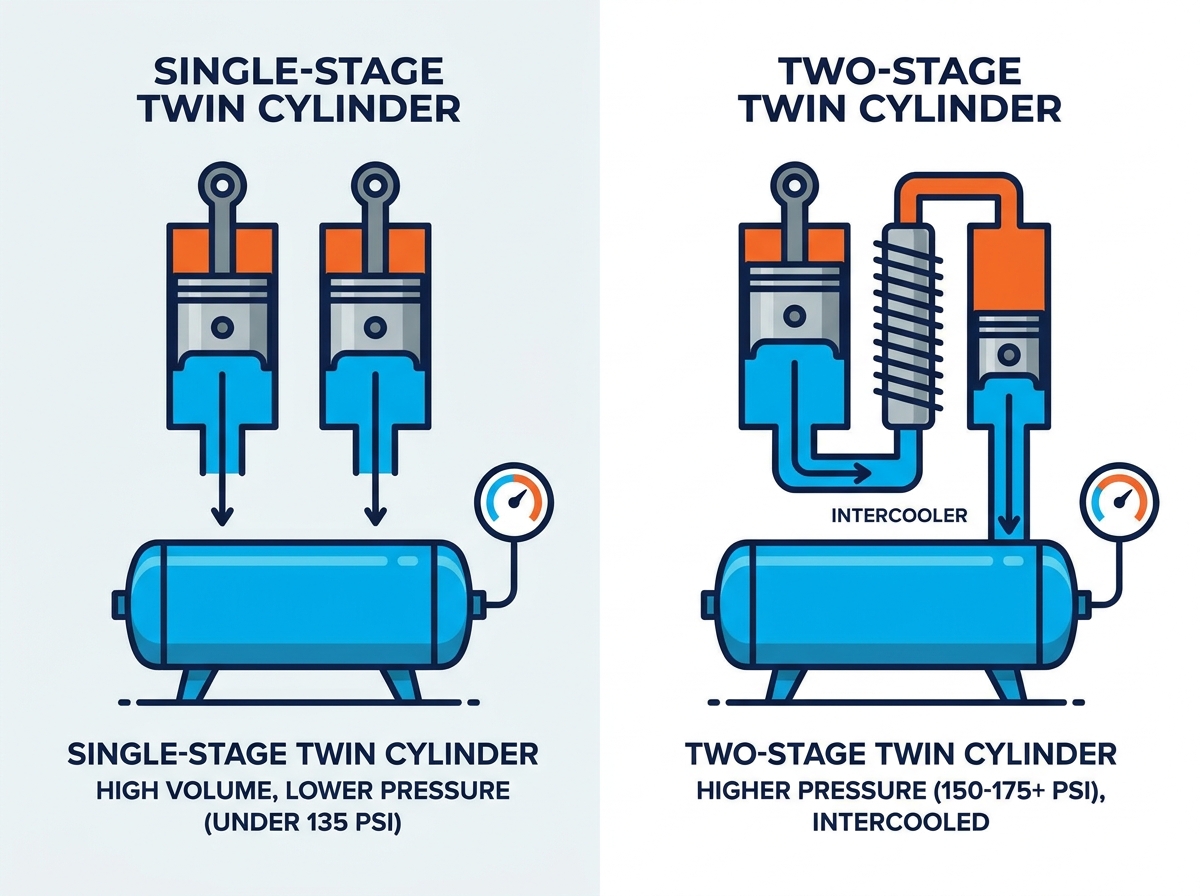
Many buyers falsely assume any dual-cylinder setup is automatically a two-stage unit. This causes immense confusion. The number of cylinders only indicates the pump's physical layout. It does not dictate how the air gets compressed. You must understand the internal mechanics to choose the correct two-cylinder piston compressor for your facility.
In a single-stage system, both pistons share the exact same diameter. They work in parallel. Each piston draws in ambient air. They compress it once and push it directly into the storage tank simultaneously. This design maximizes air volume at lower pressures.
A two-stage system operates sequentially. It features one large low-pressure piston and one smaller high-pressure piston. The large piston draws in air and compresses it slightly. This air then travels through an intercooler tube. The intercooler reduces the air temperature before it enters the smaller piston. The smaller piston compresses the air a second time to reach much higher pressures.
| Feature | Single-Stage Twin Cylinder | Two-Stage Twin Cylinder |
|---|---|---|
| Piston Size | Both identical | One large, one small |
| Compression Process | Parallel (One step) | Sequential (Two steps) |
| Max PSI Range | 90 - 135 PSI | 150 - 175+ PSI |
| Primary Strength | Faster recovery at low pressure | High sustained pressure capability |
| Ideal Workload | Standard automotive, carpentry | Heavy fabrication, tire shops |
Your building's electrical infrastructure dictates your equipment options. Smaller consumer units might run on standard 110V/120V household outlets. However, true high-CFM dual-cylinder models draw massive current. They almost exclusively require 220V/240V single-phase or true 3-phase commercial power.
Implementation Risk: Buying a 3-phase commercial unit for a residential garage is a massive mistake. Standard homes only receive single-phase power. Running a 3-phase motor requires installing an expensive rotary phase converter. Always verify your breaker panel capacity before making a purchase. Consult a licensed electrician to ensure safe installation.
Some environments lack reliable grid access. Engine-driven units provide a viable alternative. These systems pair a heavy-duty pump with a gas or diesel engine. Mobile mechanics and remote construction crews rely heavily on them. They mount easily onto service trucks. You get full pneumatic capability entirely off the grid. However, they require outdoor operation due to exhaust fumes.
Drive mechanisms significantly impact equipment longevity. Direct-drive units attach the pump directly to the motor shaft. They spin at very high RPMs. This creates excessive heat and loud operational noise.
We strongly advocate for belt-driven models in this class. Belt-drive systems separate the motor from the pump using pulleys. This allows the pump to operate at substantially lower RPMs. Slower rotation means better thermal management. The equipment stays cooler. It operates much quieter. Furthermore, replacing a worn belt is far easier than repairing a shattered direct-drive coupling.
Industrial applications almost universally rely on oil-bathed systems. These pumps utilize a crankcase filled with lubricating oil to protect moving parts. The cylinders are usually cast iron.
Oil-free pumps use permanently sealed bearings. The cylinders feature Teflon or specialized synthetic friction rings instead of liquid oil.
Verdict: Choose oil-lubricated pumps for standard mechanical or fabrication work. They represent the verifiable choice for ultimate longevity. You can easily manage trace oil vapors by installing inline coalescing filters downstream.
Dual-cylinder pumps are inherently loud pieces of machinery. They generate significant low-frequency vibration. Bolting them directly to an untreated concrete floor amplifies this noise throughout the building.
Best Practice: Install heavy-duty vibration isolation pads under each mounting foot. Use a flexible braided steel hose to connect the pump to your rigid shop piping. Keep the equipment away from shared office walls or retail spaces.
Compressing ambient air inevitably creates heat. As the hot air hits the cooler steel tank, intense condensation forms. Water rapidly accumulates inside the system. If left unchecked, this moisture travels down your lines and destroys expensive pneumatic tools.
You must implement a strict moisture management protocol. Install an automatic electronic tank drain to purge standing water daily. Use aftercoolers immediately following the pump head. For paint booths or CNC operations, a refrigerated air dryer is an absolute necessity. It drops the air dew point and strips out all remaining vapor.
Piston pumps rely entirely on ambient air for internal cooling. The large flywheel acts as a fan, blowing room air across the finned cylinders. Placing the unit in a tight, unventilated utility closet guarantees rapid overheating. It severely degrades performance and will immediately void manufacturer warranties.
Ensure your installation space provides at least three feet of clearance on all sides. Consider installing an active exhaust fan in the compressor room. Pulling fresh, cool air into the space extends the life of the motor and pump head significantly.
Selecting the proper equipment requires careful evaluation of your facility's daily workflow. Your final selection comes down to matching verifiable CFM requirements against available power. You must distinguish between single-stage volume needs and two-stage pressure demands.
Follow these action-oriented next steps to finalize your decision:
A: Not necessarily. Fill speed depends entirely on the total pump displacement and the motor RPM. While dual cylinders generally process a higher overall volume of air than a single cylinder of the same motor size, the specific pump design dictates the actual recovery speed.
A: Only smaller, single-stage portable models might run on a 15-amp breaker. Most stationary dual-cylinder units draw significant startup amperage. They typically require a dedicated 20-amp, 30-amp, or higher 220V dedicated circuit to operate safely without tripping breakers.
A: High-volume compression generates significant heat. When this hot air hits the tank, it creates rapid condensation. This is a perfectly normal physical byproduct of compressing air. The solution is installing proper downstream filtration and a refrigerated air dryer, not changing the pump itself.
A: Cast iron retains its structural shape much better under extreme heat. It offers superior longevity for heavy-duty industrial use. Aluminum is much lighter and dissipates heat more quickly. High-quality aluminum pumps often utilize cast-iron internal sleeves to combine durability with rapid cooling.