Call Us
+86-18072289720
- All
- Product Name
- Product Keyword
- Product Model
- Product Summary
- Product Description
- Multi Field Search

Views: 0 Author: Site Editor Publish Time: 2026-11-07 Origin: Site

Industrial facilities eventually outgrow basic pneumatic setups. Plant managers need robust solutions for high-demand, intermittent air supply. Relying on undersized equipment leads to frequent breakdowns and costly production bottlenecks. A two-cylinder piston compressor bridges the critical gap between light-duty single-cylinder units and capital-intensive rotary screw systems. Operators often struggle to balance upfront procurement budgets against strict performance limits. Choosing the wrong configuration risks premature thermal shutdown or chronically inadequate pressure. This article provides an evidence-based framework for evaluating these rugged systems. We will explore specific industrial applications, daily performance metrics, and strict operational constraints. You will learn how to match compressor specifications directly to your facility's unique pneumatic demands.
Facilities across various sectors face highly fluctuating pneumatic demands. A repair shop might see heavy impact wrench usage for ten minutes, followed by an hour of silence. You need flexible air power to handle these unpredictable spikes. These units offer an excellent operational sweet spot for intermittent consumption. They deliver rapid pressure recovery during peak bursts. They excel where air consumption spikes sharply and then drops to zero. Conversely, continuous flat-line consumption usually demands different compression technology.
You must understand the mechanical differences between cylinder configurations. Purchasing the wrong design will cripple your daily operations.
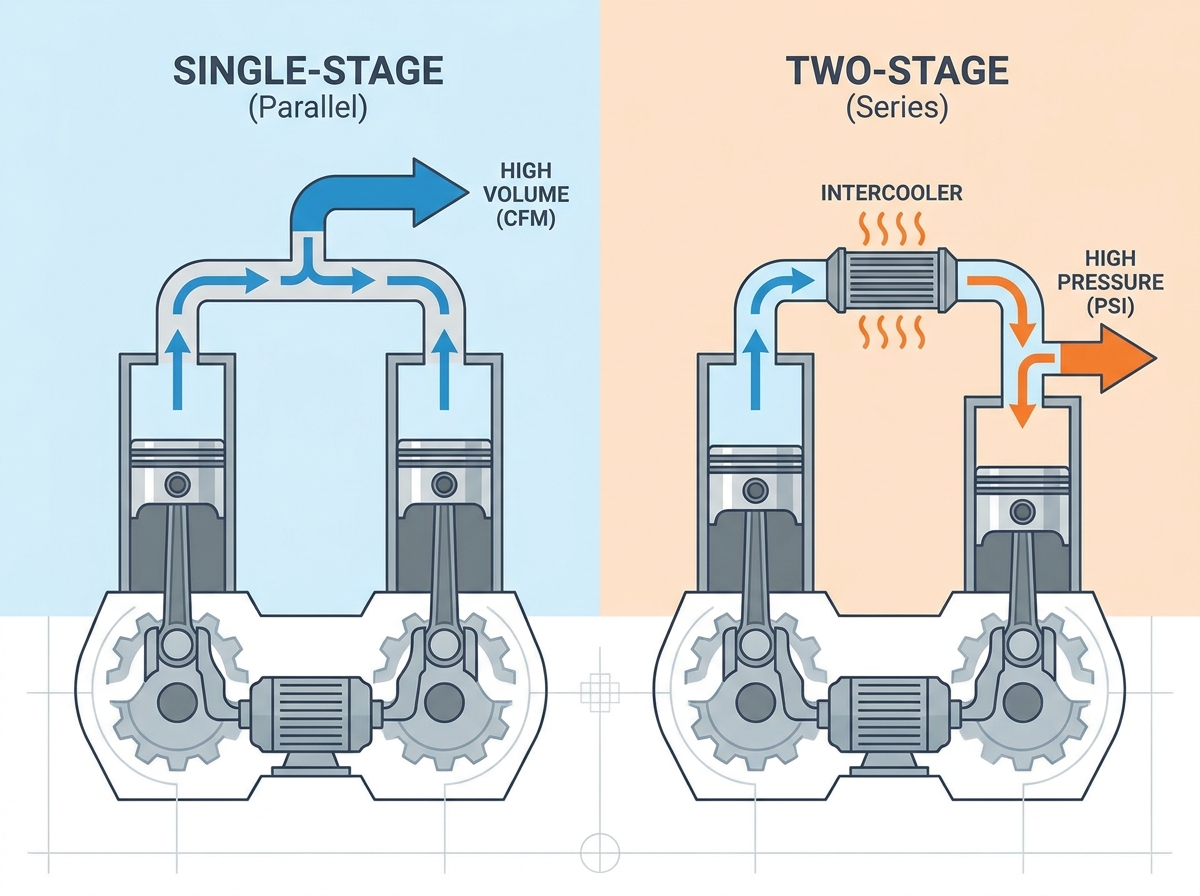
Twin-Cylinder Single-Stage: Parallel cylinders draw ambient air simultaneously. They compress the air in a single stroke. The pistons push this air directly into the storage tank. This setup maximizes volumetric flow rate (CFM). Operators choose this design for high-volume, lower-pressure tasks.
Two-Stage Dual-Cylinder: This configuration uses a sophisticated compounding compression method. Ambient air enters a large, low-pressure cylinder first. After initial compression, it travels through an intercooler tube. This cooling step sheds dangerous excess heat. Finally, a smaller high-pressure cylinder compresses the air further before storing it. You need this specific mechanical sequence for demanding high-PSI applications.
Table: Single-Stage vs. Two-Stage Configuration Comparison
| Feature | Twin-Cylinder Single-Stage | Two-Stage Dual-Cylinder |
|---|---|---|
| Primary Goal | Maximum volume (CFM) | Maximum pressure (PSI) |
| Max Pressure Limit | Typically up to 135 PSI | Typically up to 175+ PSI |
| Compression Cycle | One stroke per cylinder | Two consecutive strokes |
| Cooling Mechanism | Air-cooled fins on cylinders | Inline intercooler between cylinders |
| Ideal Application | Pneumatic nailing, basic painting | Heavy automotive lifts, metal fabrication |
Piston units offer significantly lower upfront capital expenditure compared to rotary alternatives. They boast highly accessible rebuild costs using standard off-the-shelf replacement parts. Facilities can often train internal maintenance teams to service them. However, you must respect their inherent duty cycle limits. Pushing them too hard erodes these financial benefits rapidly. Running them continuously causes accelerated internal wear. You trade lower initial purchase prices for stricter operational boundaries.
Different industries extract unique values from these versatile machines. A two-cylinder piston compressor adapts to diverse environments, provided you match the specifications to the task.
Purchasing industrial equipment requires rigorous data analysis. Guessing your pneumatic requirements usually leads to expensive premature failures or wasted capacity.
You must transparently address the physical limitations of piston mechanics. Manufacturers design standard commercial units for a 60% to 75% duty cycle. This means the motor should run for six to seven minutes out of every ten. Pushing it past 70% accelerates ring wear significantly. Excess friction generates dangerous heat levels. The lubricating oil begins to break down and lose viscosity. This ultimately risks thermal shutdown or catastrophic pump seizure. Always size your tank larger if your operators tend to overuse air tools.
Never base your procurement solely on horsepower. You need a reliable framework for calculating true pneumatic load. Facility managers use a simultaneous use factor to prevent critical undersizing.
Chart: Simultaneous Use Factor Calculation Example
| Pneumatic Tool | CFM Requirement | Simultaneous Usage Probability | Calculated Load (CFM) |
|---|---|---|---|
| 1/2" Impact Wrench | 5.0 | 100% (Primary use) | 5.0 |
| Pneumatic Sander | 8.0 | 50% | 4.0 |
| Plasma Cutter | 6.0 | 25% | 1.5 |
| Blow Gun | 3.0 | 10% | 0.3 |
| Total Base Load | - | - | 10.8 CFM |
| Required Capacity (+20% Buffer) | - | - | 12.96 CFM |
Reciprocating mechanics create significant noise and violent vibrations. OSHA heavily regulates workplace noise exposure limits, generally capping continuous exposure at 85 dBA. Many dual-cylinder units exceed 80 dBA easily. You must discuss noise mitigation before installation.
We highly recommend vibration-damping mounts. These thick rubber pads prevent the machine from destroying its own concrete anchors. Acoustic enclosures reduce decibel levels dramatically for indoor installations. You must factor these essential accessories into your initial installation budget. Ignoring vibration leads to cracked pipe fittings and dangerous air leaks.
Frequent motor start and stop cycles consume heavy electrical currents. Every time the motor kicks on, it pulls a massive amperage spike. These frequent motor starts drive monthly utility bills higher. You should assess the value of mechanical unloading mechanisms. An unloader valve allows the electric motor to run continuously while the pump stops compressing air. This eliminates electrical spikes during highly variable production shifts. While it wastes some mechanical energy idling, it saves your electrical contactors from premature burnout.
Even the best equipment fails if you install it poorly. Operational longevity requires proactive maintenance and excellent room design.
Compression physics generates intense, unavoidable heat. Inadequate ventilation in the compressor room ruins operational efficiency. If you place the machine in a cramped, hot closet, it suffocates. Poor ambient airflow stifles the intercooler in two-stage models. If the intercooler cannot shed heat, the second cylinder compresses hot air. Hotter air holds significantly more moisture. This excess water travels down your airlines, causing downstream rust and destroying expensive pneumatic tools.
Best Practice: Install thermostatically controlled exhaust fans in your compressor room. Route the intake air from a cool, clean outside source.
Lubricated piston compressors inherently bypass microscopic amounts of oil. As pistons move, oil slips past the metal rings into the air stream. Certain end-applications cannot tolerate this contamination under any circumstances. Paint booths, food packaging, and laser cutting require aggressive air treatment.
You must define the filtration and drying requirements necessary for your specific application. Sensitive environments demand strict adherence to ISO 8573-1 air quality standards. You will likely need to install staged coalescing filters to strip out aerosols. Refrigerated or desiccant dryers must accompany these filters to eliminate moisture vapor.
Field installations teach hard lessons about preparation. A two-cylinder piston compressor is heavy and top-heavy. You must anchor the unit properly into reinforced concrete. We have seen unsecured machines literally vibrate themselves across a shop floor. This shears electrical conduits and causes catastrophic airline ruptures.
Common Mistakes During Break-In:
Choosing the right technology requires brutal honesty about your operational habits. Sometimes, stepping away from piston technology is the smartest financial move.
We provide a clear "walk-away" threshold for our clients. You should abandon piston technology and direct your budget toward rotary screw systems if your facility meets these conditions:
Gather hard data before you contact a vendor. Provide them with an exact checklist outlining your site realities. Guessing these numbers leads to poor recommendations.
Do not guess your consumption rates. You should secure hard data before issuing an RFQ (Request for Quote). Follow these sequential steps:
A two-cylinder piston compressor remains a highly cost-effective and remarkably durable solution. It serves specific, intermittent-demand applications better than almost any other technology on the market. Proper specification hinges entirely on a realistic assessment of your duty cycle limits and air quality requirements. You must respect the physical constraints of reciprocating mechanics. Provide adequate ventilation, enforce strict maintenance schedules, and monitor your simultaneous tool usage. By aligning these variables correctly, you ensure the unit serves as a reliable utility rather than a frustrating production bottleneck. Take the time to audit your air usage today before committing your procurement budget.
A: Most commercial units operate safely within a 60% to 75% duty cycle. This means the motor should rest for roughly three to four minutes out of every ten. Pushing the equipment continuously generates excessive heat. This accelerates wear on piston rings, degrades lubricating oil, and damages valves. Allowing the machine adequate rest periods prevents thermal shutdown and greatly extends its operational lifespan.
A: A twin-cylinder single-stage unit draws air into both cylinders simultaneously, compressing it in one stroke. This prioritizes high volume (CFM) at lower pressures. A two-stage compressor pushes air from a low-pressure cylinder through an intercooler, then into a high-pressure cylinder. This compounding mechanical sequence prioritizes higher final pressure (PSI) outcomes over maximum volume.
A: Standard maintenance depends heavily on operating hours and environment. You should generally change the pump oil every 500 hours or every three months. Inspect and replace intake air filters monthly, especially in dusty fabrication shops. Check V-belt tension after the first 50 hours of operation to account for stretching, then inspect it quarterly to prevent slipping.
A: Standard lubricated models cannot guarantee entirely oil-free air due to inherent ring bypass. Microscopic oil aerosols always enter the air stream. If your application demands absolute purity, you must specify specialized oil-less models. Alternatively, you can install aggressive downstream coalescing filters and refrigerated dryers to effectively remove airborne oil vapors before they reach your tools.