Call Us
+86-18072289720
- All
- Product Name
- Product Keyword
- Product Model
- Product Summary
- Product Description
- Multi Field Search

Views: 0 Author: Site Editor Publish Time: 2026-11-20 Origin: Site

Commercial and industrial refrigeration procurement carries enormous financial stakes for any facility. Selecting the wrong compressor technology often leads to inflated lifecycle expenses. It can also cause severe operational bottlenecks. Facility managers face mounting pressure to get this choice exactly right. We frame the reciprocating versus rotary decision as a critical balancing act. You must weigh upfront capital expenditure (CAPEX) against ongoing operational expenditure (OPEX). Furthermore, you have to closely examine your facility demand cycles. Every plant operates differently. The optimal choice depends entirely on your specific duty cycles. It relies heavily on your capacity requirements and maintenance infrastructure. There is no universal best option in the market today. Instead, you must match the machinery to your operational reality. In this guide, we break down the fundamental differences between these technologies. You will learn how to evaluate your load profiles. You will also discover how to anticipate maintenance demands and make a highly informed procurement decision.
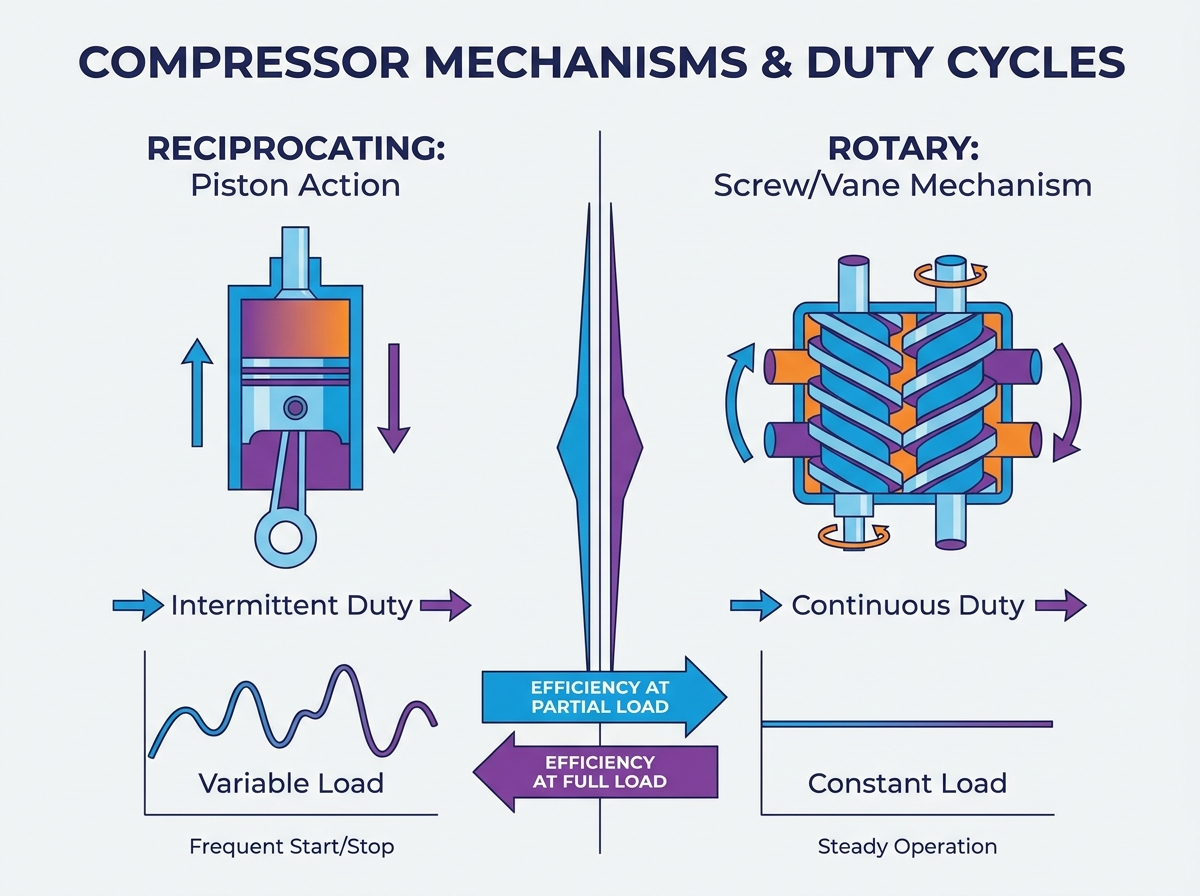
A reciprocating refrigeration compressor relies on a proven piston-and-cylinder arrangement. A motor drives a crankshaft. This crankshaft pushes pistons up and down inside cylinders. The downward stroke draws refrigerant vapor into the chamber. The upward stroke compresses this gas. Finally, the system discharges the high-pressure vapor through a valve. These units handle incredibly high discharge pressures with ease. They also manage variable cooling loads highly efficiently. However, we must acknowledge their physical realities. These machines contain many moving parts. They rely on delicate suction valves, discharge valves, and piston rings. These components experience continuous mechanical stress during operation.
Rotary compressors operate using a completely different mechanical philosophy. These machines typically use intermeshing helical screws or spinning vanes. As the internal rotors turn, they trap refrigerant gas in a pocket. This pocket gradually decreases in volume. The continuous sweeping motion forces the compressed gas out of the discharge port. You will notice a distinct lack of pulsation during this process. The gas flows smoothly and continuously. This design drastically reduces internal mechanical wear. It utilizes far fewer moving parts than a piston-driven alternative. There are no valves to fail or rings to wear down. The rotors float on a thin film of lubricating oil.
Both machines achieve the exact same fundamental thermodynamic goal. They raise the pressure and temperature of refrigerant gas. This enables the heat rejection process in the condenser. However, their specific mechanical pathways differ significantly. These internal differences dictate entirely different facility outcomes. They impact vibration levels, noise generation, and overall energy consumption. You cannot swap one for the other without careful consideration. The internal mechanics directly influence how the machine responds to your facility's cooling demands.
Your facility duty cycle acts as the primary deciding factor. Rotary compressors require continuous, uninterrupted operation. This constant runtime maintains internal temperatures. It prevents harmful moisture buildup inside the lubricating oil. Rotary designs thrive as 24/7 baseload machines. They love running at full capacity all day. Conversely, reciprocating units handle frequent start/stop cycles brilliantly. They do not suffer from excessive mechanical wear during these transitions. Their quick-acting valves adjust rapidly to changing conditions. This makes them significantly superior for shifting seasonal loads. They also dominate in batch-cooling demands where cooling requirements spike and drop suddenly.
You must balance initial purchase price against long-term running costs. Piston-driven machines typically require a much lower initial capital expenditure (CAPEX). This lower entry price appeals to budget-conscious facility managers. Rotary technology carries a premium upfront price tag. However, energy efficiency profiles paint a different picture over time. Rotary units operate highly efficiently at full load. They consume less power per ton of refrigeration when running continuously. Reciprocating models often show much better part-load efficiency. When the cooling demand drops to fifty percent, a piston machine steps down smoothly. A rotary machine often struggles to maintain efficiency at partial loads.
Compressor Technology Performance Comparison
| Feature Dimension | Reciprocating Technology | Rotary (Screw/Vane) Technology |
|---|---|---|
| Ideal Duty Cycle | Intermittent, variable loads | Continuous 24/7 baseloads |
| Initial CAPEX | Generally lower | Generally higher premium |
| Part-Load Efficiency | Excellent stepping capability | Poor without advanced VFDs |
| Vibration Output | High (requires robust mounts) | Low (smooth operation) |
| Maintenance Complexity | Frequent but standard skill level | Infrequent but requires specialists |
Maintenance realities heavily influence your daily operations. Reciprocating machines require a more frequent routine maintenance cadence. You must regularly inspect suction valves, replace piston rings, and monitor oil changes. Fortunately, standard in-house technicians can often handle these tasks. Replacement parts remain generally cheaper and widely available across the globe. Rotary machines boast much longer intervals between routine service checks. They experience less friction and run cleanly for thousands of hours. However, this convenience comes with a specific risk. When a rotary air-end fails, you face a major mechanical crisis. Air-end rebuilds require highly specialized technicians. They also carry massive component replacement costs.
Certain industrial environments practically demand piston-driven technology. Cold storage facilities represent a perfect use case. These buildings experience constantly fluctuating inventory levels. Forklift doors open and close continuously. This causes rapid spikes in cooling requirements. Batch processing plants also benefit immensely. Food and beverage manufacturers often chill massive vats of product quickly. After the batch finishes, the cooling load drops to zero. Applications requiring exceptionally high discharge pressures also favor this technology. Piston machines effortlessly compress gas to extreme pressures safely.
Many operations operate under strict upfront budget constraints. You might have limited CAPEX funds available for equipment upgrades. In this scenario, piston technology aligns perfectly with your financial reality. It allows you to replace aging infrastructure without breaking the capital budget. It also works best when you already employ a capable in-house maintenance team. Your mechanics can manage the routine upkeep easily. They can swap valves and rings quickly. This keeps outsourced labor costs incredibly low.
You must respect the limitations of this equipment. We strongly warn against using reciprocating models for continuous, maximum-capacity demands. Pushing a piston machine to run at 100% capacity constantly creates excessive heat. It accelerates internal mechanical wear dramatically. The constant friction degrades piston rings prematurely. Eventually, this aggressive usage profile shortens the overall equipment lifespan. If your facility needs relentless, round-the-clock maximum cooling, look elsewhere. Ignoring this limitation leads to sudden catastrophic failures and expensive production downtime.
Rotary machines dominate large-scale industrial refrigeration applications. Continuous manufacturing processes rely heavily on this robust technology. Chemical processing plants and massive pharmaceutical facilities need stable temperatures. They require a steady, massive volume of cooling without any interruption. The continuous sweeping motion of the rotors delivers perfectly stable refrigerant flow. The lack of pulsation protects delicate downstream piping from vibration stress. When your production line runs continuously for months at a time, rotary technology provides ultimate peace of mind.
Modern facility infrastructure sometimes dictates your technology choices. Rotary compressors provide exceptional value for facilities with limited floor space. They pack a massive amount of cooling capacity into a very small footprint. They also align perfectly with strict noise and vibration compliance requirements. If your mechanical room sits near occupied office spaces, acoustic performance matters. Rotary units hum quietly compared to the aggressive hammering of piston machines. Furthermore, they suit budgets that allow for higher initial investments. Spending more upfront secures long-term operational stability.
Facility planners often make one critical mistake with rotary technology. They intentionally oversize the compressor for future expansion. We must highlight the financial risk of oversizing a rotary compressor. Running a rotary unit consistently at low partial loads causes severe problems. It heavily degrades thermodynamic efficiency. It also prevents the system from reaching optimal operating temperatures. Moisture accumulates in the oil reservoir rapidly. This moisture causes internal corrosion and premature bearing failure. You must size rotary machines precisely to your actual, current baseload demands.
Installation requirements differ vastly between the two technologies. You cannot simply drop these machines onto a standard concrete floor. Reciprocating units require incredibly heavy-duty mounting solutions. They generate severe low-frequency vibrations during operation. You must pour thick, isolated concrete pads. You also need heavy-duty spring isolators to absorb the mechanical shaking. Without proper isolation, these vibrations travel through the building structure. Rotary units offer far more flexible installation options. They operate so smoothly you can often use simple skid-mounted installations. This drastically reduces your structural engineering costs during the initial build phase.
Integrating new compressors into an aging facility requires careful planning. You must discuss compatibility with existing refrigeration piping. Piston machines create pressure pulsations. Your existing pipes might require special dampeners to handle this stress safely. Control system integration also demands attention. Modern Variable Frequency Drives (VFDs) pair beautifully with both technologies. However, Programmable Logic Controllers (PLCs) must handle the specific startup sequences. A rotary machine requires a carefully managed startup to ensure immediate oil flow to the bearings. You must verify your facility power grid can handle the electrical inrush currents. Rotary machines occasionally demand massive starting amps compared to smaller piston arrays.
Smart buyers look far beyond the initial purchase order. We strongly encourage buyers to calculate all expenses over a 10-year horizon. You must factor in predicted energy rates for your specific region. Electricity costs often outpace the machine's initial purchase price within three years. You should also analyze potential downtime risks. How much does a single hour of lost production cost your facility? Finally, factor in specific local labor costs for maintenance. If specialist rotary technicians cost double the hourly rate of standard mechanics in your area, note this. A comprehensive 10-year financial view often changes the procurement decision entirely.
Your final procurement decision rarely comes down to choosing the objectively "better" machine. Instead, the decision hinges entirely on matching technology to your duty cycle. Continuous cooling demands heavily favor rotary designs. Fluctuating, intermittent loads strongly favor piston-driven mechanisms. You must also align the choice with your budget structure, balancing initial CAPEX against long-term OPEX. We recommend conducting a professional energy audit first. You should complete a detailed load profile analysis before ever requesting vendor quotes. Encourage your team to shortlist vendors who provide transparent, 10-year lifecycle financial calculations. Demand to see the long-term energy and maintenance projections rather than just focusing on the base unit pricing.
A: Rotary models are generally more efficient when operating at a 100% continuous baseload. However, a reciprocating refrigeration compressor is usually much more efficient at variable or partial loads. If your cooling demand fluctuates constantly, piston technology typically consumes less total electricity over the year.
A: Yes, but it requires careful engineering. You cannot simply swap the machines. You must thoroughly evaluate existing piping for flow compatibility. You also need to assess vibration isolation setups and review your actual facility load profiles. Oversizing a new rotary unit for a variable load causes severe operational issues.
A: Both machines offer excellent longevity when maintained correctly. Industry averages suggest 15 to 20 years of reliable service. Rotary air-ends eventually require complete factory rebuilding after 40,000 to 60,000 hours. Conversely, piston units can be continuously rebuilt on-site by standard technicians, theoretically extending their life indefinitely.
A: Extreme ambient temperatures significantly impact both technologies. High heat affects cooling mechanisms and alters internal oil viscosity. Rotary machines rely heavily on oil sealing, so high ambient heat requires robust oil coolers. Piston machines handle extreme ambient pressure ratios slightly better, making them robust in harsh outdoor industrial environments.