Call Us
+86-18072289720
- All
- Product Name
- Product Keyword
- Product Model
- Product Summary
- Product Description
- Multi Field Search

Views: 0 Author: Site Editor Publish Time: 2026-11-06 Origin: Site

Upgrading your shop equipment to a two-cylinder piston compressor represents a significant jump in air capacity. It also requires a substantial upfront investment compared to basic single-cylinder models. Many buyers unfortunately stop their research at the initial price tag. However, the sticker price reveals only one part of the purchasing equation.
Real operating costs extend far beyond the checkout cart. They include complex installation requirements, heavy electrical power draw, and routine maintenance overhead. You might also encounter confusing manufacturer metrics during your research. Marketing teams often design these metrics to upsell unnecessary features. Our objective is to strip away this marketing jargon. We will expose inflated peak horsepower claims for what they are. This guide provides a clear, skeptical breakdown of what you should actually expect to pay. You will learn how to evaluate technical specifications properly. By the end, you will know exactly what hardware features are worth your premium investment.
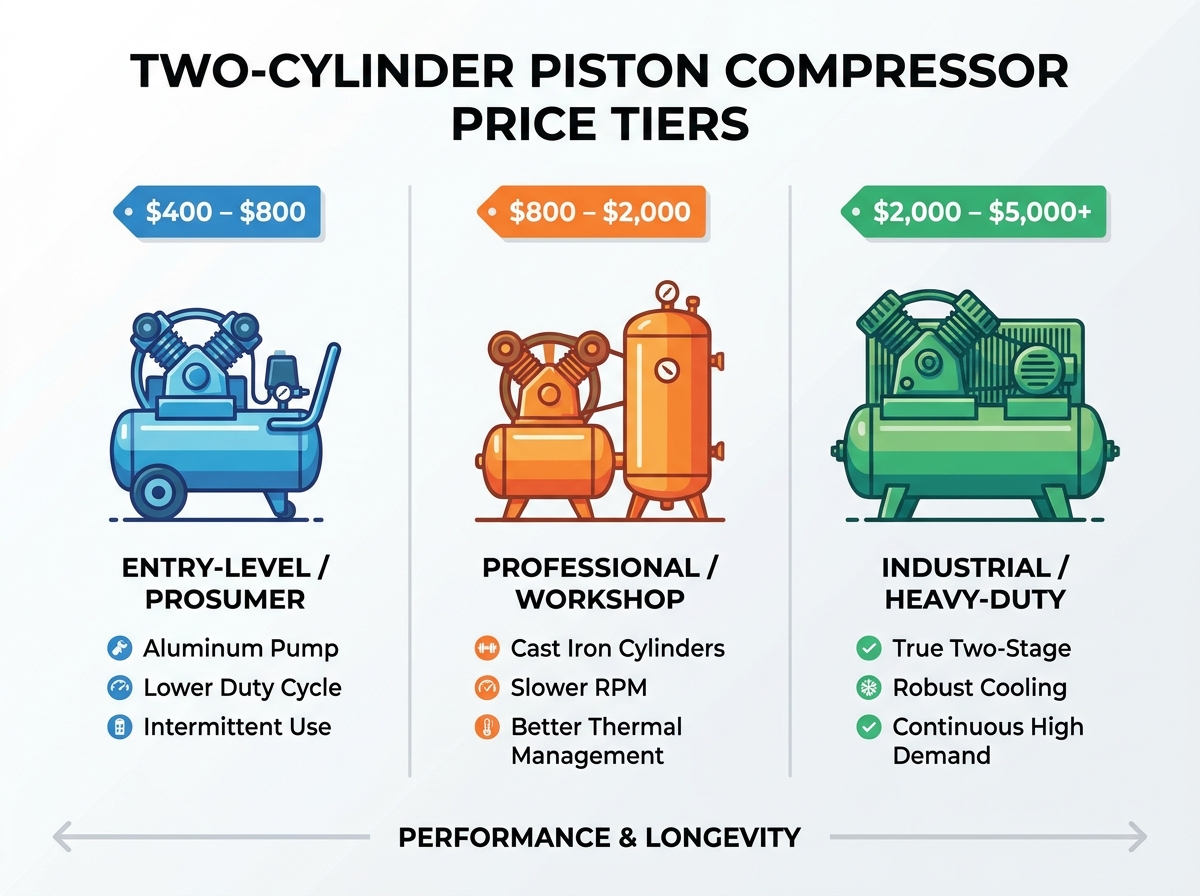
Let us explore the current market segments for these machines. You will generally find three main hardware categories available. Each tier targets specific user needs and varying workflow demands. Understanding these tiers prevents you from overbuying or under-speccing your equipment.
These models typically feature single-stage, twin-cylinder aluminum pumps. They serve perfectly as robust upgrades for home garages. You can use them for intermittent pneumatic tool operation. They also handle off-road tire inflation effortlessly. However, they come with distinct operational limitations.
You will face lower duty cycles, often hovering around 50 percent. This means the motor must rest for half of its operating hour. A common mistake involves running dual-action sanders on these small units. The motor will quickly overheat and shut down. Additionally, these machines generate more noise and include smaller storage tanks.
Stepping up into this tier introduces heavy cast iron cylinders. These machines frequently utilize belt drives instead of direct-drive mechanisms. Belt-driven systems allow for much slower pump RPMs. Slower rotation significantly extends the overall operational longevity of the unit. We highly recommend this tier for daily automotive repair shops.
They easily support continuous sanding, painting, and high-demand DIY fabrication. The primary value addition here is superior thermal management. A cooler pump translates to a significantly longer lifespan. Many professionals consider this specific tier the ultimate sweet spot for value.
Top-tier models utilize true two-stage compression systems. Manufacturers equip them with robust cooling fins and specialized intercoolers. You will also find integrated magnetic starters for electrical load protection. Standard pressure switches simply cannot handle massive electrical surges.
These heavy-duty machines belong on busy manufacturing floors. They easily serve multi-bay garages running continuously. You can operate heavy air tools simultaneously without experiencing sudden pressure drops. If your entire business relies on uninterrupted compressed air, this category demands your attention.
Compressor Hardware Cost Tiers Summary
| Category Tier | Price Range | Typical Pump Material | Best Use Cases | Common Limitations |
|---|---|---|---|---|
| Entry-Level / Prosumer | $400 – $800 | Aluminum | Home garages, intermittent use, tire inflation | Lower duty cycles (approx. 50%), smaller tanks, louder operation |
| Professional / Workshop | $800 – $2,000 | Cast Iron | Auto repair shops, continuous sanding/painting | Requires dedicated floor space, heavier weight |
| Industrial / Heavy-Duty | $2,000 – $5,000+ | Heavy Cast Iron | Manufacturing floors, multi-bay commercial garages | High upfront cost, requires 220V/3-phase power |
Many buyers confuse cylinder count and compression stages. A two-cylinder piston compressor can function as either a single-stage or a two-stage unit. In a single-stage setup, both cylinders draw in ambient air. They then push it directly into the storage tank simultaneously. Both pistons work at the exact same pressure rating.
In a two-stage system, one large cylinder compresses the air partially. It feeds this warm air into a cooling tube known as an intercooler. Then, a second smaller cylinder compresses it further to achieve much higher final pressure. The intercooler plays a vital role in reducing thermal stress.
Understanding this ratio prevents you from overspending on unnecessary mechanical capabilities.
You must ask yourself one critical question before purchasing. Do you need air volume (CFM) or air pressure (PSI)? Volume dictates how many tools you can run simultaneously. Pressure dictates the raw force those tools exert. Do not pay the two-stage premium if your tools max out at 90 PSI. You will waste capital on pressure you never actually use.
The initial purchase price covers only the bare hardware. You must budget carefully for several hidden installation and operational expenses.
Most high-output units demand substantial electrical power. You cannot safely plug them into a standard wall outlet. They require a dedicated 220V circuit to operate smoothly. Some larger industrial models demand specialized 3-phase power connections. You should factor in $300 to $800 for a licensed electrician.
This applies if your workspace currently lacks proper heavy-duty wiring. Upgrading your main electrical panel might cost considerably more. A common mistake involves relying on long extension cords. Extension cords cause severe voltage drops. This starves the motor of power and burns out internal windings prematurely.
Piston compressors inherently operate very loudly. They produce noise levels frequently reaching 80 to 90 decibels or higher. Prolonged daily exposure causes severe hearing damage. You might need to invest in custom acoustic enclosures.
Vibration isolation pads help reduce structural noise transfer through concrete floors. Alternatively, you might decide to build a separate, insulated compressor room. This choice requires routing expensive copper or specialized aluminum piping back to your main workspace. These piping materials add significant material costs.
You must actively choose between oil-lubricated and oil-free designs. Each path carries different long-term expenses.
Many budget retail brands heavily advertise massive horsepower numbers. You must ignore "peak horsepower" claims completely. It serves as a heavily flawed metric for pricing and performance comparison. Manufacturers often inflate these HP ratings artificially.
They base them on the momentary electrical startup power draw. They do not reflect continuous, working mechanical output. A machine labeled as 5-peak-HP might only deliver 2 continuous HP under actual load. Evaluating a machine based on peak HP guarantees disappointment.
The true measure of a compressor's value is its delivered CFM. You should specifically look at the CFM rated at 90 PSI. Follow this straightforward sizing formula. Calculate the total continuous CFM requirement of your single most demanding tool. Add a strict 30 percent safety margin to that total number. Then, price the compressor matching that exact air output.
This method ensures you neither under-spec your shop nor overspend on excess capacity. Best practice dictates checking the ISO standards for the manufacturer's CFM testing methods to ensure accuracy.
Duty cycle indicates exactly how long a compressor can run safely within one hour. A cheaper unit might offer a meager 30 percent duty cycle. It will stall your workflow continuously. You will sit around waiting for the pump to cool down and refill the tank.
A slightly pricier unit might feature a 100 percent continuous duty rating. Factor your potential employee downtime into your operational calculations. Time wasted waiting for air quickly negates any initial purchase savings.
You must evaluate the manufacturer just as harshly as the machine itself. Brand reputation matters immensely in industrial equipment purchasing.
Material choices dictate thermal performance and ultimate longevity. Cast iron cylinders justify higher retail prices. They offer superior structural durability. They also boast excellent heat dissipation properties over long shifts.
Cheaper aluminum sleeves heat up rapidly during continuous operation. They can warp under heavy daily use. Always prioritize cast iron components for serious professional applications. It adds weight, but it guarantees reliable thermal stability.
You must read the fine print closely before handing over your credit card. Many budget brands loudly advertise "3-year warranties" on the box. However, this coverage often only protects the steel storage tank against rusting.
It entirely excludes the electric motor and the mechanical pump assembly. The pump and motor are the most expensive components to replace. Look exclusively for comprehensive warranties covering the entire mechanical and electrical system against factory defects.
A reliable shop machine should remain serviceable for decades. Before buying, always check the manufacturer's parts catalog online. Do they sell direct replacement gaskets and valves? Can you easily purchase full mechanical rebuild kits?
If a manufacturer restricts parts access, you should walk away immediately. When you cannot fix minor wear issues, the long-term financial burden becomes a total machine replacement. Choose established industry brands supporting their legacy models. We highly recommend verifying spare parts availability for any two-cylinder piston compressor before you finalize the transaction.
Finding the ideal shop compressor requires balancing your initial budget against continuous performance reliability. Upgrading to a heavier cast-iron unit prevents workflow interruptions and overheating issues. Paying close attention to delivered CFM guarantees your tools perform at their intended capacity. Ignoring inflated marketing metrics protects your capital.
Take these actionable next steps before making your final selection:
A: No. A two-cylinder setup simply means the pump uses two physical pistons. In a single-stage model, both pistons compress air directly into the tank at the same pressure level. In a two-stage model, the first cylinder compresses the air partially. It then sends it through an intercooler to the second cylinder for high-pressure compression before entering the tank.
A: It depends heavily on the pump RPM and the drive type. Belt-driven twin cylinders running at lower RPMs generally operate quieter. They produce a lower-pitched, manageable hum. Direct-drive single-cylinder units spin much faster and create a high-pitched, abrasive noise. Upgrading to a slower two-cylinder unit often significantly improves your shop acoustics.
A: Yes, if you need longevity and continuous daily performance. Oil-lubricated models manage heat much better. They suffer less internal metal friction. This significantly extends the lifespan of the cylinders and piston rings. However, they do require mandatory routine maintenance, including regular crankcase oil changes and proper waste fluid disposal.
A: You should budget approximately $100 to $300 for basic downstream air treatment components. Oil-lubricated units require proper inline filtration. You will need a reliable water trap to catch condensation. You must also install a dedicated oil separator to prevent lubricant vapor from ruining expensive paint jobs or damaging sensitive pneumatic tools.