Call Us
+86-18072289720
- All
- Product Name
- Product Keyword
- Product Model
- Product Summary
- Product Description
- Multi Field Search

Views: 0 Author: Site Editor Publish Time: 2026-11-01 Origin: Site

Transitioning from light-duty equipment to heavy-duty industrial air demand requires a strategic upgrade. You need continuous, reliable output to keep operations running smoothly. Undersized compressors often struggle to meet these rigorous facility demands. They lead to severe pressure drops and frustrating pneumatic tool stalling. Overworked pumps also face premature failure due to excessive overheating and constant running.
Enter the heavy-duty solution for serious manufacturing floors. A 4 cylinder compressor stands out as the industry standard for these exact scenarios. It handles high-volume air requirements effortlessly. These units deliver low-RPM, continuous-duty performance perfectly suited for harsh production environments.
This guide cuts through typical marketing fluff. We evaluate leading industrial models objectively. You will learn how to assess verifiable CFM output and effective thermal management. Our breakdown ensures you choose a robust system built for maximum uptime and long-term operational efficiency.
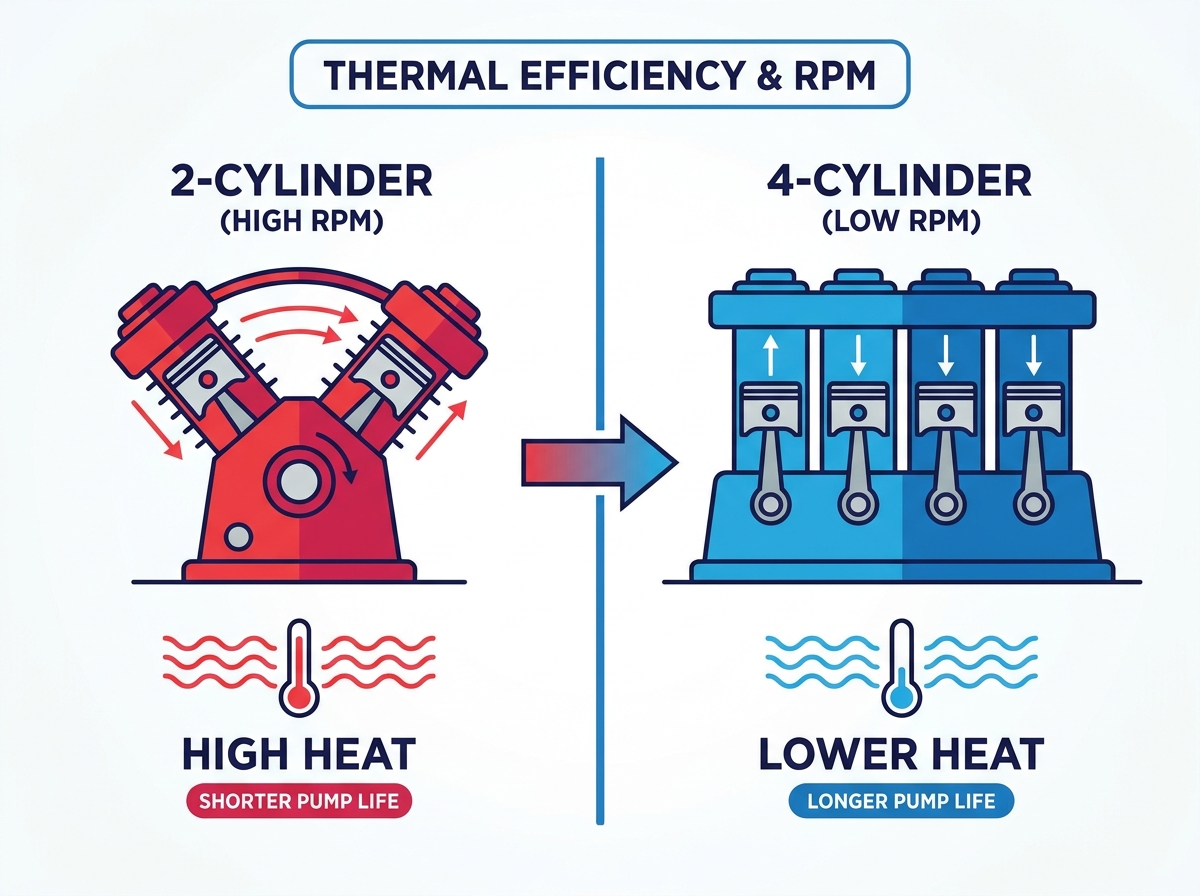
Dividing the compression workload across four cylinders completely changes how the pump behaves. The pump runs at significantly lower speeds (RPM) while delivering the same volume of air. Lower RPMs mean moving parts experience far less friction. Reduced friction directly limits the amount of heat generated during operation. Heat destroys compressor valves, seals, and rings over time. By running cooler, these units preserve their internal components and last years longer.
Standard intermittent-duty compressors cannot handle non-stop factory demands. They need frequent downtime to cool off. In contrast, manufacturers build industrial 4-cylinder models for 80-100% continuous duty cycles. You can run them through entire manufacturing shifts without risking thermal shutdown. They feature oversized cooling fins and heavy-duty internals designed specifically to withstand sustained workloads.
Industrial units typically use V-block or W-block cylinder configurations. These layouts naturally balance the reciprocating mass inside the crankcase. Four pistons moving in opposing pairs effectively cancel out harsh operational vibrations. This inherent balance creates a much smoother running machine. It dramatically reduces wear on the main bearings and lowers overall noise levels on the shop floor.
You must calculate your facility's simultaneous peak air demand before looking at models. Combine the CFM requirements of all tools operating at the exact same time. Always evaluate CFM delivery at specific operating pressures. A rating of 30 CFM at 90 PSI serves standard assembly tools perfectly. However, heavy industrial equipment often requires CFM ratings evaluated at 175 PSI to function correctly.
Many industrial 4-cylinder compressors function as two-stage units. Two cylinders handle low-pressure compression first. They push this partially compressed air into an intercooler. The remaining two cylinders then compress it further to reach high pressure. Frame your choice based strictly on your required system pressure. If you need pressures above 135 PSI, a two-stage configuration becomes mandatory for efficiency.
Material choices dictate the lifespan of your equipment. Demand solid cast-iron cylinders and cast-iron crankcases for true industrial durability. Cast iron resists warping under extreme thermal stress better than aluminum alternatives. While aluminum pumps weigh less, they simply cannot survive the thermal cycling of a 100% duty cycle manufacturing environment.
The motor and drive system determine electrical efficiency and safety. Prioritize the following components:
We selected specific industrial benchmarks for each category. We focus strictly on technical specifications, verifiable performance data, and objective advantages. Use these profiles to align your facility needs with the correct equipment type.
| Category | Primary Benchmark | Target Application | Key Technical Advantage |
|---|---|---|---|
| Heavy Manufacturing | Quincy QR-25 Series | Continuous 24/7 Production | 100% Duty Cycle, Low RPM |
| Automotive & Fleet | Champion Advantage Series | Multi-bay Garages | High Peak CFM, Rapid Recovery |
| High-Pressure Industrial | Ingersoll Rand Type 30 | Heavy Machinery Operation | True Two-Stage, 175+ PSI |
| Variable Demand | Atlas Copco Automan | Fluctuating Shift Work | Energy Efficient Motors, Smart Unloaders |
Benchmark Model Type: Quincy QR-25 Series equivalents.
Selection Criteria: 100% duty cycle, robust cast-iron pump, low-RPM operation.
Evidence Focus: These models excel in CFM per kilowatt-hour efficiency. They typically operate below 500 RPM. This incredibly slow speed practically eliminates overheating risks. They feature advanced cooling features like finned tube intercoolers and aftercoolers. Oil pressure lubrication ensures main bearings receive constant protection. They lack portability, but they offer unmatched longevity for stationary factory lines.
Benchmark Model Type: Champion Advantage Series equivalents.
Selection Criteria: High peak CFM, 80-gallon+ tank capacity, rapid recovery time.
Evidence Focus: Fleet shops require simultaneous pneumatic tool usage across multiple bays. These units deliver massive bursts of air to support impact wrenches and paint booths simultaneously. We assess their footprint-to-output ratio highly. They pack large 80 to 120-gallon horizontal or vertical tanks. Effective moisture separation capabilities come standard, preventing water from ruining expensive automotive paint jobs.
Benchmark Model Type: Ingersoll Rand Type 30 equivalents.
Selection Criteria: True two-stage 4-cylinder design capable of sustaining 175+ PSI.
Evidence Focus: Heavy stamping presses and large CNC machines require sustained high pressure. These two-stage powerhouses deliver constant 175 PSI output. We evaluate them based on robust valve design. Many utilize heavy-duty stainless steel disc valves instead of cheaper reed valves. Disc valves handle high-pressure thermal stress much better. High-pressure seal integrity prevents blow-by, ensuring consistent force delivery to your equipment.
Benchmark Model Type: Atlas Copco Automan equivalents.
Selection Criteria: Premium efficiency motors, advanced unloader valves, VFD compatibility.
Evidence Focus: Facilities with fluctuating air demand need smart power management. These models utilize premium NEMA-rated efficiency motors. Advanced unloader valves allow the motor to run freely without compressing air during low-demand periods. Some advanced setups integrate easily with Variable Frequency Drive (VFD) systems. VFDs adjust the motor speed to match exact air demand, drastically lowering long-term energy consumption.
Upgrading to a heavy-duty 4 cylinder compressor often requires facility electrical modifications. Warn your operations team about the hidden costs of upgrading facility wiring. High-amperage, 3-phase motors draw significant power upon startup. You may need to install new breaker panels, heavy-gauge conduit, and dedicated disconnect switches to support the load safely.
High-volume compressors generate significant condensation as a byproduct of compressing ambient air. You cannot send wet air into industrial machinery. Factor in the cost of refrigerated air dryers. You also need inline particulate and coalescing filtration. Proper air treatment protects your downstream pneumatic tools from rust and internal contamination.
Industrial upkeep requires strict adherence to maintenance schedules. You must perform regular oil changes using specialized non-detergent compressor oil. Intake filter replacements remain critical to prevent dust from scoring the cylinder walls. Belt tensioning requires monthly checks. Loose belts slip and burn, while overtightened belts destroy motor bearings.
Never bolt a heavy-duty compressor directly to a concrete floor without isolation. You must use proper vibration pads. Secure anchoring prevents the unit from "walking" across the floor. Proper isolation prevents structural damage to your facility. It also stops vibration from traveling down the discharge line, which causes severe pipe fatigue and dangerous air leaks.
Never buy a compressor that exactly matches your current peak demand. We recommend sizing the compressor to deliver 1.5 times your calculated peak CFM demand. This buffer allows for future facility expansion. More importantly, it prevents overworking the pump. Running the unit at 60-70% of its maximum capacity ensures it runs cooler and lasts significantly longer.
Scrutinize the fine print of all manufacturer warranties. Warranties often separate pump coverage from motor coverage. A "5-year warranty" might only cover the cast-iron pump block, leaving the motor with a standard 1-year guarantee. Pay attention to maintenance clauses. Many manufacturers require you to use their proprietary OEM oil and filters to keep the warranty valid.
Prompt your engineering team to conduct a comprehensive air audit of your facility. Identify all current air leaks and map out simultaneous tool usage. Once you have hard data on your actual CFM and PSI requirements, you can confidently request technical quotes from industrial distributors.
Investing in a heavy-duty 4 cylinder compressor provides immense strategic value for industrial reliability. These machines form the backbone of continuous manufacturing operations. By dividing the workload across four pistons, they run cooler, smoother, and longer than standard alternatives.
Prioritizing low RPMs, solid cast-iron construction, and true CFM delivery yields the best operational returns. Avoid getting distracted by peak horsepower marketing claims. Focus entirely on the unit's ability to sustain your required pressure at a 100% duty cycle.
Take action today to secure your facility's pneumatic infrastructure. Consult with a certified compressed air specialist. Request detailed technical spec sheets for your shortlisted models, and ensure your electrical infrastructure can support the upgrade.
A: No. Cylinder count and compression stages measure different things. A 4-cylinder pump can operate as either a single-stage or two-stage unit. In a single-stage setup, all four cylinders compress air simultaneously to the final pressure. In a two-stage configuration, two cylinders perform initial low-pressure compression. They push this air into the remaining two cylinders for high-pressure compression. Your required system pressure dictates which configuration you need.
A: Reciprocating models excel at intermittent, high-demand workloads. They also require a much lower initial investment. Rotary screw compressors dominate in 24/7 continuous operations where air demand never drops. If your facility runs single shifts or has fluctuating air demands, the reciprocating unit wins. If you run three continuous shifts requiring a 100% flatline duty cycle, a rotary screw system provides better long-term efficiency.
A: Lifespan depends entirely on maintenance adherence and operating RPMs. Heavy-duty cast-iron models typically deliver 15,000 to 50,000 hours of service. Running the unit at lower RPMs extends this timeframe significantly. Regular oil changes and timely intake filter replacements prevent premature wear. By sticking to OEM maintenance schedules, you can easily maximize the pump's operational life.
A: Yes, in most industrial scenarios. While a few smaller 4-cylinder units operate on single-phase power, true industrial models require 3-phase electricity. Compressors rated at 10HP and above almost universally use 3-phase motors. This power configuration ensures higher motor efficiency and lower operating temperatures. It also significantly extends motor longevity in heavy-duty environments.