Call Us
+86-18072289720
- All
- Product Name
- Product Keyword
- Product Model
- Product Summary
- Product Description
- Multi Field Search

Views: 0 Author: Site Editor Publish Time: 2026-11-04 Origin: Site

Choosing the wrong industrial air compressor results in crippling operational downtime or massive wasted capital. Many buyers focus entirely on the initial sticker price. They mistakenly ignore how energy consumption and routine maintenance quickly dwarf that initial purchase. Mismatching your compressor technology to your actual workflow guarantees premature equipment failure. It also ensures inflated utility bills every month.
This guide breaks down the mechanical realities, performance capabilities, and specific operational environments of modern compressors. We will help facility managers and operators objectively evaluate their true air demand. You will learn to differentiate between sporadic bursts of air and continuous steady-state workflows. By understanding these mechanical boundaries, you can identify whether a piston or a rotary screw design is the optimal fit for your facility. You will secure reliable airflow while protecting your bottom line.
Every compressor relies on fundamental physics to function. You must understand how these machines generate pressure. This knowledge prevents you from misapplying the equipment. Mechanical design dictates operational limits.
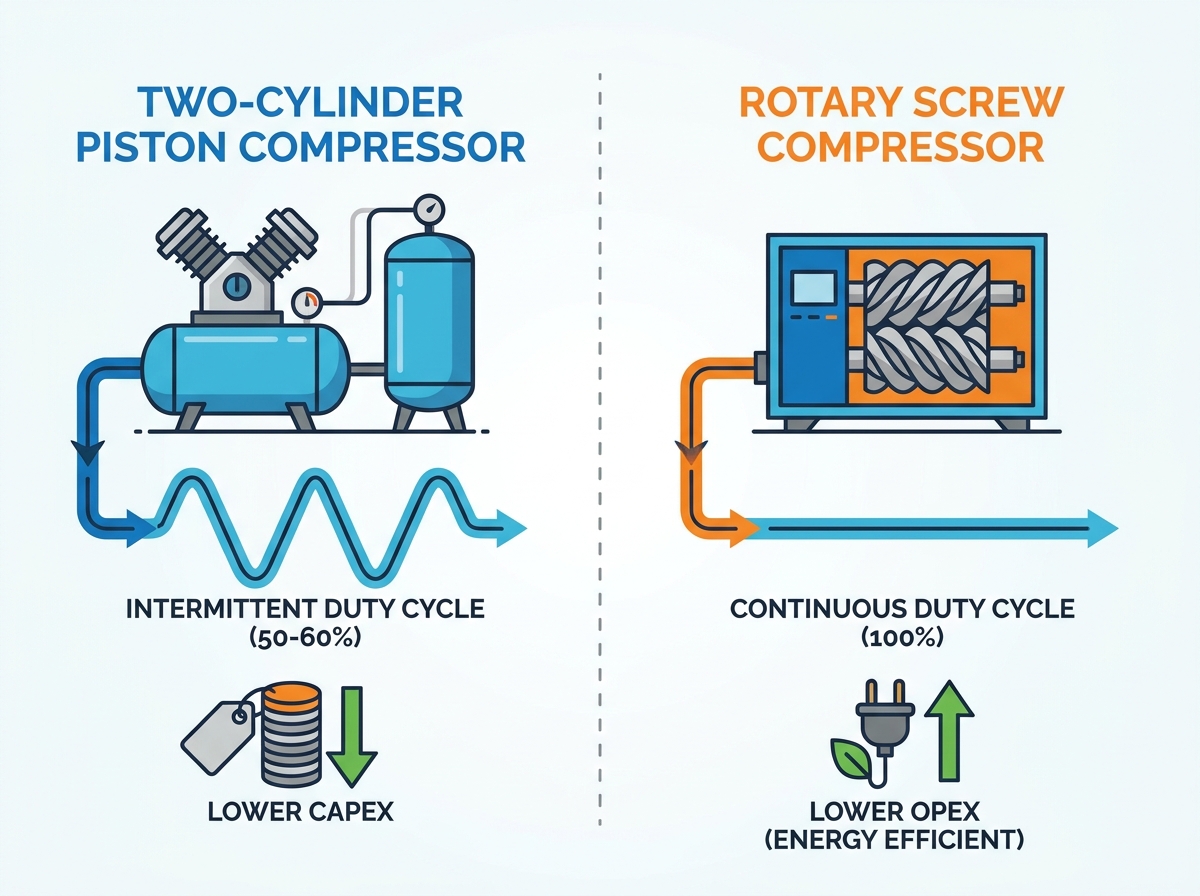
A two-cylinder piston compressor operates using a positive displacement mechanism. It functions much like an internal combustion engine. The crankshaft drives connecting rods, pushing pistons up and down inside cylinders. On the downstroke, intake valves open to pull ambient air inside. On the upstroke, the piston forces this air through exhaust valves. It then packs the compressed air into a heavy-duty storage tank. They often utilize two-stage compression to reach higher pressures efficiently.
This reciprocating action delivers a specific outcome. It is excellent for generating high pressure quickly. It stores this pressurized air for sporadic bursts of heavy demand. You can rely on it for sudden impact wrench operations or intermittent tire inflation.
Rotary screw machines take a completely different mechanical approach. They use two interlocking helical rotors housed within a tightly machined casing. As the rotors turn, they continuously sweep air into the housing. The gap between the rotor lobes progressively shrinks. This action forces the air into a smaller space, increasing the pressure before discharging it. They operate smoothly without the violent back-and-forth motion of pistons.
The outcome is a smooth, pulsation-free airflow. You do not require massive storage tanks to buffer the air delivery. These machines are ideal for steady-state demand. They shine in environments requiring a constant, unwavering volume of air.
Mismatching the mechanical design with your facility's actual air demand profile guarantees failure. It leads to premature equipment breakdowns. It also causes wildly inflated utility bills. You cannot force a reciprocating machine to act like a continuous-duty rotary machine. You will destroy the internal components. You must align the mechanical reality with your workflow.
You must accurately map how your facility consumes air. Buying based on horsepower alone is a common mistake. You need a systematic approach to measure your load profile.
Duty cycle defines how long a compressor can run before it must rest. We can break this evaluation down into several critical steps:
Air tools and robotic assemblies require specific pressure parameters. Piston compressors naturally experience pressure drops as the storage tank depletes. The machine cycles on when pressure hits a minimum threshold. It turns off at a maximum limit. You will notice pressure fluctuations at the tool end.
Rotary systems deliver constant, unwavering pressure. They do not rely heavily on a receiver tank buffer. This constant delivery is mandatory for sensitive applications. CNC machining, robotic assembly lines, and paint booths fail if air pressure fluctuates. You must match the pressure consistency to your tooling tolerance.
Compressor economics extend far beyond the initial purchase. You must account for purchasing costs, utility bills, and long-term upkeep expenses.
The price gap between these technologies is significant. Piston compressors offer a highly cost-effective barrier to entry. They are relatively inexpensive to acquire and install. You can simply plug many smaller models into standard electrical outlets. This affordability makes them an attractive choice for small-to-medium shops. They also serve well as secondary or backup air systems.
Rotary screw machines demand a much higher initial capital investment. They utilize tightly toleranced, specialized components. Installation often requires dedicated electrical drops and professional setup. You face a steeper financial hurdle on day one.
Energy consumption dictates long-term operating expenses over a 5-to-10-year lifespan. Piston units draw heavy starting currents every time they cycle on. If they cycle frequently, your electrical costs will spike. However, when they are off, they consume zero energy.
Rotary screw compressors become highly efficient during continuous operation. They significantly benefit from Variable Speed Drive (VSD) technology. VSD allows the machine to speed up or slow down the rotors instantly. It strictly matches the air output to your real-time demand. This prevents wasted energy from unloading or idling. You can save thousands of dollars in electricity annually if you run continuous operations.
Mechanical wear dictates your maintenance schedule. Piston maintenance is straightforward but frequent. The high vibration leads to wear on valves, piston rings, and drive belts. However, replacement parts are notoriously cheap. In-house maintenance is often highly feasible. Your internal mechanics can usually handle rebuilds and belt swaps without specialized training.
Rotary maintenance presents a different challenge. The fluid-sealed rotors generate much lower friction. This means fewer mechanical breakdowns over time. However, routine maintenance is strict and expensive. You must perform specialized synthetic oil changes. You need to replace expensive air/oil separator filters. Air-end servicing requires highly specialized technicians. The parts cost is noticeably higher.
Compressor Financial Comparison Matrix
| Financial Factor | Piston Technology | Rotary Screw Technology |
|---|---|---|
| Initial Capital (CAPEX) | Low to Moderate | High |
| Energy Efficiency (Continuous) | Poor (Prone to overheating) | Excellent (Especially with VSD) |
| Energy Efficiency (Intermittent) | Excellent (Shuts off completely) | Poor (Wastes energy idling) |
| Routine Parts Cost | Inexpensive | Expensive (Separators, synthetic oils) |
| Labor Requirements | Basic (In-house possible) | Advanced (Requires certified technicians) |
Installing an air system introduces distinct logistical challenges. You must protect your workforce and ensure environmental compliance.
Workplace noise regulations are stricter than ever. You must address OSHA compliance and overall workplace comfort. Rotary compressors are generally housed within acoustic enclosures. They operate quietly, often generating under 75 dBA. You can install them directly on the production floor without requiring hearing protection for nearby workers.
Piston compressors are notoriously loud. The violent reciprocating action generates significant mechanical noise and heavy vibration. They frequently exceed 85 dBA. You often require isolated installation, separate compressor rooms, or heavy soundproofing to maintain a safe working environment.
Footprint variations dictate installation feasibility. Tank-mounted piston compressors offer rugged portability. You can mount them on the back of service trucks. Mobile mechanics rely on them because they withstand rough roads and uneven mounting surfaces. They handle physical abuse exceptionally well.
Rotary setups often require dedicated, level installation footprints. While compact models exist, larger units require dedicated compressor rooms. You must provide proper ventilation clearances to ensure adequate cooling air intake.
Industrial environments push equipment to their thermal limits. You must address performance in harsh conditions. Poorly ventilated garages or high-ambient-temperature regions present serious risks.
Piston units generally utilize air-cooling fins. If the ambient temperature climbs too high, they lose cooling efficiency. Rotary units utilize advanced cooling mechanisms, including large air-cooled radiators or fluid-cooled heat exchangers. However, if you specify a rotary system incorrectly for a dirty, sweltering environment, the coolers will clog. You risk sudden thermal shutdown. You must actively manage your ambient ventilation.
You have reviewed the mechanical limits, the financial realities, and the environmental risks. Now you must apply these factors directly to your operational profile.
Piston technology excels in specific, rugged scenarios where demand is highly variable.
Rotary technology is the undisputed choice for continuous, mission-critical industrial applications.
Neither compressor technology is inherently superior. They are simply engineered for fundamentally different workflow profiles. Forcing a piston compressor to run a 24/7 assembly line guarantees catastrophic failure. Relying on a rotary screw unit for occasional tire inflation wastes massive amounts of capital and ruins the machine's internal lubrication.
To secure the best outcome, follow these immediate action steps:
A: No. Doing so risks catastrophic overheating and premature failure. They are designed for intermittent duty cycles. They require sufficient cooling time between compression cycles to dissipate the intense friction heat generated by the cylinders.
A: Only in continuous-use applications. In environments with highly sporadic air demand, a rotary compressor idling without producing air will waste significantly more energy than a piston compressor that simply shuts off completely.
A: Assuming correct sizing and proper routine maintenance, a rotary air-end can significantly outlast a piston pump. However, this lifespan is highly contingent on the rotary unit running continuously within its intended thermal and operational parameters.
A: Piston compressors generally experience higher oil carryover as their internal rings wear down over time. This requires robust downstream filtration. Rotary compressors feature highly effective, integrated air/oil separators that severely minimize oil contamination in the discharged air stream.